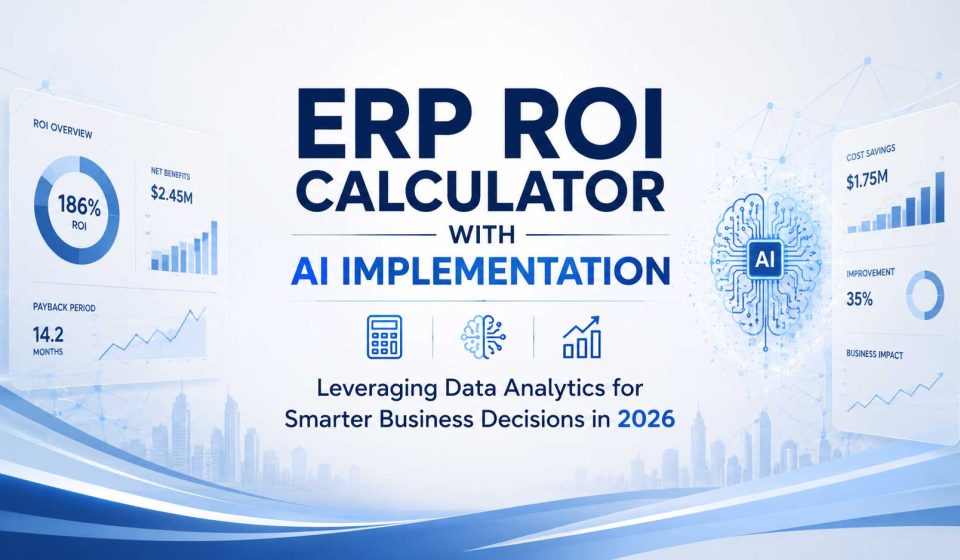
ERP ROI Calculator with AI Implementation: Leveraging Data Analytics for Smarter Business Decisions in 2026

Introduction
In today’s highly competitive business environment, organizations are under constant pressure to improve efficiency, reduce operational costs, increase profitability, and make faster decisions. However, despite investing significantly in digital transformation initiatives, many businesses still struggle to measure the actual return on investment (ROI) of their technology implementations.
This challenge becomes even more critical when organizations invest in Enterprise Resource Planning (ERP) systems. While ERP software promises streamlined operations, real-time visibility, improved productivity, and enhanced customer experiences, many decision-makers often ask a fundamental question:
“How much ROI will our ERP implementation actually generate?”
Traditionally, calculating ERP ROI involved spreadsheets, manual assumptions, and historical estimates. Unfortunately, these methods frequently produced inaccurate forecasts because they failed to account for changing business conditions, hidden operational costs, employee productivity variations, market trends, and future growth patterns.
Therefore, modern organizations are increasingly turning toward AI-powered ERP ROI Calculators combined with advanced data analytics to generate accurate, data-driven investment decisions.
An AI-powered ERP ROI Calculator goes beyond basic cost-versus-benefit calculations. Instead, it leverages machine learning algorithms, predictive analytics, operational data, financial records, and business intelligence to forecast future outcomes with significantly greater accuracy.
As organizations prepare for 2026 and beyond, implementing AI-driven ERP ROI analysis is becoming a strategic necessity rather than a competitive advantage.
What is an ERP ROI Calculator?
An ERP ROI Calculator is a business assessment tool designed to estimate the financial benefits organizations can expect from implementing an ERP solution.
Traditionally, ERP ROI calculations focused on comparing implementation costs against expected savings. While this approach offered a basic understanding of project viability, it rarely captured the complete business impact.
Today, modern ERP ROI Calculators evaluate multiple business dimensions including:
Cost Reduction Analysis
Organizations often experience excessive operational expenses due to manual processes, duplicate data entry, disconnected systems, and inefficient workflows.
An ERP system helps eliminate these inefficiencies by automating repetitive tasks and centralizing business information.
Consequently, businesses can significantly reduce labor costs, administrative overhead, and operational waste.
Productivity Improvement Measurement
Many companies lose thousands of productive hours annually because employees spend excessive time searching for information, creating reports manually, and coordinating across departments.
ERP software automates these activities and enables teams to focus on high-value business functions.
As a result, productivity increases become measurable components of ROI calculations.
Revenue Growth Forecasting
ERP implementations frequently contribute to revenue growth by improving customer service, accelerating order processing, optimizing inventory management, and supporting data-driven decision-making.
Therefore, modern ROI calculations include projected revenue gains alongside cost savings.
Why Traditional ERP ROI Calculations Fail
Many businesses underestimate the complexity of ERP ROI analysis.
Although spreadsheets appear simple and convenient, they often create misleading projections because they rely on static assumptions.
For example, a traditional ROI model may assume that employee productivity improves by 20% after implementation.
However, real-world business environments are dynamic.
Employee adoption rates vary.
Market demand changes.
Supply chain disruptions occur.
Business expansion creates new operational challenges.
Consequently, traditional ROI calculations frequently fail to capture the true financial impact of ERP investments.
This limitation often results in:
- Overestimated returns
- Underestimated implementation costs
- Poor investment decisions
- Delayed project approvals
- Budget overruns
Therefore, organizations increasingly require AI-powered predictive models capable of adapting to real-time business conditions.
How AI Transforms ERP ROI Calculations
Artificial Intelligence introduces a completely new approach to ROI forecasting.
Instead of relying solely on assumptions, AI systems analyze actual business data to identify patterns, trends, risks, and opportunities.
Consequently, organizations gain a much more accurate understanding of potential ERP outcomes.
Predictive Analytics
AI algorithms analyze historical business performance and predict future operational improvements.
For example, the system can estimate:
- Inventory optimization savings
- Workforce efficiency gains
- Procurement cost reductions
- Revenue growth opportunities
- Customer retention improvements
As a result, businesses can make investment decisions based on data rather than assumptions.
Machine Learning-Based Forecasting
Machine learning models continuously improve prediction accuracy by learning from operational outcomes.
Unlike static spreadsheets, AI models evolve as new data becomes available.
Therefore, ERP ROI projections remain relevant and reliable over time.
Risk Assessment
One of the most overlooked aspects of ERP implementation is risk management.
AI-powered ROI calculators identify potential risks such as:
- User adoption challenges
- Implementation delays
- Integration complexities
- Operational disruptions
Consequently, organizations can proactively mitigate these risks before they impact project success.
AI Model-Based Algorithm for ERP ROI Prediction
Modern ERP ROI Calculators utilize sophisticated machine learning algorithms to generate highly accurate forecasts.
Step 1: Data Collection Layer
The AI model gathers data from multiple sources including:
- Financial systems
- HR systems
- Inventory databases
- CRM platforms
- Supply chain applications
- Manufacturing systems
This comprehensive data collection ensures a holistic understanding of business operations.
Step 2: Data Processing and Cleansing
Raw business data often contains inconsistencies, duplicate records, and missing values.
Therefore, AI algorithms automatically cleanse and standardize information before analysis.
This process improves prediction reliability and eliminates data quality issues.
Step 3: Feature Engineering
The AI engine identifies key business indicators affecting ROI such as:
- Revenue per employee
- Inventory turnover ratio
- Procurement cycle time
- Customer acquisition costs
- Order fulfillment speed
- Operational expenses
These variables become predictive factors within the machine learning model.
Step 4: Predictive Modeling
The system applies advanced machine learning techniques including:
Regression Analysis
Used to estimate financial outcomes and cost savings.
Random Forest Algorithms
Used to identify critical business drivers influencing ERP success.
Neural Networks
Used to detect complex relationships across large datasets.
Time Series Forecasting
Used to predict future business performance trends.
Step 5: ROI Score Generation
The final model calculates:
ROI (%) = ((Projected Benefits – Total ERP Investment) / Total ERP Investment) × 100
However, unlike traditional methods, AI-generated ROI includes predictive confidence scores, risk factors, and alternative business scenarios.
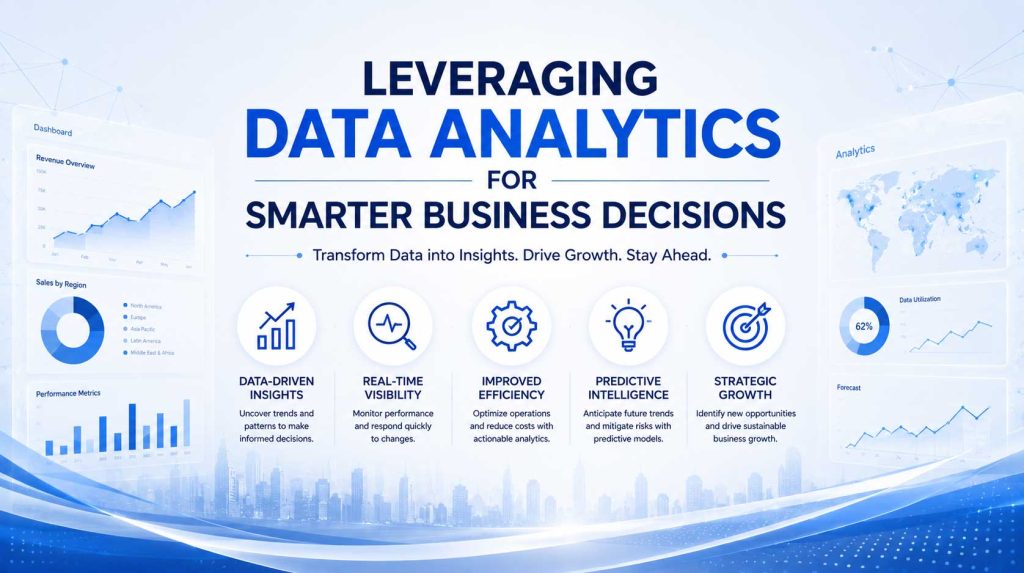
Leveraging Data Analytics for Smarter Business Decisions
Modern businesses generate enormous amounts of data every day.
Unfortunately, much of this data remains underutilized.
AI-powered ERP ROI platforms transform this information into actionable business intelligence.
Real-Time Decision Making
Executives no longer need to wait for monthly reports.
Instead, AI dashboards provide instant visibility into performance metrics.
Consequently, organizations can respond quickly to changing business conditions.
Resource Optimization
Data analytics identifies areas where resources are being underutilized or wasted.
As a result, companies can optimize workforce allocation, inventory management, and operational spending.
Strategic Planning
Predictive analytics enables long-term planning based on future scenarios rather than historical assumptions.
Therefore, organizations become more agile and resilient.
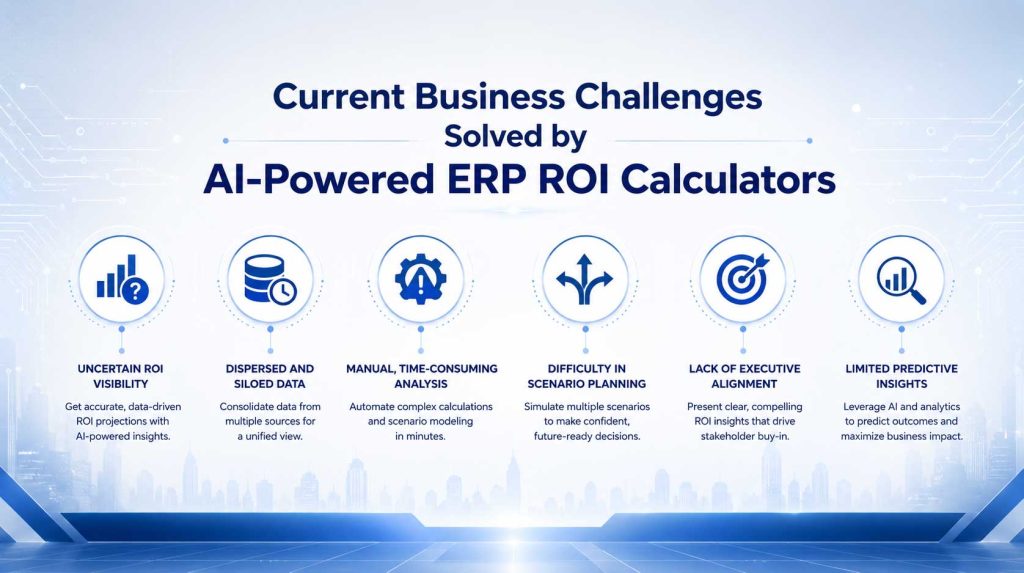
Current Business Challenges Solved by AI-Powered ERP ROI Calculators
Many organizations face common operational challenges.
Challenge: Rising Operational Costs
Manual processes, disconnected systems, and inefficient workflows increase operating expenses.
AI-driven ERP analysis identifies automation opportunities that significantly reduce costs.
Challenge: Poor Visibility Across Departments
Departments often operate in isolation, creating communication gaps and decision delays.
ERP systems centralize data while AI analytics provide unified business insights.
Challenge: Inventory Management Issues
Excess inventory increases carrying costs while insufficient inventory creates stock shortages.
AI forecasting improves inventory planning and reduces waste.
Challenge: Slow Decision-Making
Traditional reporting methods delay critical business decisions.
AI-powered dashboards provide real-time insights for immediate action.
Benefits of Implementing an AI-Powered ERP ROI Calculator
Organizations adopting AI-driven ERP ROI solutions can expect significant benefits.
Improved Investment Confidence
Executives gain greater confidence when approving ERP projects because decisions are supported by data-driven forecasts.
Faster ERP Adoption
Clear visibility into expected returns helps secure stakeholder support and accelerates implementation initiatives.
Better Financial Planning
Organizations can allocate budgets more effectively based on accurate projections.
Continuous Performance Monitoring
AI systems continuously evaluate ERP performance against projected outcomes.
Therefore, businesses can make ongoing improvements after implementation.
Conclusion
As businesses move deeper into the digital economy, making technology investment decisions based on assumptions is no longer sustainable. Organizations require accurate, data-driven insights capable of forecasting future outcomes with confidence.
An AI-powered ERP ROI Calculator represents the next evolution of business intelligence. By combining ERP systems, machine learning algorithms, predictive analytics, and real-time operational data, organizations can accurately estimate returns, reduce implementation risks, optimize resources, and accelerate digital transformation success.
Most importantly, AI-driven ROI analysis empowers leaders to make smarter business decisions based on evidence rather than guesswork.
Companies that adopt AI-powered ERP ROI forecasting in 2026 will not only maximize their ERP investments but will also gain a significant competitive advantage in an increasingly data-driven marketplace.
The future of ERP success is no longer about implementation alone. Instead, it is about predicting, measuring, and continuously optimizing business value through AI and advanced analytics.