
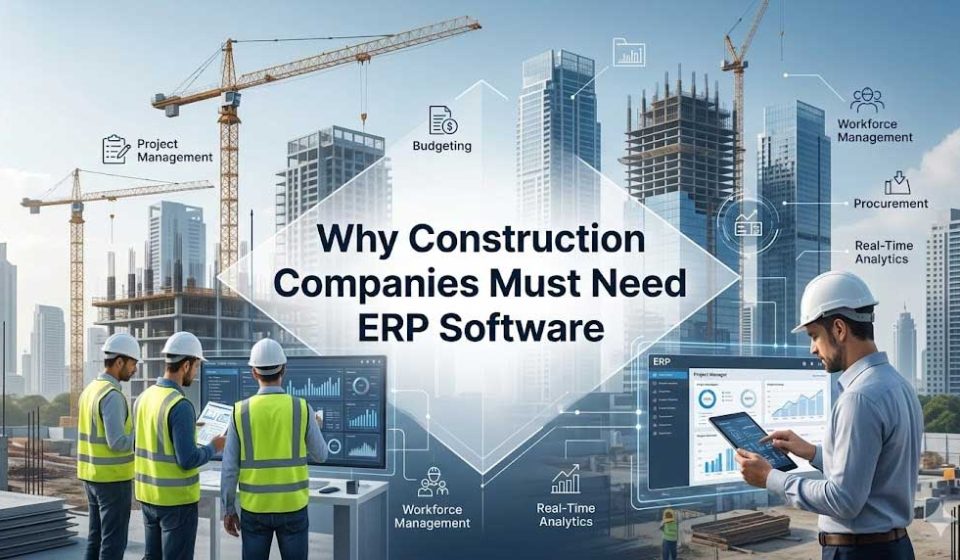
Why Construction Companies Must Need ERP Software in 2026: The Complete Guide to Managing Projects, Costs, Workforce, and Profitability

Introduction
The construction industry is undergoing a massive transformation in 2026. Rising material costs, increasing labor shortages, stricter compliance requirements, project delays, and growing client expectations are forcing construction companies to rethink how they manage operations.
While many construction firms still rely on spreadsheets, disconnected software applications, manual reporting systems, and paper-based workflows, these traditional methods are no longer sufficient to handle the complexities of modern construction projects.
According to recent industry reports, digital transformation investments in the global construction sector continue to grow as companies seek better visibility, improved productivity, and stronger profit margins. Furthermore, Artificial Intelligence (AI), predictive analytics, cloud computing, and integrated ERP systems are becoming the foundation of successful construction businesses.
As a result, ERP software for construction companies has emerged as one of the most important technology investments in 2026.
An Enterprise Resource Planning (ERP) system enables construction businesses to connect project management, procurement, inventory, finance, HR, payroll, equipment management, subcontractor coordination, and reporting into a single centralized platform.
Consequently, construction companies gain complete visibility into their operations, make faster decisions, reduce cost overruns, and deliver projects on time.
In this comprehensive guide, we will explore why construction companies need ERP software in 2026, the major challenges facing the industry, and how modern ERP solutions powered by AI-driven analytics help businesses achieve sustainable growth and profitability.
The Construction Industry Is Facing More Challenges Than Ever Before
Construction businesses are operating in one of the most competitive and unpredictable environments in recent history.
Although demand for infrastructure, commercial projects, residential developments, and industrial construction remains strong, project profitability is becoming increasingly difficult to maintain.
Many construction companies struggle because critical information is scattered across multiple systems.
Project managers often use separate software for scheduling. Account teams maintain financial records in accounting applications. Procurement departments track materials using spreadsheets. HR teams manage labor records independently.
As a result, decision-makers rarely have access to real-time project data.
This lack of visibility creates numerous operational challenges.
Project delays become common because managers cannot identify bottlenecks quickly.
Budget overruns occur because material costs and labor expenses are not monitored in real time.
Equipment remains underutilized because allocation data is unavailable.
Client communication suffers because project updates are delayed.
Ultimately, profitability declines despite increasing project volume.
This is precisely where construction ERP software becomes essential.
What Is Construction ERP Software?
Construction ERP software is a specialized enterprise management platform designed to unify all construction-related business processes into a single integrated ecosystem.
Unlike generic accounting software, a construction ERP system is built specifically to manage complex project-based operations.
The platform integrates:
Project Management
Construction ERP software tracks project schedules, milestones, resource allocation, task completion, and progress monitoring from project initiation to handover.
Financial Management
The system automates budgeting, accounts payable, accounts receivable, cash flow management, taxation, and financial reporting.
Procurement Management
Construction companies can manage vendor relationships, purchase orders, material requests, quotations, and supplier performance through a centralized platform.
Inventory Management
ERP software helps track construction materials across warehouses, sites, and storage locations in real time.
Workforce Management
The platform monitors employee attendance, payroll, certifications, labor productivity, and workforce deployment.
Equipment Management
Construction firms can track machinery utilization, maintenance schedules, fuel consumption, and equipment availability.
Business Intelligence and Analytics
Advanced dashboards provide real-time insights into project performance, profitability, and operational efficiency.
Therefore, construction ERP software acts as the central nervous system of the organization.
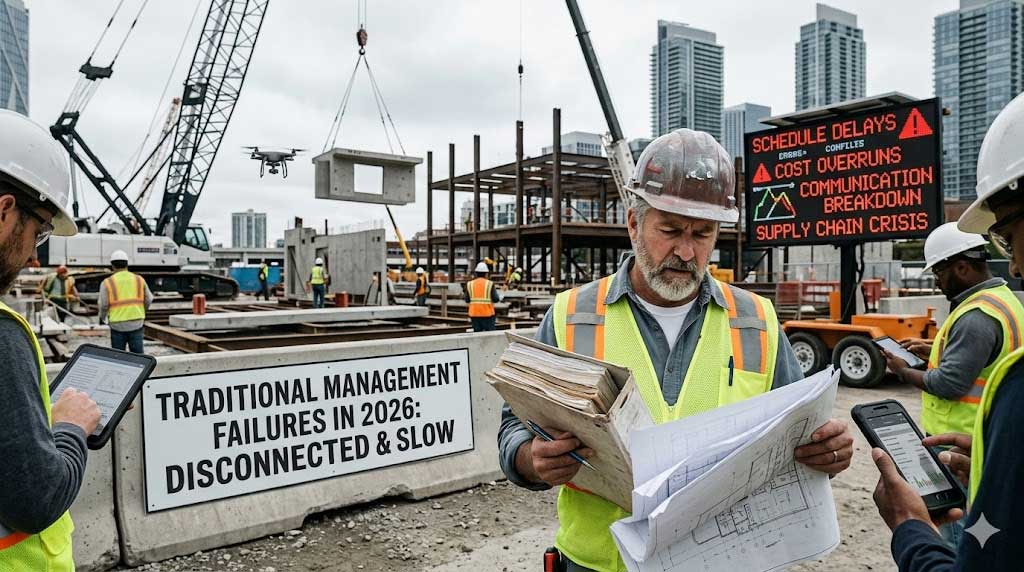
Why Traditional Management Methods Are Failing Construction Companies in 2026
Many construction companies continue to rely on spreadsheets because they appear inexpensive and familiar.
However, the hidden costs associated with manual systems are enormous.
When project information is spread across multiple files and departments, teams spend significant time searching for data instead of acting on it.
Furthermore, manual data entry increases the likelihood of human errors.
For example, a single incorrect inventory entry can lead to material shortages at the construction site.
Similarly, delayed financial reporting can prevent management from identifying budget overruns until it is too late.
As construction projects become larger and more complex, these inefficiencies multiply.
Consequently, businesses lose valuable time, money, and opportunities.
Modern ERP systems eliminate these challenges by creating a single source of truth for the entire organization.
How ERP Software Solves Project Cost Overruns
One of the biggest reasons construction projects fail is uncontrolled cost escalation.
Material prices fluctuate rapidly.
Labor costs increase unexpectedly.
Equipment maintenance expenses often exceed initial estimates.
Meanwhile, project managers frequently discover budget issues only after substantial financial damage has already occurred.
An ERP system addresses this problem by providing real-time budget tracking.
Every purchase order, material consumption record, labor hour, and subcontractor invoice is automatically connected to the project budget.
As a result, managers can immediately identify deviations from planned costs.
Furthermore, AI-powered ERP systems use predictive algorithms to forecast future expenditures based on historical trends and current project conditions.
Therefore, construction companies gain proactive control over project finances rather than reacting after losses occur.
Why Real-Time Visibility Is Critical for Construction Success
Modern construction projects involve multiple stakeholders, including clients, contractors, subcontractors, suppliers, engineers, architects, and site managers.
Without real-time visibility, communication gaps inevitably arise.
For instance, a supplier delay may not reach the project manager in time.
Similarly, budget updates may not be visible to the finance department immediately.
These delays create costly disruptions.
ERP software solves this challenge by connecting all stakeholders through a centralized platform.
Every department accesses the same data in real time.
Consequently, decisions are made faster, collaboration improves, and project risks are reduced significantly.
Organizations that operate with real-time visibility consistently outperform competitors that rely on fragmented information systems.
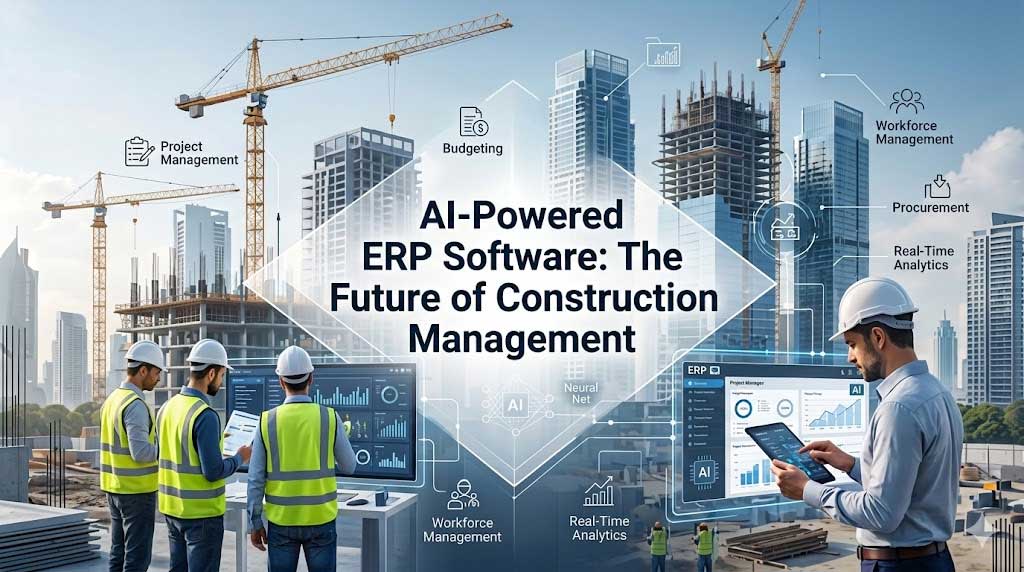
AI-Powered ERP Software: The Future of Construction Management
Artificial Intelligence is transforming ERP software in 2026.
Modern ERP platforms are no longer simple record-keeping systems.
Instead, they function as intelligent decision-support tools.
AI-powered ERP systems analyze massive amounts of project data to identify patterns and predict future outcomes.
For example, AI algorithms can:
Predict Project Delays
The system analyzes project timelines, resource availability, procurement status, and workforce productivity to identify potential delays before they occur.
Forecast Budget Risks
Machine learning models compare current spending trends against historical projects and predict future cost overruns.
Optimize Resource Allocation
AI recommends the most efficient distribution of labor, machinery, and materials across projects.
Improve Procurement Decisions
The system identifies preferred vendors based on pricing trends, delivery performance, and quality metrics.
Enhance Workforce Productivity
Predictive analytics help managers optimize labor deployment while reducing overtime costs.
As a result, construction companies become more efficient, agile, and profitable.
How ERP Improves Cash Flow Management
Cash flow challenges remain one of the leading causes of construction business failures.
Even profitable projects can create financial stress when payments are delayed or expenses exceed expectations.
ERP software provides complete visibility into receivables, payables, project billing, retention amounts, and vendor payments.
Consequently, finance teams can forecast cash requirements more accurately.
Furthermore, automated invoicing accelerates payment collection.
Meanwhile, AI-driven cash flow forecasting identifies potential liquidity risks before they impact operations.
Therefore, construction companies maintain healthier financial positions and avoid unnecessary borrowing.
ERP Software Enhances Inventory and Material Management
Material waste significantly impacts construction profitability.
Without proper inventory control, companies often purchase excess materials or experience shortages that delay project completion.
ERP software provides real-time inventory tracking across multiple sites and warehouses.
Managers know exactly what materials are available, where they are located, and when replenishment is required.
Consequently, procurement becomes more efficient and material waste decreases substantially.
In addition, automated reorder alerts ensure uninterrupted project execution.
Conclusion
The construction industry in 2026 is becoming increasingly competitive, data-driven, and technology-focused. Companies that continue relying on spreadsheets, disconnected applications, and manual processes will struggle to maintain profitability and operational efficiency.
Construction ERP software provides the visibility, automation, intelligence, and control needed to manage complex projects successfully. Moreover, AI-powered ERP systems enable predictive decision-making, helping organizations prevent delays, reduce costs, optimize resources, and improve customer satisfaction.
Businesses that invest in ERP today position themselves for long-term growth, stronger project performance, and higher profitability. As construction projects become more demanding and margins continue to tighten, ERP software is no longer a luxury—it has become a strategic necessity for every modern construction company.
Organizations looking to scale operations, improve project outcomes, and gain a competitive advantage should prioritize implementing a comprehensive construction ERP solution in 2026.