
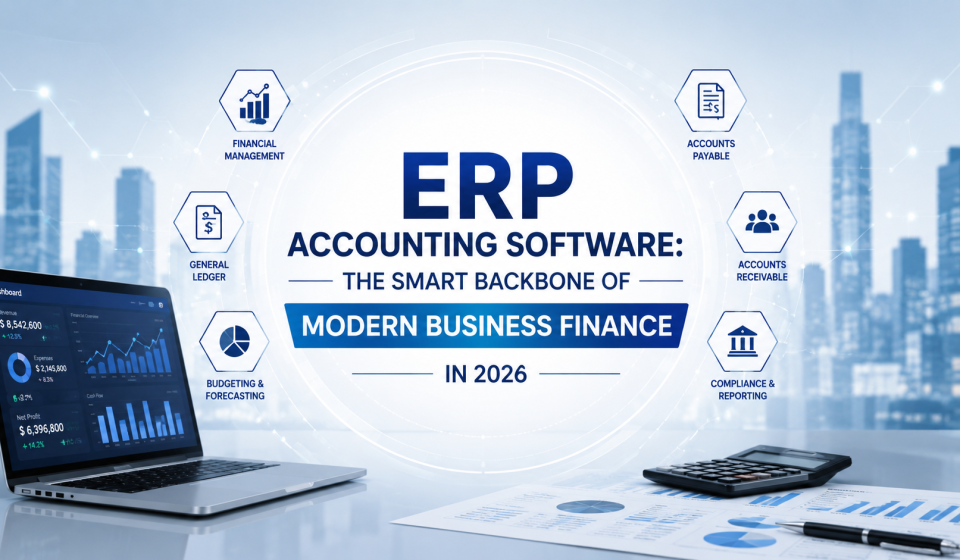

Introduction: Why Businesses Can No Longer Rely on Traditional Accounting Systems
In 2026, financial management has become significantly more complex than it was just a few years ago. Businesses are handling larger transaction volumes, managing multiple revenue streams, complying with evolving tax regulations, and making critical decisions in highly competitive markets. Consequently, relying on spreadsheets, disconnected accounting applications, and manual financial processes is no longer sustainable.
Many growing companies continue to face challenges such as delayed financial reporting, inaccurate cash flow forecasting, compliance risks, duplicate data entry, and limited visibility into business performance. As a result, decision-makers often struggle to access real-time financial insights when they need them most.
This is precisely where ERP Accounting Software emerges as a game-changing solution.
Unlike traditional accounting tools that primarily focus on bookkeeping, ERP accounting software integrates finance with procurement, inventory, sales, human resources, production, customer management, and business intelligence. Therefore, organizations gain a unified financial ecosystem that enables faster decision-making, improved accuracy, stronger compliance, and enhanced profitability.
As businesses increasingly embrace digital transformation, ERP accounting software is becoming the foundation of modern financial management. Furthermore, advancements in Artificial Intelligence (AI), machine learning algorithms, predictive analytics, and automation are making ERP platforms smarter than ever before.
In this comprehensive guide, we will explore how ERP accounting software is transforming business finance in 2026, the challenges it solves, the technologies driving innovation, and how organizations can leverage it for sustainable growth.
What Is ERP Accounting Software?
ERP Accounting Software is a comprehensive financial management system that serves as the central hub for all financial transactions and business operations.
Rather than operating as a standalone accounting application, ERP accounting software connects every department within an organization. Consequently, financial data flows automatically across various business functions without requiring manual intervention.
For example, when a sales order is created, the ERP system automatically updates inventory records, generates invoices, adjusts accounts receivable balances, and records revenue entries. Similarly, when procurement activities occur, the system updates inventory valuation, supplier accounts, and cash flow projections simultaneously.
As a result, organizations eliminate data silos and gain complete visibility into their financial health.
Modern ERP accounting software typically includes:
General Ledger Management
The general ledger serves as the financial backbone of the organization. It records all financial transactions and provides the foundation for financial reporting.
Because ERP systems update ledger entries automatically, businesses significantly reduce accounting errors while improving reporting accuracy.
Accounts Payable Automation
Managing vendor payments manually often leads to delayed payments, duplicate invoices, and compliance risks.
ERP accounting software automates invoice processing, approval workflows, payment scheduling, and vendor reconciliation. Therefore, finance teams can focus on strategic initiatives rather than repetitive administrative tasks.
Accounts Receivable Management
Cash flow remains one of the biggest concerns for growing businesses.
ERP accounting software automates invoicing, payment tracking, customer reminders, and collections management. Consequently, businesses improve cash flow while reducing overdue receivables.
Financial Reporting and Analytics
Traditional reporting methods often require hours or even days of manual work.
Modern ERP platforms generate real-time financial reports instantly, enabling management teams to monitor profitability, expenses, revenue growth, and operational performance continuously.
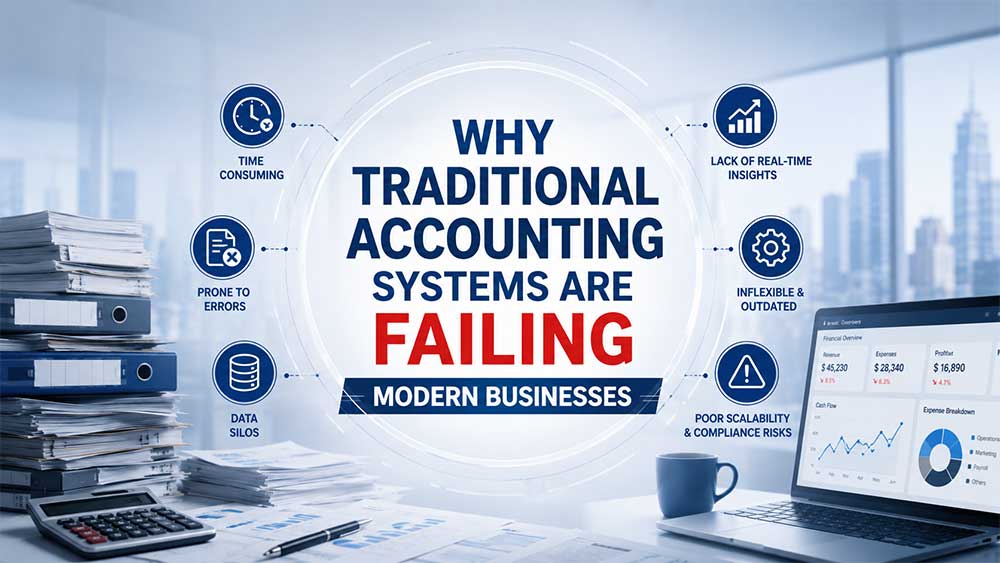
Why Traditional Accounting Systems Are Failing Modern Businesses
Despite technological advancements, many organizations continue using outdated accounting processes.
Unfortunately, these systems create significant operational bottlenecks.
Lack of Real-Time Financial Visibility
Many businesses still depend on month-end reporting cycles.
However, waiting weeks for financial insights can be costly in today’s fast-moving business environment.
When management lacks real-time visibility, they cannot respond quickly to changing market conditions, customer demands, or operational challenges.
ERP accounting software solves this issue by providing live dashboards and instant access to financial metrics.
Increasing Compliance Complexity
Tax regulations, financial reporting standards, and industry-specific compliance requirements continue evolving.
Manual compliance management increases the likelihood of errors, penalties, and audit findings.
ERP systems automate compliance workflows and maintain detailed audit trails, thereby reducing regulatory risks significantly.
Data Silos Across Departments
When finance, inventory, sales, procurement, and HR operate independently, data inconsistencies become inevitable.
Consequently, businesses struggle with duplicate records, reporting discrepancies, and inaccurate forecasts.
ERP accounting software creates a single source of truth, ensuring consistent and reliable information across the organization.
Growing Operational Costs
Manual accounting processes require extensive administrative effort.
As transaction volumes increase, businesses often need additional accounting personnel simply to manage workloads.
ERP automation reduces repetitive tasks, allowing organizations to scale without proportionally increasing overhead costs.
The Evolution of ERP Accounting Software in 2026
ERP accounting software has evolved far beyond traditional financial management.
Today, leading ERP platforms leverage artificial intelligence, machine learning, predictive analytics, robotic process automation, and cloud technologies to deliver unprecedented business value.
AI-Powered Financial Intelligence
Artificial Intelligence is transforming how businesses manage financial operations.
Instead of merely recording transactions, modern ERP systems analyze patterns, identify anomalies, and generate predictive insights.
For example, AI algorithms can:
- Detect unusual spending behavior.
- Identify potential fraud risks.
- Predict cash flow shortages.
- Recommend budget adjustments.
- Forecast future revenue trends.
As a result, finance teams can make proactive decisions rather than reacting to problems after they occur.
Machine Learning-Based Forecasting
Traditional forecasting models rely heavily on historical data and manual assumptions.
In contrast, machine learning algorithms continuously learn from evolving business patterns.
Consequently, ERP systems produce more accurate forecasts related to:
- Revenue growth
- Inventory demand
- Customer payment behavior
- Operational expenses
- Working capital requirements
This enables organizations to improve planning accuracy while reducing financial uncertainty.
Intelligent Automation
One of the most impactful innovations in ERP accounting software is intelligent automation.
Routine tasks such as invoice processing, reconciliations, payment approvals, expense management, and financial reporting can now be automated entirely.
Therefore, finance professionals can devote more time to strategic planning and business analysis.
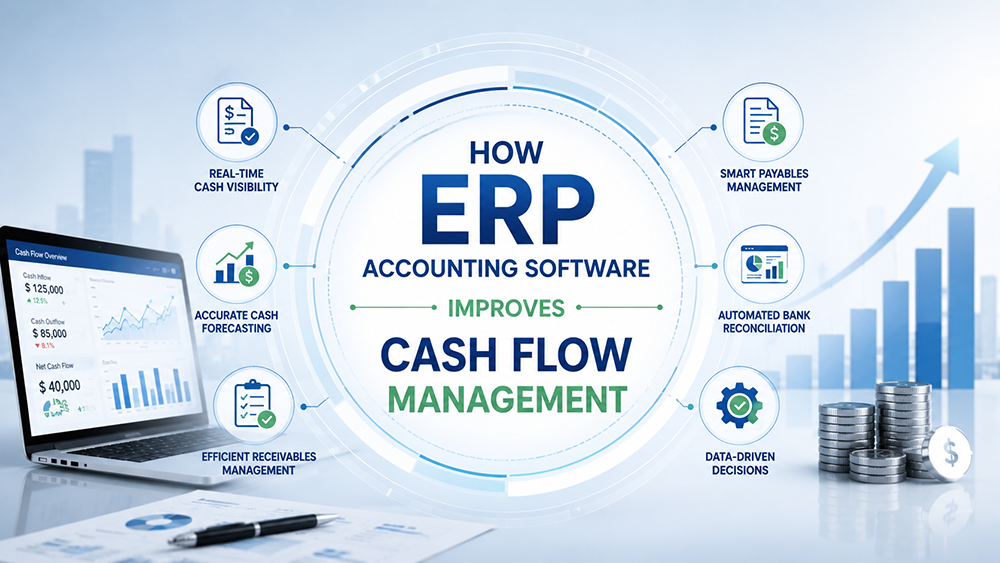
How ERP Accounting Software Improves Cash Flow Management
Cash flow remains the lifeblood of every organization.
Unfortunately, many businesses struggle with delayed payments, poor forecasting, and limited financial visibility.
ERP accounting software addresses these challenges through comprehensive cash flow management capabilities.
Real-Time Cash Position Monitoring
Finance leaders can instantly view:
- Available cash balances
- Incoming receivables
- Pending payments
- Outstanding liabilities
- Future cash commitments
As a result, organizations maintain greater control over liquidity.
Automated Collections Management
Late customer payments often create cash flow bottlenecks.
ERP systems automate collection reminders, payment follow-ups, and escalation workflows.
Consequently, businesses reduce Days Sales Outstanding (DSO) and improve working capital performance.
Predictive Cash Flow Forecasting
Using AI-powered forecasting models, ERP accounting software can predict future cash positions based on historical trends, customer payment behavior, seasonal fluctuations, and upcoming obligations.
Therefore, finance teams can identify potential shortages before they become critical issues.
ERP Accounting Software and Business Intelligence Integration
Financial data alone does not drive growth.
Actionable insights drive growth.
This is why modern ERP platforms integrate accounting functions with business intelligence capabilities.
Rather than reviewing static reports, executives gain access to dynamic dashboards that visualize business performance in real time.
Revenue Analysis
Organizations can analyze revenue trends across:
- Products
- Customers
- Regions
- Sales channels
- Business units
Consequently, management can identify high-performing segments and growth opportunities.
Expense Optimization
ERP analytics help businesses uncover:
- Unnecessary expenditures
- Cost overruns
- Inefficient processes
- Vendor pricing issues
As a result, companies can improve profitability without compromising operational effectiveness.
Profitability Tracking
Modern ERP systems provide profitability insights at multiple levels.
Decision-makers can evaluate:
- Product profitability
- Customer profitability
- Project profitability
- Department profitability
Therefore, strategic investments become more data-driven and financially sound.
The Future of ERP Accounting Software Beyond 2026
The future of ERP accounting software will be shaped by autonomous finance, advanced AI decision support, hyperautomation, and predictive business intelligence.
Organizations that adopt intelligent ERP solutions today will gain a significant competitive advantage tomorrow.
As AI capabilities continue evolving, ERP systems will increasingly automate complex financial decisions while providing deeper strategic insights.
Consequently, finance departments will transition from transactional processing centers into strategic business partners driving innovation, growth, and profitability.
Conclusion
ERP Accounting Software has become far more than a financial management tool. It is now the strategic backbone of modern business operations.
By integrating accounting, automation, artificial intelligence, machine learning, compliance management, forecasting, and business intelligence into a single platform, ERP systems enable organizations to overcome today’s most pressing financial challenges.
For businesses seeking greater visibility, stronger compliance, improved cash flow, higher efficiency, and sustainable growth in 2026, investing in ERP accounting software is no longer optional—it is a strategic necessity.
Companies that continue relying on disconnected accounting systems risk falling behind competitors that leverage intelligent ERP platforms to make faster, smarter, and more profitable decisions.
The future belongs to organizations that transform financial data into actionable intelligence, and ERP accounting software is the technology making that transformation possible.