
Introduction: Why ERP Features Matter More Than Ever in 2026
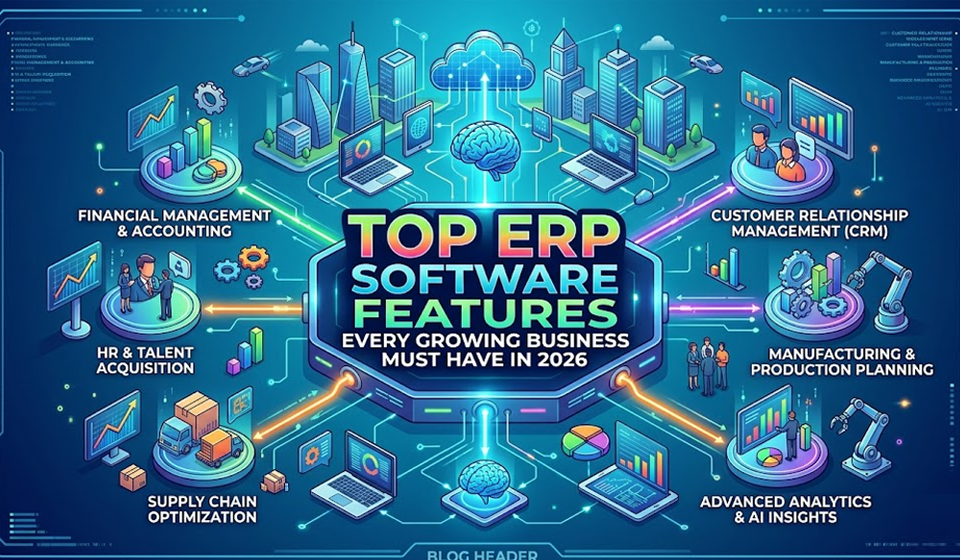
As businesses grow, managing operations through spreadsheets, disconnected applications, manual approvals, and scattered data becomes increasingly challenging. While these methods may work during the early stages, they often create bottlenecks as operations expand. Consequently, rising customer expectations, increasing transaction volumes, and complex workflows begin affecting productivity, profitability, and customer satisfaction. This is precisely why understanding the Top ERP Software Features has become essential for growing businesses in 2026. The right ERP system helps organizations streamline processes, centralize information, automate repetitive tasks, and gain real-time visibility into every aspect of their operations, enabling sustainable growth and long-term success.
In 2026, businesses face a completely different environment than they did just a few years ago. Artificial Intelligence is transforming decision-making. Customers expect real-time service. Employees require remote accessibility. Meanwhile, management teams need instant visibility into operations.
As a result, selecting an ERP system is no longer about purchasing software. Instead, it is about investing in a digital foundation that supports future growth.
Unfortunately, many organizations make the mistake of choosing ERP software based solely on pricing or brand popularity. Consequently, they end up with systems that fail to address their actual operational challenges.
The real question is not whether your business needs an ERP system. Rather, the question is whether your ERP includes the features necessary to support growth in 2026 and beyond.
In this guide, we will explore the most important ERP software features every growing business must have, why they matter, and how they solve common business problems.
Understanding the Modern ERP Landscape
Traditional ERP systems were designed primarily to record transactions and generate reports. While that approach worked in the past, today’s businesses require much more.
Modern ERP platforms act as intelligent business management systems. They integrate departments, automate workflows, provide predictive insights, and support real-time decision-making.
Furthermore, AI-powered ERP platforms can now identify trends, forecast demand, detect operational bottlenecks, and recommend corrective actions before problems escalate.
Therefore, businesses investing in ERP software must prioritize capabilities rather than simply evaluating software vendors.
Real-Time Data Visibility and Centralized Information Management
One of the biggest challenges growing companies face is fragmented data.
For example, sales teams often maintain customer information in CRM systems, finance departments use separate accounting software, and operations teams manage inventory using spreadsheets.
As a result, leadership struggles to obtain a complete picture of business performance.
Modern ERP software solves this challenge by creating a centralized data environment where information flows seamlessly across departments.
When data is centralized, decision-makers gain immediate access to accurate business information. Consequently, they can respond faster to market changes, customer demands, and operational issues.
Additionally, centralized visibility reduces duplicate data entry, minimizes human errors, and improves collaboration across departments.
Organizations that implement real-time ERP visibility often experience faster reporting cycles, improved forecasting accuracy, and stronger operational control.
AI-Powered Business Intelligence and Predictive Analytics
Data alone does not create value. Instead, actionable insights generate business growth.
This is precisely why AI-powered business intelligence has become one of the most important ERP software features in 2026.
Many companies collect vast amounts of operational data. However, they struggle to convert that information into meaningful decisions.
AI-enabled ERP systems analyze historical patterns, identify anomalies, and forecast future outcomes automatically.
For instance, the system can predict inventory shortages before they occur. Similarly, it can identify declining sales trends, forecast customer demand, and recommend purchasing decisions.
Moreover, management teams can access dynamic dashboards that present critical insights in real time.
Instead of reacting to problems after they occur, organizations can proactively address challenges before they impact profitability.
Consequently, businesses become more agile, competitive, and data-driven.
Workflow Automation That Eliminates Manual Processes
Manual business processes remain one of the largest productivity killers in growing organizations.
Employees often spend hours handling repetitive activities such as approvals, document routing, invoice processing, purchase requests, and data entry.
Although these tasks are necessary, they consume valuable time that could otherwise be devoted to strategic activities.
Modern ERP systems address this issue through workflow automation.
Automation allows organizations to define rules, triggers, and approval hierarchies that execute tasks automatically.
For example, purchase orders can be approved automatically based on predefined thresholds. Likewise, invoices can move through approval workflows without requiring multiple email exchanges.
As a result, businesses experience faster processing times, fewer errors, and significantly improved operational efficiency.
Furthermore, automation enhances accountability because every action is tracked within the system.
This visibility helps management monitor performance and identify process bottlenecks quickly.
Integrated Financial Management for Better Cash Flow Control
Financial visibility remains one of the most critical factors influencing business growth.
Unfortunately, many organizations struggle because financial information is spread across multiple systems.
Without accurate financial insights, management teams find it difficult to control costs, forecast cash flow, and evaluate profitability.
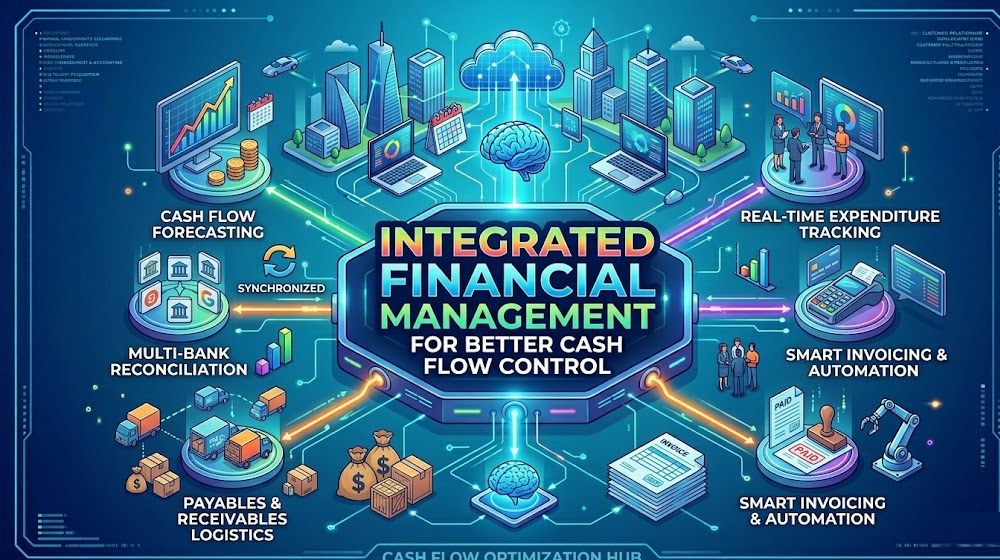
A modern ERP platform integrates all financial activities into a single environment.
This integration includes:
Automated Accounting Processes
ERP systems automatically record transactions, reducing manual bookkeeping efforts and improving accuracy.
Real-Time Financial Reporting
Instead of waiting for month-end reports, leadership teams can access live financial dashboards.
Cash Flow Forecasting
Advanced ERP platforms use historical and current data to forecast future cash flow positions.
Budget Monitoring
Managers can compare actual spending against planned budgets and take corrective action immediately.
Consequently, businesses gain stronger financial control and make more confident investment decisions.
Smart Inventory and Supply Chain Management
Inventory challenges can quickly impact customer satisfaction and profitability.
When inventory levels are too high, businesses tie up valuable capital. Conversely, when inventory levels are too low, sales opportunities are lost.
Modern ERP software provides intelligent inventory management capabilities that optimize stock levels continuously.
Using AI-driven forecasting models, ERP systems analyze historical demand patterns, seasonal fluctuations, supplier lead times, and purchasing trends.
As a result, businesses maintain optimal inventory levels while reducing excess stock and preventing shortages.
Additionally, integrated supply chain management features improve procurement planning, supplier coordination, and order fulfillment efficiency.
Therefore, companies can achieve lower operational costs while delivering better customer experiences.
Customer Relationship Management Integration
Customer expectations continue rising every year.
Consequently, organizations must ensure every customer interaction is informed, personalized, and efficient.
ERP systems that include CRM integration provide a complete view of customer activities across sales, service, marketing, finance, and support functions.
When employees have access to unified customer data, they can respond more effectively to inquiries and opportunities.
Furthermore, sales teams gain better visibility into customer behavior, purchasing patterns, and engagement history.
This visibility enables more targeted sales strategies and stronger customer relationships.
Ultimately, businesses improve retention rates, increase customer lifetime value, and drive sustainable revenue growth.
Mobile Accessibility and Remote Workforce Support
The modern workforce is no longer confined to traditional office environments.
Employees increasingly require access to business systems from multiple locations and devices.
Consequently, mobile ERP functionality has become essential rather than optional.
Modern ERP platforms provide secure access through smartphones, tablets, and web-based applications.
Whether managers need to approve requests, review reports, monitor operations, or track performance, they can do so from anywhere.
This flexibility improves responsiveness, enhances productivity, and supports business continuity.
Moreover, organizations with distributed teams benefit significantly from centralized mobile access because everyone works from the same real-time information source.
Conclusion
As businesses continue to navigate an increasingly competitive and technology-driven landscape, investing in an ERP system is no longer a luxury—it is a strategic necessity. While many organizations struggle with disconnected processes, manual operations, limited visibility, and inefficient decision-making, the right ERP solution can transform these challenges into opportunities for growth.
The Top ERP Software Features discussed in this guide, including AI-powered analytics, workflow automation, real-time reporting, integrated financial management, inventory optimization, CRM integration, mobile accessibility, and advanced security, are no longer optional capabilities. Instead, they have become essential requirements for businesses seeking to improve efficiency, enhance customer experiences, and scale operations successfully in 2026 and beyond.
Moreover, organizations that adopt modern ERP platforms gain a significant competitive advantage because they can make faster decisions, reduce operational costs, improve collaboration, and respond quickly to changing market demands. As a result, they are better positioned to achieve sustainable growth while maintaining operational excellence.
If your business is experiencing process inefficiencies, data silos, reporting challenges, or limited visibility across departments, now is the ideal time to evaluate your ERP readiness. By choosing an ERP solution equipped with the right features and future-ready technologies, you can build a stronger foundation for long-term success, innovation, and profitability.
At Bluechip Solutions, we help businesses accelerate their digital transformation journey with intelligent, scalable, and customizable ERP solutions designed for modern business challenges. The sooner you embrace the right ERP technology, the sooner your organization can unlock greater efficiency, productivity, and growth.