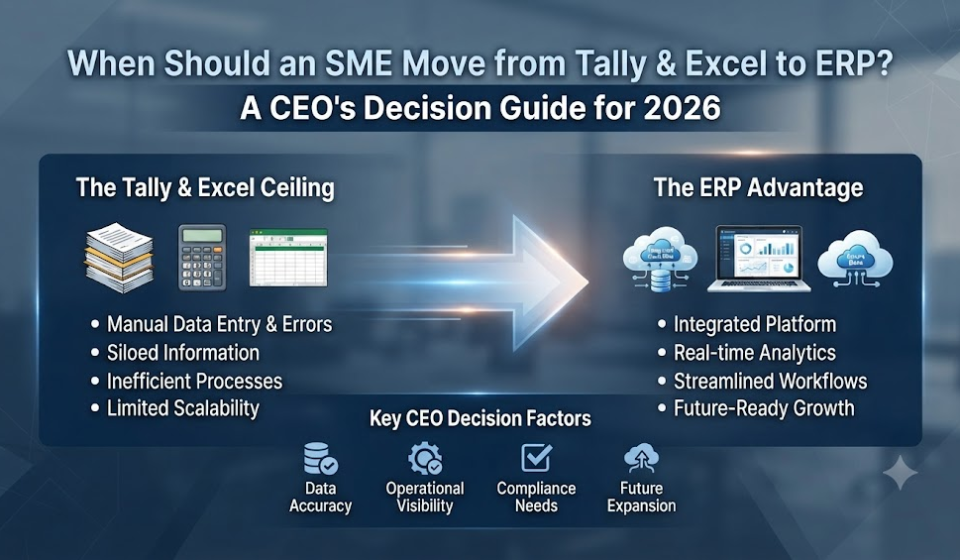
When Should an SME Move from Tally & Excel to ERP? A CEO’s Decision Guide for 2026

For many Indian SMEs, Tally and Excel remain part of everyday business operations. Tally handles accounting, invoicing, GST, banking and inventory, while Excel fills the gaps for production planning, sales analysis, costing, procurement, HR, customer follow-up and management reporting.
That combination can work well when the business is small and processes remain relatively simple. However, as transaction volumes increase, locations multiply and teams become dependent on shared spreadsheets, the same setup can gradually create operational blind spots. The real question for a CEO is therefore not whether Tally or Excel is good enough. The more important question is: when does the business outgrow a Tally-and-Excel operating model and need an ERP system?
TallyPrime itself provides accounting, inventory, payroll, banking, GST and reporting capabilities, and its current documentation shows that it can support increasingly sophisticated accounting and inventory requirements. However, an ERP decision involves a wider business question. It concerns how sales, purchasing, inventory, production, finance, people and management decisions work together.
Why Tally and Excel Still Work for Many SMEs
Before discussing ERP, CEOs should recognize why businesses continue using Tally and Excel. Tally is widely used for accounting because it provides structured financial records, invoicing, inventory capabilities, statutory compliance functions and reporting. Current TallyPrime documentation also covers GST, inventory, payroll, banking, multi-user access and audit-related controls.
Excel, meanwhile, gives businesses flexibility. A finance manager can create a costing sheet in minutes. A sales manager can maintain a customer pipeline. A production manager can prepare a daily production report without waiting for software changes. That flexibility is useful. The problem begins when Excel becomes the unofficial system connecting several departments.
One employee maintains the purchase sheet. Another maintains production data. Someone else updates sales information. Finance maintains accounting separately. Management then combines these reports before making decisions. Consequently, the business may have plenty of data but still lack one reliable version of the truth.
What Changes When an SME Starts Growing?
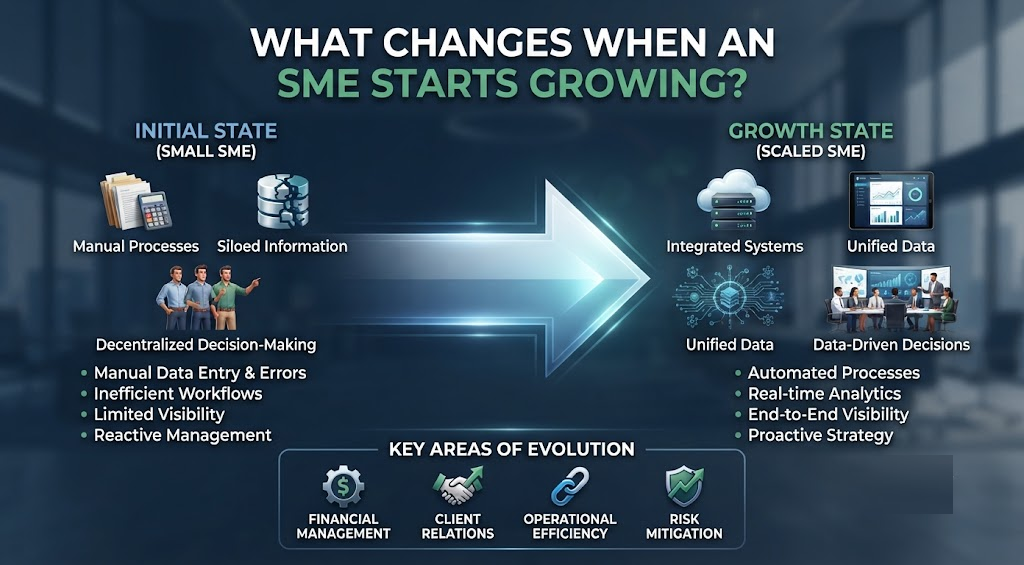
Growth creates complexity faster than many CEOs expect. For example, a company may initially operate from one location with 10 employees and a manageable number of customers. At that stage, accounting software plus spreadsheets may be sufficient. However, after adding another warehouse, manufacturing unit, branch, product category or sales team, the number of transactions and dependencies increases.
A purchase affects inventory. Inventory affects production. Production affects costing. Costing affects profitability. Sales affect receivables. Receivables affect cash flow. When these processes operate in separate systems, employees must repeatedly enter, export, reconcile and verify information. As a result, management spends more time asking, “Which number is correct?” instead of asking, “What should we do next?” That is one of the clearest signs that an SME should evaluate ERP software.
The First Warning Sign: Excel Has Become a Business System
Excel is not the problem by itself. The problem occurs when critical business decisions depend on spreadsheets that were never designed to function as an integrated enterprise system. Consider a manufacturing SME. The purchase department maintains raw-material requirements in Excel. Production maintains another spreadsheet. Stores maintains stock information separately. Finance records transactions in Tally. Sales maintains customer information in another workbook.
Now imagine that management wants to know the actual profitability of a product. Someone has to collect purchase costs, material consumption, production quantities, wastage, labour expenses, overheads, sales values and financial data. The calculation may eventually be correct. Nevertheless, it can take hours or even days. An ERP connects these operational transactions so that management can access a more consistent business picture without repeatedly consolidating spreadsheets.
The Second Warning Sign: Tally Handles Accounts but Management Still Lacks Operational Visibility
Tally is fundamentally strong in accounting and related business management functions. Its current capabilities include accounting, inventory, banking, GST and real-time reporting. However, many SMEs use Tally primarily as their financial system while operational information continues to live elsewhere. That creates a common gap.
The CEO can see revenue and expenses, but may not immediately see the operational reasons behind them. For example, revenue may have increased while margins declined. Why? Perhaps raw-material costs increased. Perhaps production wastage increased. Perhaps certain customers received excessive discounts. Perhaps slow-moving inventory increased working-capital requirements.
Perhaps purchase prices changed without corresponding sales-price adjustments. An integrated ERP can connect these operational events with financial information, making it easier for management to investigate the reasons behind business performance.
The Third Warning Sign: Employees Re-enter the Same Data
Repeated data entry is one of the strongest practical indicators that an SME should evaluate ERP. When sales enters an order in one system and another employee manually enters it into Excel, inventory, production or accounting, the organization creates additional opportunities for errors. The same problem occurs with purchase orders, goods receipts, sales invoices, stock transfers and payment information.
Moreover, every manual handoff consumes employee time. An ERP reduces this duplication by allowing information captured during one business process to flow into connected processes. For example, a confirmed sales order can trigger inventory requirements. If stock is insufficient, procurement or production planning can respond accordingly. Once the transaction progresses, finance can receive the relevant accounting information.
Therefore, the objective is not simply automation. The objective is connected business execution.
The Fourth Warning Sign: Management Reports Arrive Too Late
A CEO should not have to wait until the end of the month to discover what happened last week. Yet this situation is common when reporting depends on multiple spreadsheets. Sales teams submit files. Inventory teams update stock. Finance reconciles transactions. Operations prepares production reports. Someone then consolidates everything into a management report.
By the time the report reaches the CEO, the underlying business situation may already have changed. ERP software changes this reporting model by capturing transactions within a centralized business process. The result can be faster visibility into sales, inventory, receivables, payables, production and profitability. For a growing SME, faster information can be more valuable than simply having more information.
When Does an SME Actually Need ERP?
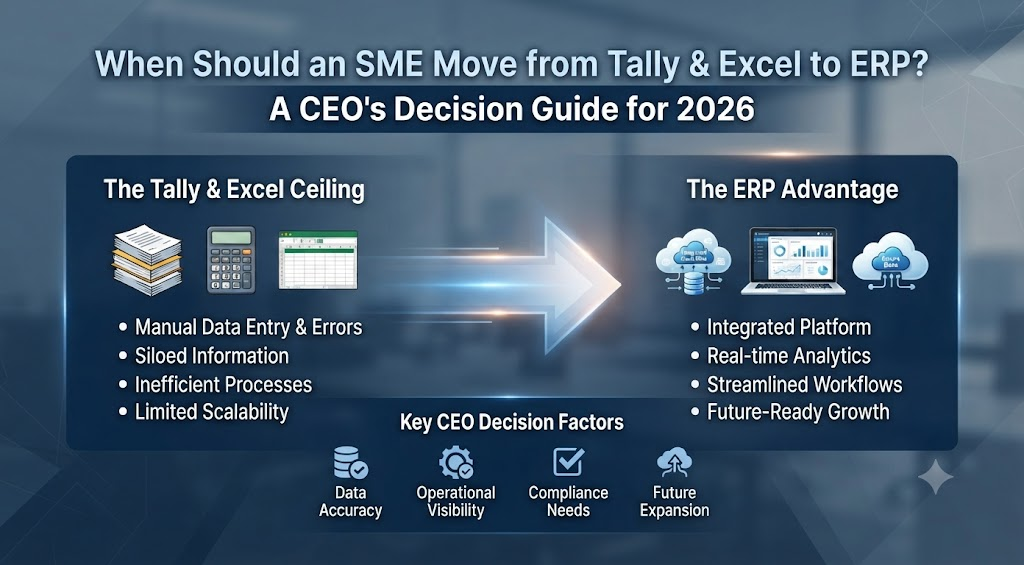
There is no universal employee count or revenue number at which every SME must implement ERP. Instead, the decision should depend on operational complexity. An SME should seriously evaluate ERP when several business processes have become interconnected but remain managed separately.
For example, the trigger may be multiple warehouses rather than employee count. It may be manufacturing complexity rather than turnover. It may be rapid growth in SKUs, customers, vendors or branches. Similarly, an SME may need ERP when management cannot obtain reliable business information without manual reconciliation. Therefore, the better question is not, “Are we big enough for ERP?”
The better question is:
“Has our business become too complex for disconnected systems?”
Tally + Excel vs ERP: What Actually Changes?
The difference is primarily architectural. With a Tally-and-Excel model, accounting may remain centralized while operational information is distributed across spreadsheets and other applications. With ERP, the objective is to create a connected environment in which transactions across departments contribute to a common business database.
This can connect sales, purchasing, inventory, production, finance, customer management, HR and management reporting. Consequently, the CEO gets a broader operational view without depending on multiple employees to manually consolidate information.
That does not mean every business needs to abandon Tally immediately. For some SMEs, Tally may continue to meet accounting requirements effectively. TallyPrime currently supports accounting, inventory, GST, banking, reporting and other business functions, including real-time financial reporting. The ERP decision becomes more relevant when the organization needs deeper cross-functional integration than its existing setup provides.
The Hidden Cost of Staying with Tally and Excel
Many CEOs compare ERP pricing against the visible cost of existing software. That comparison can miss the larger operational cost. The actual cost of a disconnected system includes repeated data entry, spreadsheet maintenance, reconciliation time, reporting delays, duplicated records, avoidable errors and management time spent validating information.
There is also a scalability cost. A spreadsheet that works for 500 transactions may become difficult to manage at 5,000. A process that works with one warehouse can become increasingly complicated with five locations. Therefore, CEOs should calculate the cost of maintaining the current process, not simply the subscription or license cost of the proposed ERP.
What Should a CEO Check Before Choosing ERP?
The first requirement should be business-process fit. An ERP should reflect how the organization actually operates rather than forcing every department into an unrealistic workflow. Manufacturing companies may need production planning, BOM management, material consumption, wastage, job work and production costing.
Distributors may prioritize purchasing, inventory, warehouse management, sales orders, receivables and multi-location stock visibility. Service businesses may require project management, service billing, employee allocation, customer management and financial control. Consequently, CEOs should evaluate ERP software against their actual workflows.
The second requirement should be scalability. The system should accommodate additional users, products, branches, warehouses and processes without forcing the company to rebuild its entire technology environment. The third requirement should be integration. An ERP should be able to connect relevant operational and financial information rather than creating another isolated database. The fourth requirement should be reporting.
Management should be able to move from high-level dashboards to the underlying transactions when necessary. Finally, the implementation approach matters. Even capable ERP software can fail to deliver value if business processes, master data, user responsibilities, training and adoption are poorly managed.
Should an SME Replace Tally Immediately?
Not necessarily. A responsible ERP transition should begin with a process assessment. First, identify what Tally currently handles. Next, identify what Excel handles. Then document which activities still require manual reconciliation. After that, calculate how much time employees spend maintaining those processes.
Finally, identify the reports management needs but cannot currently obtain quickly. This exercise provides a much clearer ERP business case than simply comparing software feature lists. In some cases, the organization may discover that improving existing processes is enough. In other cases, the assessment may reveal that the company has reached a level of operational complexity where ERP integration is becoming necessary.
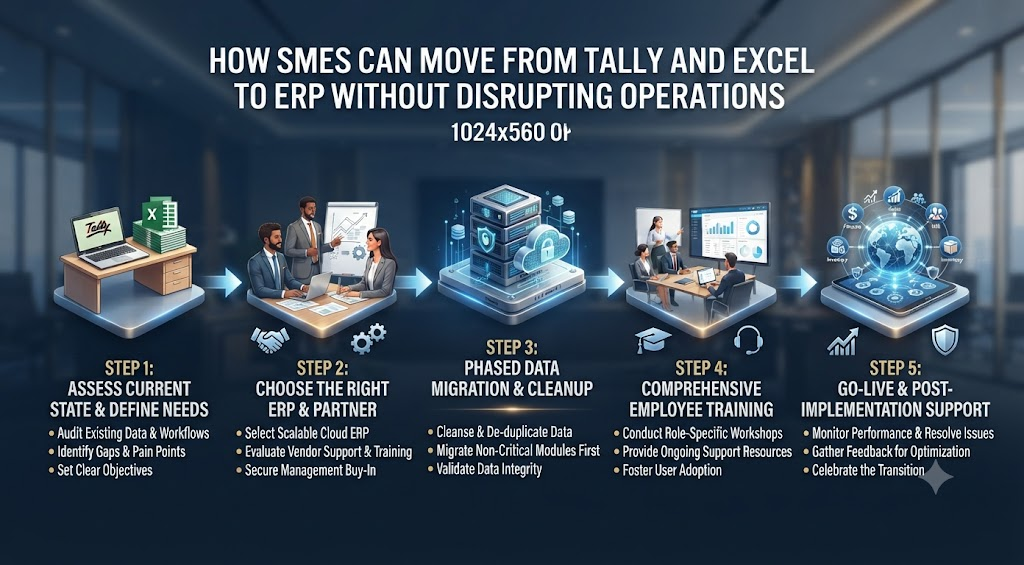
How SMEs Can Move from Tally and Excel to ERP Without Disrupting Operations
ERP migration does not have to mean switching every process overnight. A phased implementation can reduce operational disruption. The organization can begin with core master data and critical workflows. Subsequently, it can connect purchasing, inventory, sales, production and finance according to business priorities.
Data cleansing should happen before migration. Duplicate customers, obsolete products, inconsistent units, incorrect opening balances and outdated supplier records can otherwise create problems inside the new system. Employee training is equally important.
An ERP should not be treated as an IT project alone. Finance, sales, purchasing, stores, production and management should understand how the new workflows affect their responsibilities. Most importantly, the CEO should define measurable outcomes before implementation. The goal might be faster reporting, lower reconciliation time, improved inventory visibility, better production costing or stronger receivables control. That creates a practical basis for measuring ERP value after implementation.
Is No-Code ERP Relevant for Growing SMEs?
For SMEs, business processes often change faster than traditional software customization cycles. A company may introduce a new approval workflow, change its sales process, add a warehouse or modify a production procedure. Traditional customization can sometimes make these changes expensive and time-consuming.
A no-code or business-process-automation approach can provide greater flexibility by allowing organizations to configure workflows, forms, approvals, dashboards and processes without rebuilding the entire application. For a growing SME, this can be particularly relevant because the software should evolve with the business.
However, CEOs should evaluate no-code claims carefully. The important question is not whether a vendor uses the term “no-code,” but whether the platform can actually accommodate the company’s required workflows, integrations, security controls and reporting requirements.
What Should an SME Measure After Moving to ERP?
ERP success should be measured through business outcomes rather than the number of modules implemented. Management can track reporting turnaround time, inventory accuracy, order-processing time, purchase-cycle time, receivables visibility, production-cost visibility and manual reconciliation effort.
For example, if management previously needed two days to consolidate departmental information and the new system reduces that process substantially, the organization has created measurable value. Similarly, if production costing previously depended on spreadsheets but becomes available through connected transactions, management gains a stronger basis for pricing and profitability decisions.
The objective is therefore not simply to “implement ERP.” The objective is to create a more controlled, connected and decision-ready business.
The CEO’s 2026 ERP Decision: What Is the Real Trigger?
The strongest ERP trigger is not company size. It is complexity. If your SME still operates comfortably with Tally and a few spreadsheets, there may be no immediate reason to replace the existing system. However, if employees constantly reconcile spreadsheets, management waits for reports, departments maintain separate versions of data, inventory information does not match financial information, or operational growth is creating process bottlenecks, the ERP conversation deserves serious attention.
The right time to evaluate ERP is usually before disconnected processes become an operational constraint, rather than after they begin affecting customers, cash flow and management decisions. For CEOs, the decision can therefore be framed around one simple question:
Can our current Tally-and-Excel system give management one reliable, timely view of the business as we grow? If the answer is increasingly no, an ERP assessment should move from the technology roadmap into the business strategy.
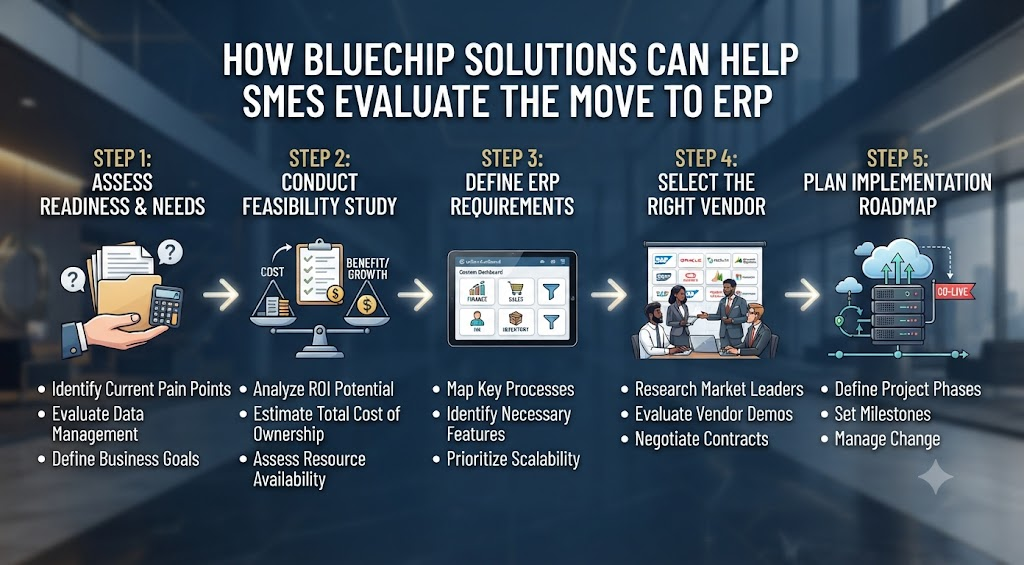
How Bluechip Solutions Can Help SMEs Evaluate the Move to ERP
Bluechip Solutions approaches ERP from the business-process perspective rather than treating implementation as a simple software replacement. Its Auvit™ No-Code ProfitPlus ERP platform is designed to connect business processes through configurable workflows, automation, dashboards and integrated modules.
For SMEs evaluating the move from disconnected accounting and spreadsheets, the practical starting point is not a product demonstration alone. It is understanding where information currently gets duplicated, where approvals slow down, where management lacks visibility and where manual reconciliation consumes time. A structured ERP consultation can help identify these gaps and map them to an appropriate implementation approach.
Ready to find out whether your SME has outgrown Tally and Excel?
Book a free ERP consultation with Bluechip Solutions and discuss your current accounting, Excel, inventory, production, sales and reporting processes with an ERP specialist.
Download the “Tally + Excel to ERP Readiness Checklist for SMEs – 2026” and evaluate your business across data duplication, reporting delays, inventory visibility, multi-location operations, workflow automation and management control.
Frequently Asked Questions About Moving from Tally and Excel to ERP
When should a small business move from Tally to ERP?
A small business should consider ERP when its operational processes become too complex for separate accounting, spreadsheet and departmental systems. Multiple locations, growing transaction volumes, manual reconciliation, delayed reporting and disconnected inventory or production information are common triggers.
Is Tally enough for an SME?
TallyPrime provides accounting, inventory, banking, GST, payroll and reporting capabilities, so it can be sufficient for many SMEs depending on their requirements. The need for ERP usually arises when the business requires broader integration across departments and operational workflows.
Why do companies use Excel along with Tally?
Companies often use Excel because it provides flexible analysis and can quickly support processes that are not configured in their accounting software. However, as the number of spreadsheets and users grows, maintaining consistent data and producing consolidated reports can become more difficult.
What are the signs that an SME needs ERP?
Common signs include repeated data entry, multiple versions of the same report, delayed management information, inventory and accounting mismatches, manual approval processes, spreadsheet dependency, increasing reconciliation work and difficulty controlling multiple branches or warehouses.
Is ERP worth it for a growing SME?
ERP value depends on the organization’s processes, complexity and expected growth. The business case becomes stronger when the cost of disconnected processes, manual work and delayed information becomes significant compared with the investment required for an integrated system.
Can an SME keep Tally while implementing ERP?
Yes, depending on the ERP architecture and implementation strategy. Businesses can evaluate integration or phased migration approaches based on their accounting, compliance, operational and reporting requirements.
How long does it take to move from Excel and Tally to ERP?
Implementation time varies significantly according to business complexity, number of users, modules, locations, integrations, data quality and customization requirements. A proper assessment should therefore be completed before committing to a timeline.
What should a CEO ask before buying ERP software?
A CEO should ask whether the system fits the company’s actual workflows, integrates departments, provides reliable management reporting, scales with growth, protects business data, supports required compliance and can be implemented without creating unnecessary operational disruption.
What is the difference between accounting software and ERP?
Accounting software primarily focuses on financial transactions and related business functions. ERP aims to connect multiple business processes, such as sales, purchasing, inventory, production, finance, HR and management reporting, within an integrated system.
What is the biggest mistake SMEs make when adopting ERP?
One common mistake is selecting software based only on a feature checklist or price. The organization should first understand its business processes, data problems, reporting requirements and measurable objectives. Technology should support those requirements rather than become the objective itself.