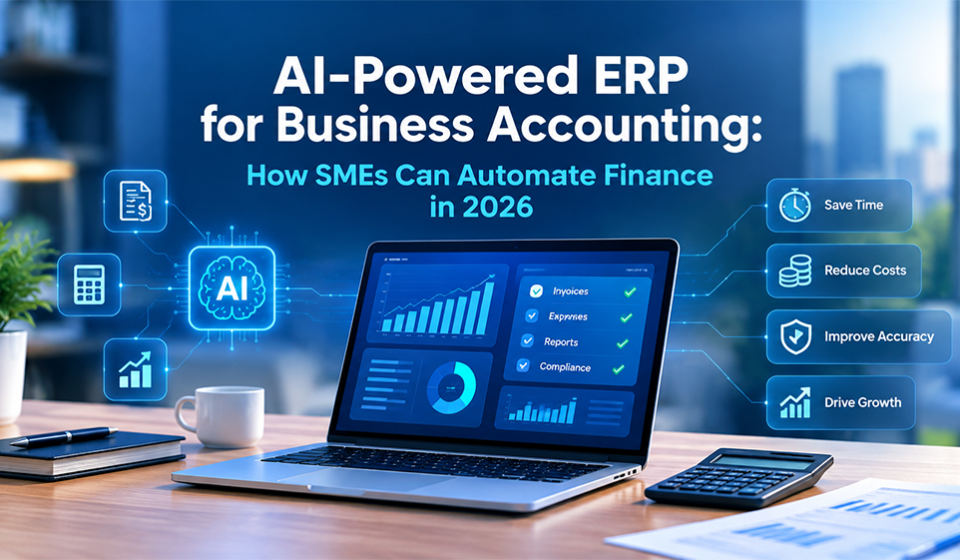
AI-Powered ERP for Business Accounting: How SMEs Can Automate Finance in 2026

For many SMEs, the finance team still spends too much time entering invoices, matching payments, checking ledgers, preparing reports, following up on receivables, and correcting data that should have been accurate from the beginning. As transaction volumes increase, these manual activities do not simply consume more hours; they also make financial visibility slower and decision-making harder.
That is where an AI-powered ERP for business accounting can change the way an SME manages finance. Instead of treating accounting as an isolated function, an AI-powered ERP connects accounting with sales, purchasing, inventory, production, projects, payroll, banking, and other operational activities. Consequently, financial information can move through the business as transactions happen rather than being reconstructed manually at the end of the day, week, or month.
The opportunity is becoming more relevant in 2026. The OECD’s 2026 D4SME Survey reports that SME adoption of AI tools is increasing, although strategic and secure integration into business operations remains uneven. The report also identifies time constraints, maintenance costs, skills gaps, and cybersecurity as continuing barriers to effective digitalisation.
Therefore, the question for an SME is no longer simply whether AI can be used in accounting. The more practical question is how AI can be introduced into an ERP environment without sacrificing financial control, data quality, compliance, or human oversight.
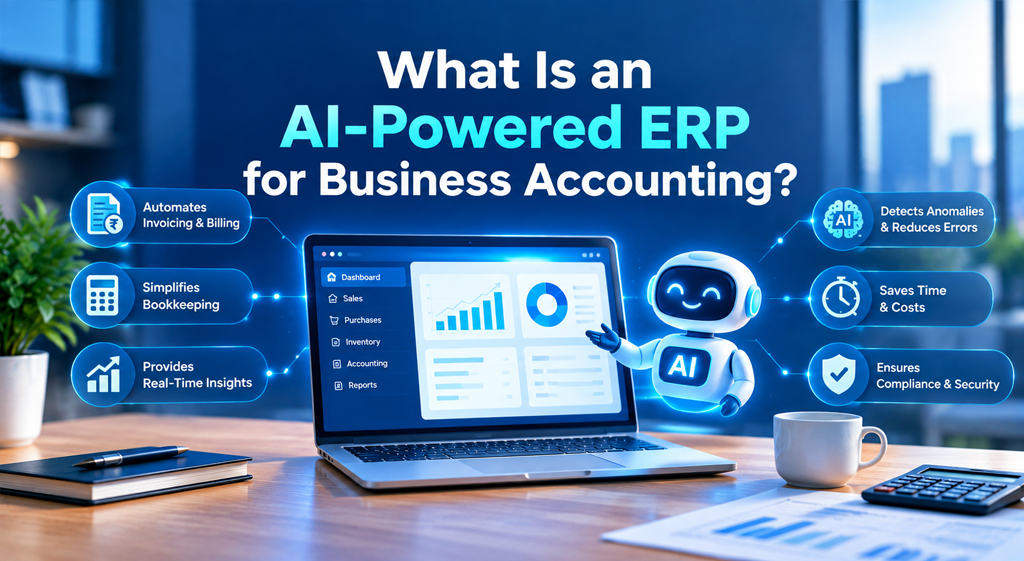
What Is an AI-Powered ERP for Business Accounting?
An AI-powered ERP for business accounting combines traditional enterprise resource planning with artificial intelligence, automation, analytics, and integrated financial management. A conventional accounting application primarily records financial transactions. However, an ERP connects those transactions with the operational activities that created them. When AI is added to that environment, the system can assist with classification, anomaly identification, forecasting, reconciliation, document processing, reporting, and decision support.
For example, when a purchase invoice enters the system, the finance team should not have to manually recreate information that already exists elsewhere in the organisation. An intelligent ERP can use information from the purchase order, supplier record, goods receipt, tax information, and accounting rules to support invoice processing and validation.
Likewise, when a customer invoice becomes overdue, the system can identify the outstanding amount, ageing period, customer history, and related transactions. Instead of waiting for a monthly report, management can receive a more timely view of receivables and cash-flow pressure. The important distinction is that AI should support accounting decisions rather than operate as an uncontrolled replacement for financial governance.
Why SMEs Are Struggling With Traditional Accounting Processes
The biggest accounting problem in many growing SMEs is not the absence of accounting software. It is the fragmentation between accounting and the rest of the business. Sales teams may maintain customer information in one system. Purchase teams may maintain supplier information elsewhere. Inventory may be tracked separately, while production records remain disconnected from finance. Consequently, accountants spend significant time collecting, comparing, correcting, and reconciling information.
This creates another problem: financial reports may describe what happened, but they do not always explain why it happened. For instance, revenue may increase while cash remains under pressure. Inventory may increase even though sales are stable. Production costs may rise without management immediately understanding which material, process, product, or operational factor caused the change.
An integrated ERP addresses the underlying data problem first. AI can then work with connected and structured information to provide deeper analysis.
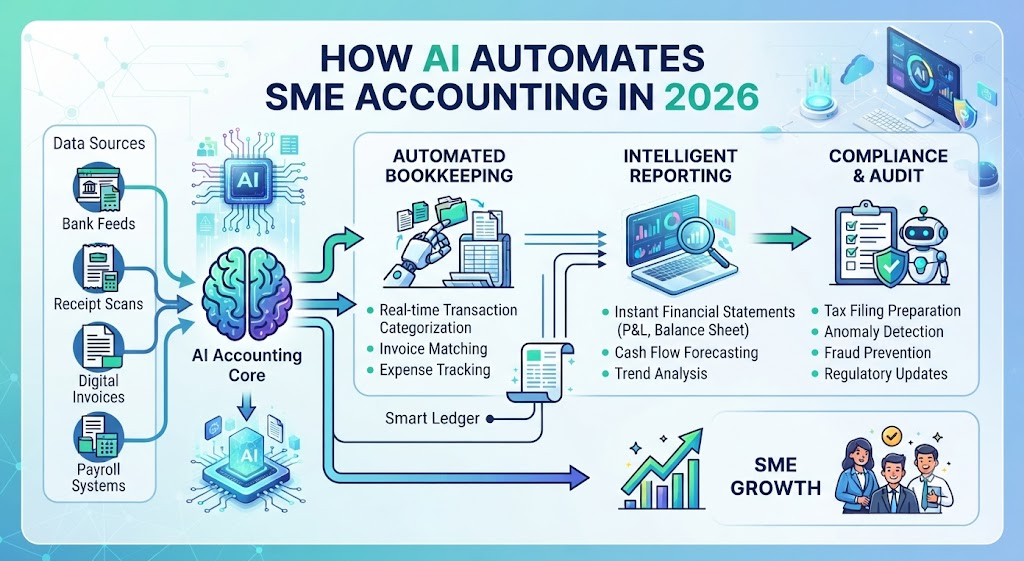
How AI Automates SME Accounting in 2026
AI-based accounting automation can begin with repetitive finance activities. Invoice data extraction is one practical example. Instead of manually entering every field from a supplier invoice, intelligent document processing can identify information such as supplier, invoice number, date, taxable value, tax amount, and total value. The system can then compare those details with existing transaction records.
Similarly, AI can assist with transaction classification and reconciliation. Where transaction patterns are consistent, the system can identify likely accounting treatments and highlight transactions that require human review. However, the strongest benefit comes when these capabilities operate inside an ERP rather than as disconnected AI tools.
The ERP provides the business context. AI provides analysis and automation. Human users provide financial judgement and approval. This combination creates a more controlled automation model.
AI-Powered Accounts Payable: From Invoice Entry to Intelligent Processing
Accounts payable becomes increasingly difficult when an SME handles hundreds or thousands of invoices every month. Manual invoice entry creates several risks. Employees can enter incorrect amounts, duplicate invoices can pass through processing, purchase orders may not match invoices, and payment schedules can become difficult to track.
An AI-powered ERP can connect purchase orders, goods receipts, supplier invoices, tax information, and payment records. For example, if the purchase order shows 1,000 units but the invoice contains 1,200 units, the system can flag the mismatch before payment approval. Similarly, if an invoice appears to duplicate an earlier transaction, the ERP can identify the pattern for review.
As a result, finance teams can spend less time searching for errors and more time resolving exceptions.
AI-Powered Accounts Receivable and Cash-Flow Visibility
Cash flow remains one of the most important concerns for growing SMEs because profitable sales do not automatically guarantee available cash. An AI-powered ERP can bring invoices, receipts, credit terms, customer payment history, outstanding balances, and ageing information into one financial view.
Consequently, management can identify customers with delayed payments and understand the financial impact of outstanding receivables. AI can also assist with cash-flow forecasting by analysing historical transaction patterns and current financial information. However, forecasts should be treated as decision-support information rather than guaranteed outcomes. This distinction matters because AI predictions depend heavily on data quality, business conditions, seasonality, and changes in customer behaviour.
AI-Based Financial Reporting for Faster Management Decisions
Traditional financial reporting often becomes a month-end activity. By contrast, an integrated ERP can continuously collect operational and financial transactions. AI-based analytics can then help management identify unusual movements, changing trends, and areas that deserve attention.
For example, management may want to understand why gross margins declined during a particular period. An integrated system can help connect sales prices, purchase costs, inventory movements, production costs, wastage, discounts, and other relevant transactions. Therefore, financial reporting becomes more than a historical statement. It becomes a management tool for understanding business performance.
AI-Powered ERP Can Help Detect Financial Anomalies
Accounting errors do not always look like obvious mistakes. A transaction can contain a technically valid amount but still be unusual compared with historical behaviour. This is where anomaly detection can become useful. An AI model can examine transaction patterns and identify unusual values, duplicate activity, unexpected timing, abnormal supplier behaviour, or deviations from established patterns.
The system should not automatically assume that every anomaly is fraud or an error. Instead, it should bring unusual transactions to the attention of the appropriate employee. That approach keeps human oversight at the centre of financial control.
AI, GST and Digital Finance Compliance
For Indian SMEs, accounting automation also needs to operate within a changing digital compliance environment. GST-related information, invoices, tax calculations, credit notes, debit notes, and reporting processes must remain consistent with the organisation’s accounting records. Therefore, connecting operational transactions with finance reduces the need to manually move information between systems.
However, AI should not be treated as a substitute for professional tax advice or regulatory review. Compliance rules can change, and businesses should configure ERP workflows according to applicable requirements. The larger benefit comes from maintaining a consistent transaction trail that finance teams can review and reconcile.
Why Data Quality Matters More Than AI Features
An SME cannot solve poor financial data simply by adding AI. If customer records are duplicated, supplier masters are inconsistent, transactions are incomplete, or departments maintain disconnected spreadsheets, an AI model can produce unreliable outputs.
The OECD’s recent SME research similarly highlights data, algorithms, skills, connectivity, and finance as important prerequisites for successful AI adoption. Therefore, the practical sequence should be clear: connect the business data, establish financial controls, automate repeatable processes, and then introduce AI-driven analysis where it creates measurable value.
AI-Powered ERP vs Separate Accounting Software
Separate accounting software can work effectively for a small organisation with relatively simple operations. However, as an SME expands into multiple branches, warehouses, product lines, projects, production units, or locations, financial information becomes increasingly dependent on operational data.
At that stage, maintaining accounting separately can create reconciliation work. An ERP takes a different approach. Sales, purchasing, inventory, production, finance, and other processes operate within a connected business environment. Therefore, the key question is not whether standalone accounting software is bad. The real question is whether the current system can provide the level of integration, automation, visibility, and control that the organisation now requires.
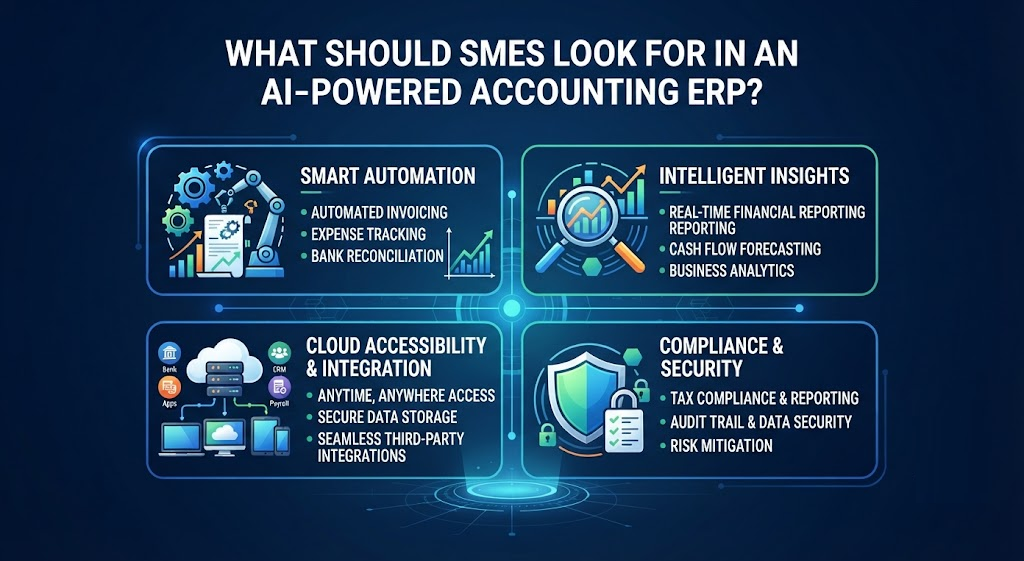
What Should SMEs Look for in an AI-Powered Accounting ERP?
An SME should look beyond the words “AI-powered” when evaluating ERP software. The platform should provide integrated financial management, configurable workflows, auditability, role-based access, reporting, dashboards, document management, automation, integrations, and reliable data controls. At the same time, AI capabilities should have a practical business purpose.
For example, invoice automation, reconciliation assistance, anomaly detection, forecasting, financial insights, and intelligent reporting can directly support finance teams. By contrast, an AI feature that produces impressive demonstrations but does not connect to real business transactions may have limited operational value.
How SMEs Can Start AI Accounting Automation Without Disrupting Finance
A successful implementation does not require an SME to automate everything simultaneously. The better approach is to identify the finance processes consuming the most employee time or creating the highest error risk. Invoice processing can be automated first. Then reconciliation, receivables monitoring, reporting, approval workflows, cash-flow analysis, and anomaly detection can be introduced according to business priorities.
This phased operational approach also gives employees time to understand the new workflows. Most importantly, automation should include approval controls. High-impact financial transactions should continue to follow appropriate review and authorisation processes.
The Human Role in AI-Powered Accounting
AI can process patterns faster than people, but finance remains a function where accountability matters. A finance manager still needs to understand why a transaction was flagged. An accountant still needs to review unusual entries. Management still needs to evaluate forecasts against actual business conditions.
Therefore, the most useful model is not “AI replaces the accountant.” Instead, it is “AI removes repetitive work so finance professionals can focus on analysis, control, and decisions.” Research from the OECD also indicates that AI adoption among SMEs brings opportunities alongside concerns involving skills, governance, security, and responsible implementation.
Is AI-Powered ERP Worth It for an SME in 2026?
The answer depends on the complexity and growth requirements of the business. If an SME has simple transactions and limited operational complexity, a basic accounting system may continue to be sufficient. However, when finance teams spend increasing amounts of time reconciling spreadsheets, tracking receivables, entering invoices, preparing management reports, correcting data, or connecting information from different departments, an integrated ERP becomes increasingly relevant.
AI adds another layer by helping the organisation move from recording transactions toward analysing them. That shift can give business leaders faster access to financial information while reducing repetitive administrative work.
Frequently Asked Questions About AI-Powered ERP for Business Accounting
What is an AI-powered ERP for business accounting?
An AI-powered ERP for business accounting is an integrated business management system that combines accounting and financial management with ERP functions and artificial intelligence. It can help automate repetitive finance processes, analyse transaction data, identify anomalies, support forecasting, and provide management insights.
Can AI automate accounting for SMEs?
Yes. AI can support several accounting activities, including invoice processing, transaction classification, reconciliation assistance, anomaly detection, reporting, and forecasting. However, businesses should retain appropriate human review and financial controls.
Is AI accounting suitable for small and medium-sized businesses?
Yes, provided the solution matches the SME’s operational complexity, budget, data maturity, and business requirements. The 2026 OECD D4SME Survey shows that SME AI adoption is increasing, although implementation barriers such as skills, maintenance, time, and cybersecurity remain important considerations.
Can an AI-powered ERP improve cash-flow management?
An integrated ERP can provide better visibility into receivables, payables, sales, purchases, inventory, and financial transactions. AI can then analyse historical and current information to support cash-flow forecasting and identify potential areas requiring attention.
Does AI replace accountants?
AI does not need to replace accountants to create value. Its strongest practical role is often automating repetitive activities and providing analysis so finance professionals can concentrate on review, controls, interpretation, compliance, and business decisions.
What is the biggest challenge when implementing AI accounting software?
Data quality and process readiness are among the most important considerations. AI requires reliable information and well-defined workflows. Therefore, organisations should improve their data structures and processes alongside AI adoption rather than treating AI as a standalone technology layer.
Turn Business Transactions Into Actionable Financial Intelligence
Your accounting system should do more than record yesterday’s transactions. When finance, sales, purchasing, inventory, production, projects, and other business processes operate through a connected ERP environment, management can gain a clearer view of what is happening across the organisation. When AI is applied responsibly on top of that connected information, SMEs can automate repetitive finance activities, identify unusual patterns, improve reporting speed, and support better financial decisions.
For SMEs evaluating their next ERP investment, the right starting point is not simply asking, “Does this ERP have AI?” Instead, ask: “Which financial problems can this ERP actually solve, how much manual work can it remove, and how clearly can it connect financial information with the rest of my business?” That is the difference between buying an AI feature and building an AI-ready finance operation.
Ready to explore how AI-powered ERP can automate your accounting and business processes?
Get a Free ERP Consultation from Bluechip Solutions and discuss your current accounting, reporting, workflow, and operational challenges with an ERP specialist.
Contact us to get the “2026 SME AI-Powered ERP & Finance Automation Checklist” to evaluate your current accounting processes, identify automation opportunities, and prepare your business for AI-driven financial management.