
Flour Mill Accounting Software: Features Every Mill Owner Needs

Running a flour mill involves far more than recording sales and expenses. Wheat procurement, stock valuation, milling production, wastage, by-products, customer orders, GST compliance, payments, and profitability all directly influence one another. However, when businesses manage these activities using spreadsheets, standalone accounting software, or disconnected systems, even a small data gap can reduce financial accuracy and lead to poor decisions.
That is why flour mill accounting software needs to do more than maintain a ledger. It should connect accounting with inventory, purchasing, production, sales, and business reporting so that mill owners can understand what is happening across the operation in real time. For a growing flour mill, the right software reduces manual work, improves stock visibility, strengthens financial control, and helps management identify where the business loses money.
Why Traditional Accounting Software Falls Short for Flour Mills
Generic accounting software may handle invoices, receipts, payments, and ledgers effectively. However, flour milling has operational requirements that ordinary accounting systems often do not address. For example, a mill purchases wheat at different rates and processes it into multiple finished products and by-products. Consequently, the finance team needs to track not only how much raw material the mill purchased, but also how it moved through production and what value it generated.
When accounting and production data remain separate, management may see revenue but struggle to determine the actual cost and margin of each product. Furthermore, spreadsheet-based processes create another problem. Employees may maintain separate files for purchases, inventory, production, sales, and accounts. As a result, information becomes duplicated, delayed, or inconsistent.
Flour mill accounting software solves this problem by bringing financial and operational information into one connected system.
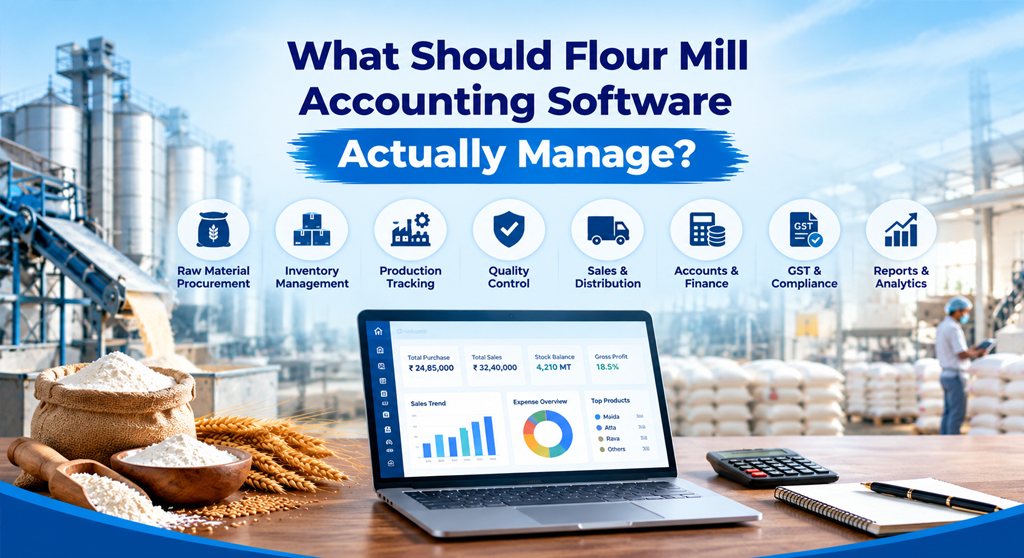
What Should Flour Mill Accounting Software Actually Manage?
A useful system should reflect how a flour mill operates rather than forcing the business to change its processes around generic accounting screens. At the financial level, the software should manage accounts payable, accounts receivable, general ledger, receipts, payments, expenses, taxation, bank transactions, and financial reporting.
At the same time, it should connect these transactions with procurement, inventory, production, sales, and dispatch. This connection is particularly important because a flour mill’s profitability depends on several variables simultaneously. Wheat purchase prices can change, production yields can vary, wastage can increase, and selling prices can move.Therefore, connecting accounting information with operational data makes it much more valuable.
Real-Time Wheat Inventory and Stock Valuation
Raw wheat is one of the most important assets in a flour mill. Yet many mills still depend on manual stock registers or spreadsheets to determine available inventory. That creates a serious management problem. If the team does not update stock figures immediately after receiving, transferring, consuming, or dispatching materials, managers may make purchasing decisions based on outdated information.
A modern flour mill accounting software system should provide real-time visibility into wheat inventory, finished products, packaging materials, and by-products. Moreover, stock valuation should reflect the accounting method used by the business. Management should be able to understand the value of inventory while also tracking movement by location, warehouse, batch, or other relevant business parameters.
This helps prevent situations where the purchase team orders additional wheat even though sufficient usable stock is already available somewhere else in the organization.
Wheat Procurement and Purchase Cost Control
The cost of wheat directly influences flour mill profitability. Therefore, businesses must treat procurement as an integrated part of their overall operations. A suitable system should connect suppliers, purchase orders, goods receipts, purchase invoices, payments, and inventory.
For instance, when the mill receives wheat, the system should immediately update the relevant stock records and link the supplier invoice to the corresponding financial transaction. This provides management with a clearer view of purchase commitments and outstanding supplier balances.
Additionally, historical purchase information can help identify price trends and supplier-wise purchasing patterns. Consequently, mill owners can make procurement decisions using actual business data instead of relying entirely on manual calculations.
Production Accounting for Milling Operations
Production is where generic accounting systems often become inadequate. A flour mill does not simply purchase wheat and sell flour. The raw material passes through several processing stages and can produce multiple outputs. Therefore, the business needs a way to connect raw-material consumption with finished production.
Production-oriented accounting should help answer questions such as:
How much wheat did the mill consume? How much finished product did it produce? What production costs did it incur? How much material did the process lose or consume? What by-products did the mill generate?
When the mill connects this information to accounting, management can better understand its production economics. Furthermore, production records can help identify unusual consumption patterns and investigate deviations before they become significant financial losses.
Yield, Wastage and By-Product Tracking
Yield management is particularly important for flour mills because relatively small variations can affect margins when production volumes are large. For example, if actual production yield consistently falls below expected levels, the business needs to determine whether the reason is raw-material quality, process efficiency, wastage, machinery performance, or inaccurate recording.
A capable flour mill ERP software solution should therefore allow businesses to compare expected and actual production. The mill should also account for by-products instead of treating them as secondary information. Bran, wheat germ, and other outputs may have commercial value. Consequently, tracking their production, inventory, sales, and revenue can provide a more complete picture of the economics of milling.
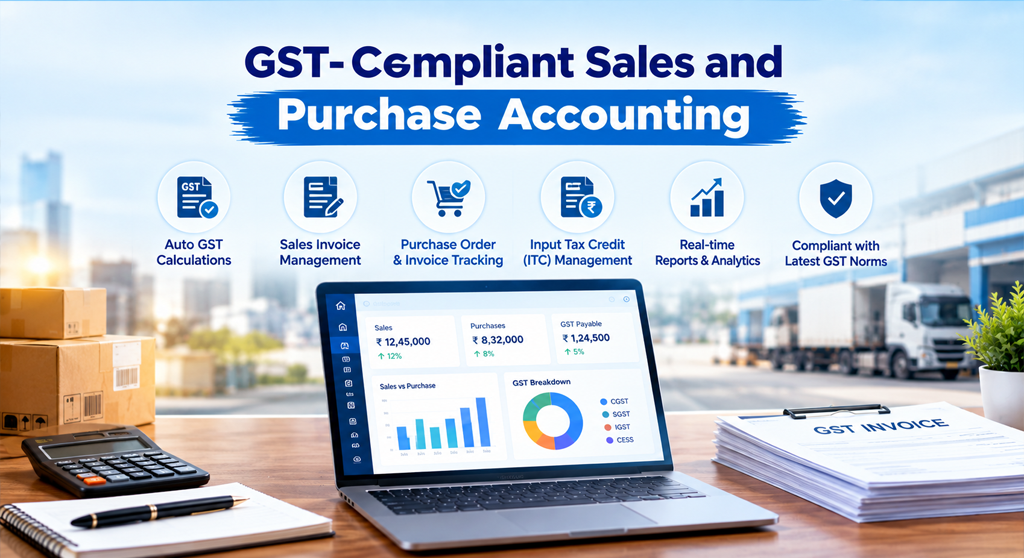
GST-Compliant Sales and Purchase Accounting
GST compliance is another area where manual processes can create unnecessary risk. A flour mill may deal with multiple suppliers, distributors, retailers, institutional buyers, and other customers. Therefore, maintaining accurate tax information across purchases and sales becomes increasingly difficult as transaction volumes grow.
Integrated accounting software can connect GST-related information with invoices, purchases, customer records, supplier transactions, and financial reporting. This reduces the need to repeatedly enter the same information into different systems. However, businesses should still ensure that their software configuration and compliance processes are reviewed appropriately as Indian tax requirements and reporting mechanisms evolve.
Accounts Receivable and Payment Follow-Up
Selling more does not necessarily mean earning more if customer payments are delayed. For flour mills supplying distributors, wholesalers, retailers, hotels, restaurants, or institutional buyers, outstanding receivables can quickly become a working-capital issue. A connected accounting system should provide clear visibility into customer balances, invoice ageing, credit limits, receipts, and overdue amounts.
Consequently, finance teams can prioritize collection follow-ups based on actual outstanding exposure rather than manually checking multiple spreadsheets. This becomes particularly valuable when a mill has hundreds of active customers and sales transactions.
Real-Time Profitability and Management Dashboards
Mill owners should not have to wait until the end of the month to discover that margins have declined. A modern flour mill accounting software solution should provide management dashboards that bring together sales, purchases, inventory, production, expenses, receivables, payables, and profitability.
For example, management could compare sales performance with wheat procurement costs and production output to identify changes in gross margins. More importantly, dashboards turn accounting data into decision-making information. Instead of asking the accounts team to prepare another spreadsheet, management can access current business information and investigate the underlying transactions when necessary.
AI-Powered Analytics for Better Flour Mill Decisions
Artificial intelligence is increasingly becoming part of modern business software. However, AI should solve a real business problem rather than simply appear as a marketing feature. For flour mills, AI-assisted analytics can potentially help identify unusual inventory movements, abnormal expenses, delayed customer payments, changing purchase patterns, and other operational signals.
For example, historical sales and inventory information can support demand analysis and help management identify products that may require closer attention. Likewise, anomaly detection can highlight transactions or patterns that differ significantly from normal business activity.
The important point is that AI should work on connected business data. If accounting, inventory, production, and sales information remain fragmented, the value of intelligent analysis is naturally limited.
Cloud Access for Flour Mill Owners and Finance Teams
Many mill owners need access to business information even when they are away from the factory or office. Cloud-based flour mill accounting software can provide authorized users with access to financial and operational information through connected devices, subject to the organization’s security and access policies.
This can be especially useful for businesses operating multiple warehouses, branches, or locations. Furthermore, centralized data can reduce dependence on individual employees maintaining separate files on local computers. However, cloud adoption should also be evaluated based on security controls, user permissions, backup practices, audit trails, integration capabilities, and the provider’s implementation approach.
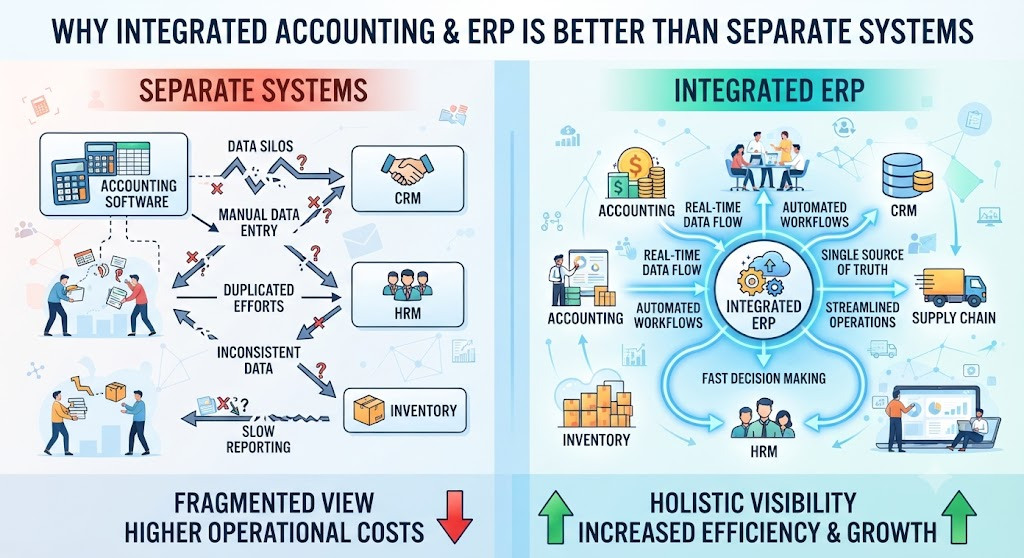
Why Integrated Accounting and ERP Is Better Than Separate Systems
Using separate software for accounting, inventory, production, and sales may appear inexpensive initially. However, integration problems can become increasingly expensive as the business grows. Employees may need to enter the same information several times. Finance may see one stock figure while the warehouse has another. Production may maintain separate records from accounts. Management may then spend hours reconciling differences.
An integrated ERP approach eliminates much of this duplication by allowing different business functions to work from connected information. For a growing flour mill, this can mean fewer manual reconciliations, better traceability, faster reporting, and stronger management control.
How to Choose the Right Flour Mill Accounting Software
The best software is not necessarily the one with the longest feature list. Instead, mill owners should evaluate whether the system can support their actual workflow from wheat procurement to production, inventory, sales, accounting, collection, and profitability analysis. It is also important to evaluate customization capabilities. Every flour mill does not operate in exactly the same way. Therefore, software that can adapt workflows, reports, approvals, and business processes without requiring extensive redevelopment can provide greater long-term flexibility.
Before making a decision, businesses should request a practical demonstration using real flour-milling scenarios rather than accepting a generic accounting presentation.
Frequently Asked Questions About Flour Mill Accounting Software
What is flour mill accounting software?
Flour mill accounting software is a business management solution designed to manage accounting alongside flour-milling activities such as procurement, inventory, production, sales, payments, and profitability.
Can flour mill software track wheat consumption and production?
Yes. An integrated ERP system can connect raw-material consumption with production transactions and finished-product inventory, helping management monitor production quantities and yields.
Can it manage GST accounting?
Yes. Modern accounting and ERP platforms can support GST-related sales, purchases, invoices, tax information, and financial reporting. Businesses should ensure that the selected system is maintained according to current compliance requirements.
Is cloud-based accounting suitable for flour mills?
Cloud-based systems can be suitable for flour mills that need centralized access across offices, warehouses, or locations. However, security, user permissions, backup, availability, and implementation quality should be evaluated before deployment.
What is the difference between accounting software and flour mill ERP?
Accounting software primarily focuses on financial transactions. Flour mill ERP connects accounting with procurement, inventory, production, sales, and other operational processes, giving management a broader view of the business.
Turn Flour Mill Data Into Better Business Decisions
The real value of flour mill accounting software is not simply replacing a ledger or spreadsheet. It is creating a connected flow of information from wheat procurement through production, inventory, sales, collections, and financial reporting. When these processes work together, mill owners can spend less time reconciling information and more time understanding margins, controlling costs, improving working capital, and planning growth.
Bluechip Solutions offers ProfitPlus ERP, a no-code ERP platform designed to connect business processes across accounting, inventory, production, sales, purchasing, and reporting. For flour mills looking to move beyond disconnected accounting and spreadsheets, a practical ERP assessment can help identify where automation and real-time visibility can deliver the greatest value.
Ready to see how an integrated ERP can work for your flour mill? Request a free ERP consultation or personalized demo and discuss your procurement, production, inventory, GST, accounting, and reporting requirements with an ERP specialist.