
Why AI-Powered ERP Has Become a Business Necessity
Businesses no longer struggle because of a lack of data. Instead, they struggle because they have too much data spread across multiple departments, applications, and spreadsheets. As a result, decision-makers spend valuable time collecting information rather than acting on it. Consequently, operational delays increase, customer expectations remain unmet, and business growth slows.
Modern Enterprise Resource Planning (ERP) systems have evolved beyond traditional process automation. Today, Artificial Intelligence (AI) enables ERP platforms to analyze business information, predict future outcomes, automate repetitive tasks, and recommend intelligent actions before problems affect operations.
Organizations across manufacturing, retail, healthcare, logistics, construction, distribution, and professional services are adopting AI-powered ERP solutions to improve efficiency, reduce operational costs, enhance customer satisfaction, and make data-driven decisions faster than ever before.
However, not every ERP system offers intelligent capabilities that genuinely transform business operations. Many solutions still rely heavily on manual workflows and static reporting, leaving businesses reactive rather than proactive.
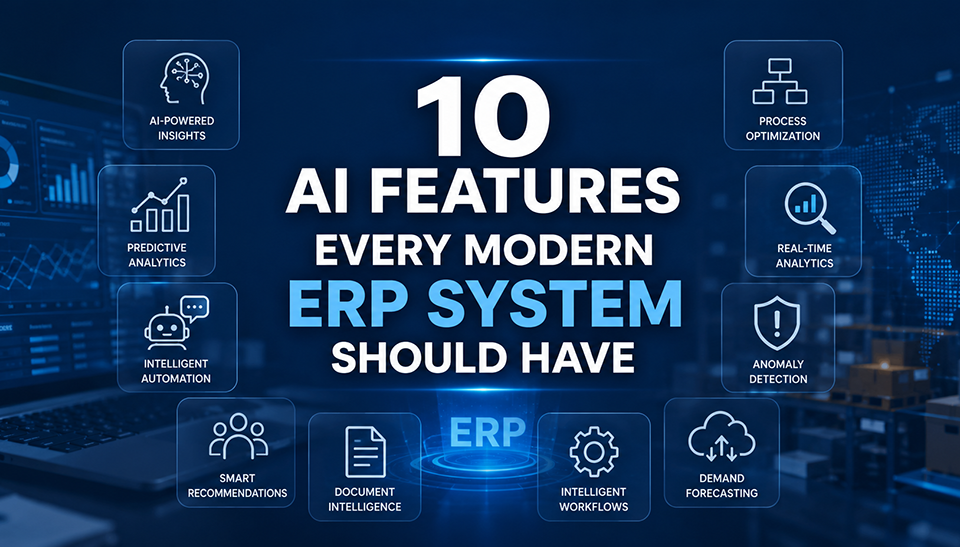
This guide explores the ten essential AI features every modern ERP system should include, explains why they matter, highlights the challenges businesses face without them, and demonstrates how intelligent ERP capabilities create measurable business value.
What Makes an ERP System Truly Intelligent?
Traditional ERP software records transactions and generates reports after activities have already occurred. While this approach helps organize business information, it does little to prevent issues before they arise.
An AI-powered ERP system continuously analyzes historical data, current operations, user behavior, market trends, and operational performance. Consequently, it learns from patterns, identifies anomalies, predicts future events, and recommends the best possible actions automatically.
Instead of asking:
“What happened?”
Modern ERP systems answer:
“What is happening?”
“Why is it happening?”
“What is likely to happen next?”
“What should we do about it?”
This shift transforms ERP from a transaction management tool into an intelligent business advisor.
AI Feature #1: Predictive Analytics for Smarter Business Decisions
One of the biggest challenges organizations face is making decisions based solely on historical reports. By the time monthly reports become available, opportunities may already be lost. Predictive analytics changes this completely. Using machine learning algorithms, AI analyzes years of historical business data together with current operational information to forecast future outcomes.
Instead of estimating next month’s sales manually, AI predicts likely demand using purchasing behavior, customer trends, seasonal patterns, supplier performance, and external market influences. For example, a manufacturing company can forecast production demand weeks in advance. Consequently, procurement teams purchase raw materials at the right time while avoiding unnecessary inventory costs.
Similarly, finance departments can predict cash flow shortages before they occur, allowing businesses to plan investments more effectively. The result is better planning, lower operational risk, improved profitability, and faster executive decision-making.
AI Feature #2: Intelligent Demand Forecasting and Inventory Optimization
Inventory management remains one of the largest operational challenges for growing businesses. Holding excessive inventory increases storage costs, ties up working capital, and leads to product obsolescence. Conversely, insufficient inventory results in delayed deliveries, dissatisfied customers, and lost revenue.
Artificial Intelligence continuously analyzes sales history, seasonal fluctuations, supplier lead times, customer purchasing behavior, market demand, promotional campaigns, and external economic indicators. Rather than relying on static reorder levels, AI dynamically adjusts inventory recommendations based on changing business conditions.
As a result, organizations maintain optimal inventory levels while reducing waste and improving order fulfillment. Manufacturers experience fewer production interruptions, distributors reduce warehouse costs, and retailers minimize stock shortages during peak demand periods. Instead of reacting to inventory issues after they occur, businesses prevent them before they happen.
AI Feature #3: Automated Financial Intelligence
Financial teams spend countless hours reconciling transactions, preparing reports, identifying discrepancies, and forecasting budgets. Artificial Intelligence significantly reduces these manual activities. Modern ERP systems automatically categorize expenses, reconcile bank transactions, detect duplicate invoices, identify unusual spending patterns, and generate financial insights in real time. Furthermore, AI continuously monitors financial performance against budgets, alerting management whenever unexpected trends appear.
For example, if operating expenses suddenly increase beyond expected thresholds, the ERP system immediately identifies the responsible departments and recommends corrective actions. Instead of waiting until month-end reporting, executives gain continuous financial visibility. Consequently, organizations improve cash flow management, strengthen compliance, reduce accounting errors, and make faster financial decisions.
AI Feature #4: AI-Powered Business Process Automation
Many organizations still rely on employees to perform repetitive administrative tasks every day. These activities often include:
approving purchase requests, sending reminders, creating invoices, processing payroll, updating customer records, tracking service requests, and generating reports. Although these tasks are necessary, they consume valuable employee time that could otherwise support innovation and customer engagement.
Artificial Intelligence automates repetitive workflows by understanding business rules and executing processes without constant human intervention. For example, purchase approvals automatically follow predefined authorization hierarchies, invoices route to appropriate departments, and overdue customer payments trigger automated reminders. Consequently, businesses reduce operational costs, improve productivity, and eliminate unnecessary delays while employees focus on strategic responsibilities.
AI Feature #5: Natural Language Business Intelligence
Business intelligence tools often require technical expertise to build reports and dashboards. AI changes this experience completely. Modern ERP systems allow executives to ask business questions using everyday language. For example:
“Show last quarter’s highest-performing products.” “Which suppliers caused the most delivery delays?” “What is our projected revenue next month?”
The ERP platform instantly generates visual dashboards and meaningful insights without requiring complex report creation. As a result, managers across finance, operations, HR, sales, and manufacturing gain immediate access to business intelligence. Decision-making becomes faster, simpler, and significantly more data-driven.
AI Feature #6: Intelligent Customer Relationship Management
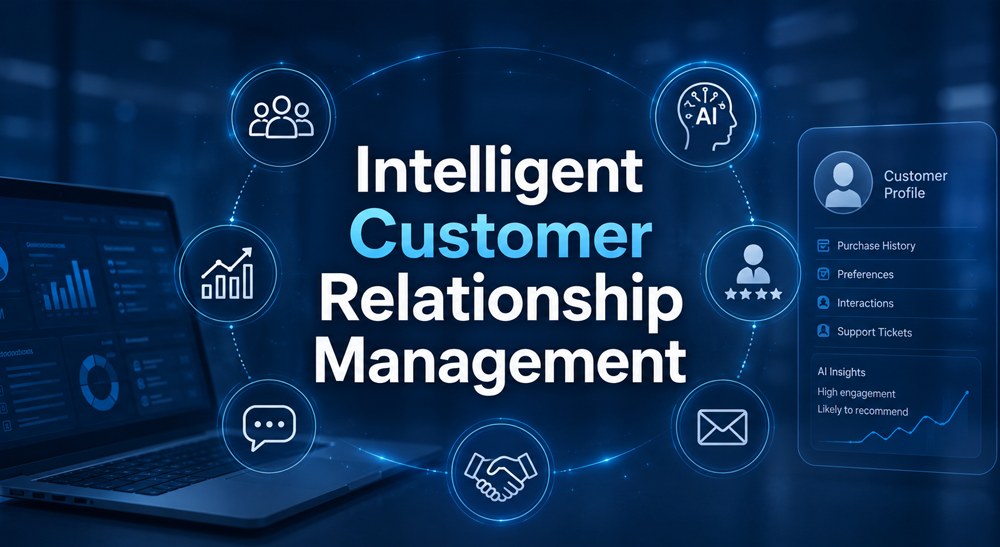
Customer expectations continue to rise across every industry. Organizations must deliver personalized experiences while responding quickly to inquiries, complaints, and service requests. Artificial Intelligence strengthens ERP-integrated CRM systems by analyzing customer purchasing history, communication patterns, service interactions, payment behavior, and engagement trends.
Consequently, sales teams receive recommendations about which customers are most likely to purchase additional products. Similarly, customer support teams identify accounts at risk of leaving before dissatisfaction increases. Rather than reacting to customer churn, businesses proactively improve customer relationships through personalized engagement. This not only increases customer retention but also creates stronger long-term revenue opportunities.
AI Feature #7: AI-Powered Supply Chain Intelligence
Supply chain disruptions have become one of the biggest operational risks for modern businesses. Delayed shipments, supplier shortages, fluctuating transportation costs, and unexpected demand spikes can quickly affect production schedules and customer satisfaction. Therefore, businesses need more than traditional supply chain management—they need intelligent systems that can anticipate problems before they occur.
An AI-powered ERP system continuously monitors supplier performance, procurement cycles, transportation routes, warehouse inventory, and external market conditions. Consequently, it identifies patterns that indicate potential risks and recommends corrective actions before disruptions impact operations.
For example, if a supplier consistently delivers raw materials later than expected, the ERP system recognizes the trend and alerts procurement teams. Furthermore, it can recommend alternative suppliers based on historical performance, pricing, quality, and delivery reliability. Instead of waiting for production delays to occur, businesses can proactively secure materials from more dependable sources.
Similarly, AI can optimize logistics by analyzing traffic conditions, fuel costs, weather forecasts, shipping schedules, and warehouse capacities. As a result, organizations reduce transportation expenses while improving delivery accuracy.
Another significant advantage is demand synchronization. Traditional supply chains often struggle because procurement decisions are based on outdated forecasts. In contrast, AI continuously updates demand predictions using real-time sales data, customer buying patterns, seasonal fluctuations, and market trends. Consequently, inventory remains balanced across warehouses while production schedules align more accurately with customer demand.
Businesses that leverage AI-powered supply chain intelligence benefit from reduced operational risks, lower procurement costs, faster deliveries, stronger supplier relationships, and improved customer satisfaction. More importantly, they become resilient enough to adapt quickly to changing market conditions.
AI Feature #8: Intelligent Human Resource Management
Employees remain one of the most valuable assets of any organization. However, managing recruitment, employee engagement, performance evaluations, payroll, attendance, compliance, and workforce planning manually often consumes significant administrative resources.
Artificial Intelligence transforms Human Resource Management (HRM) within modern ERP systems by automating repetitive processes while providing meaningful workforce insights.
One of the most valuable applications of AI in HR is intelligent recruitment. Instead of manually reviewing hundreds of resumes, AI analyzes applicant qualifications, previous experience, technical skills, certifications, and job descriptions to identify the most suitable candidates. As a result, recruiters spend more time interviewing qualified applicants rather than filtering irrelevant applications.
Employee retention is another critical business challenge. High employee turnover increases recruitment costs, disrupts productivity, and affects organizational culture. AI addresses this issue by identifying early signs of employee dissatisfaction through attendance trends, performance metrics, workload analysis, engagement surveys, and internal communication patterns. Consequently, HR teams can intervene proactively before valuable employees decide to leave.
Performance management also becomes more objective. AI evaluates employee productivity based on measurable performance indicators rather than subjective opinions. Managers receive recommendations for promotions, skill development, and training opportunities tailored to each employee’s strengths and career goals.
Furthermore, payroll processing becomes faster and more accurate through automated salary calculations, tax compliance, overtime management, and benefits administration. Employees also benefit from AI-powered self-service portals that instantly answer HR-related questions, reducing the workload on HR departments.
Ultimately, AI-powered HR management helps businesses attract top talent, retain skilled employees, improve workforce productivity, and build a more engaged organization.
AI Feature #9: AI-Driven Cybersecurity and Fraud Detection
As businesses become increasingly digital, cybersecurity threats continue to evolve. Cybercriminals constantly develop sophisticated techniques to target financial data, customer information, intellectual property, and operational systems. Therefore, protecting enterprise data requires more than traditional security measures.
Modern AI-powered ERP systems incorporate intelligent cybersecurity capabilities that continuously monitor user activities, login behavior, transaction patterns, and network access in real time.
Unlike traditional security systems that rely on predefined rules, AI learns what constitutes normal behavior for each user. Consequently, when unusual activities occur—such as unauthorized access attempts, abnormal financial transactions, or suspicious login locations—the ERP system immediately flags them for investigation.
For example, if an employee who typically accesses the ERP system during office hours suddenly logs in from another country late at night and attempts to download sensitive financial records, AI recognizes this behavior as unusual. Rather than waiting for a security breach to occur, the system can automatically block access, notify administrators, and initiate additional authentication procedures.
AI also plays a vital role in financial fraud detection. It continuously analyzes invoices, payment requests, procurement transactions, vendor details, and expense claims to identify inconsistencies that may indicate fraudulent activity.
For instance, duplicate invoices, unusual payment amounts, altered vendor bank details, or suspicious procurement requests can be detected automatically before payments are processed. Consequently, organizations reduce financial losses while strengthening internal controls.
Furthermore, AI enhances compliance by continuously monitoring business processes against regulatory requirements. Whether organizations operate under GDPR, ISO standards, financial regulations, or industry-specific compliance frameworks, intelligent ERP systems simplify auditing through automated monitoring and reporting.
By integrating AI-driven cybersecurity and fraud detection, businesses not only protect valuable data but also build greater trust among customers, partners, and stakeholders.
AI Feature #10: Generative AI and Intelligent Virtual Assistants
Generative AI has emerged as one of the most transformative technologies in enterprise software. Rather than simply analyzing historical data, Generative AI creates content, summarizes reports, answers questions, generates recommendations, and assists employees in completing daily tasks more efficiently.
Within modern ERP systems, intelligent virtual assistants function as digital business advisors available around the clock.
Instead of navigating multiple dashboards or searching through complex reports, employees can simply ask questions in natural language.
For example:
“Which customers have overdue payments exceeding 30 days?”
“Generate this month’s procurement summary.”
“Show products with declining sales performance.”
“Prepare a financial performance report for the executive meeting.”
Within seconds, the AI assistant retrieves relevant information, generates summaries, creates visual reports, and even recommends actions based on business objectives.
Sales teams can draft customer proposals faster. Finance departments can automate report generation. Procurement managers can receive purchasing recommendations. Customer support teams can instantly access complete customer histories. Executives can obtain strategic insights without manually reviewing multiple reports.
Generative AI also improves knowledge management by allowing employees to search company policies, operating procedures, technical documentation, and historical business records using conversational language.
Consequently, organizations improve productivity while reducing the time employees spend searching for information.
More importantly, Generative AI democratizes access to business intelligence, ensuring that every department—not just technical users—can make faster, smarter, and more informed decisions.