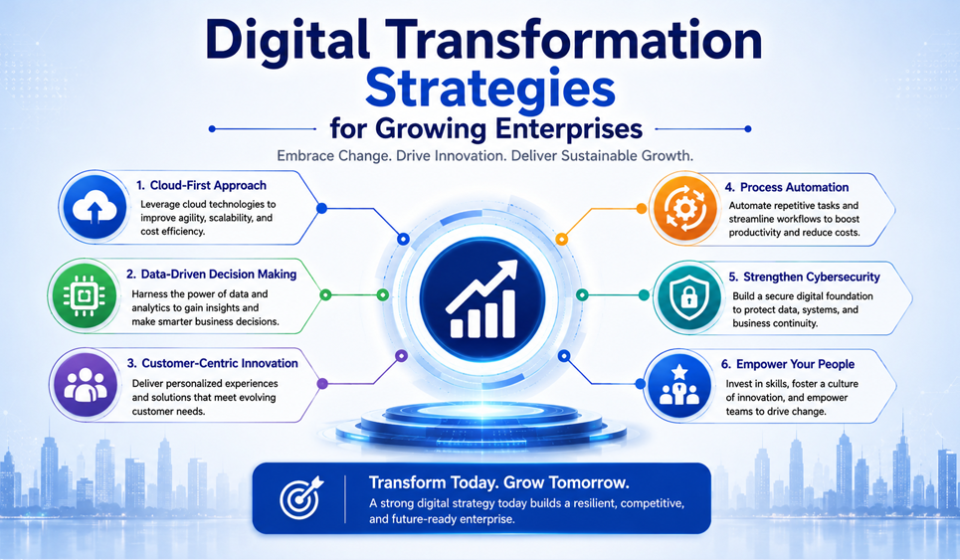

Digital transformation has become a critical business strategy for enterprises seeking sustainable growth, operational efficiency, and competitive advantage. As markets evolve rapidly and customer expectations continue to increase, growing enterprises face mounting pressure to modernize their operations, improve decision-making, enhance customer experiences, and streamline business processes. While many organizations recognize the importance of digital transformation, successful implementation requires more than adopting new technologies. Instead, it requires a comprehensive strategy that aligns people, processes, technology, and business objectives.
Many growing enterprises struggle with fragmented systems, manual workflows, limited visibility, rising operational costs, cybersecurity concerns, and changing customer demands. Consequently, these challenges often slow growth, reduce productivity, and impact profitability. However, organizations that embrace well-planned digital transformation strategies can overcome these obstacles while positioning themselves for long-term success.
Moreover, advancements in Artificial Intelligence (AI), Machine Learning (ML), Cloud Computing, Business Intelligence, Automation, and Data Analytics have created unprecedented opportunities for enterprises to transform their operations. Therefore, organizations that leverage these technologies strategically can accelerate growth, improve agility, and create exceptional customer experiences.
Understanding Digital Transformation in Growing Enterprises
Digital transformation refers to the integration of digital technologies across all business functions to fundamentally improve how organizations operate, deliver value, and interact with customers. Unlike simple technology upgrades, digital transformation involves rethinking business models, processes, workflows, and organizational culture.
As enterprises grow, operational complexity increases significantly. Departments generate vast amounts of data, customer interactions become more complex, and market competition intensifies. Consequently, traditional business processes often become inefficient and difficult to scale.
Digital transformation addresses these challenges by creating connected, intelligent, and data-driven business environments. As a result, organizations can improve operational performance, increase productivity, and respond more effectively to market changes.
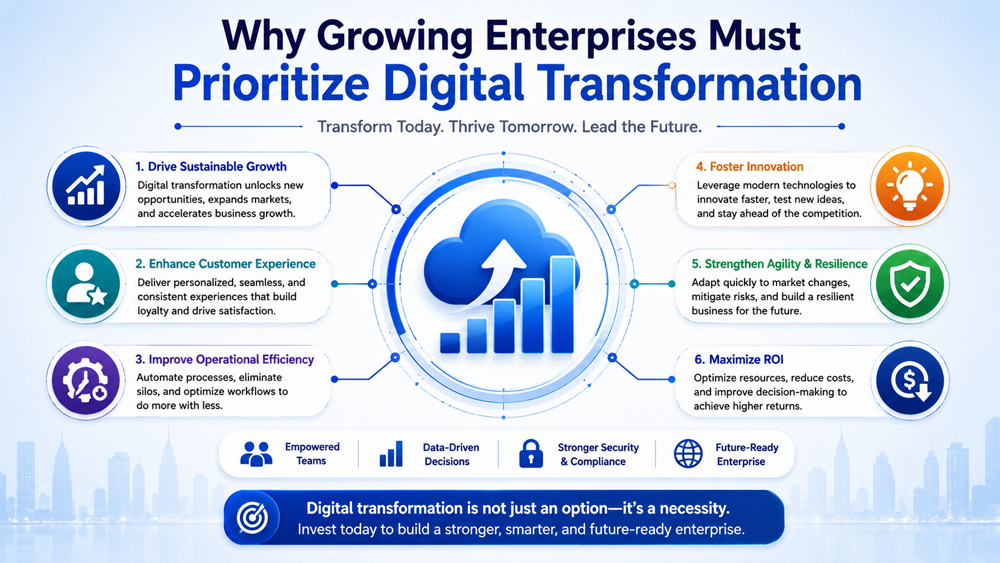
Why Growing Enterprises Must Prioritize Digital Transformation
Business growth often creates operational challenges that traditional systems cannot effectively manage. Although many organizations initially rely on spreadsheets, standalone applications, and manual processes, these approaches become increasingly problematic as business operations expand.
Managing Operational Complexity
As enterprises grow, departments become more interconnected. Sales teams depend on inventory data, finance departments require accurate operational insights, and customer service teams need real-time access to customer information. However, disconnected systems often create communication gaps and information silos. Consequently, decision-making becomes slower and less accurate. Digital transformation eliminates these barriers by integrating systems and enabling seamless information flow across the organization.
Meeting Changing Customer Expectations
Customers increasingly expect fast responses, personalized experiences, and seamless interactions across multiple channels. Organizations that fail to meet these expectations often lose customers to more agile competitors. Therefore, enterprises must leverage digital technologies to improve customer engagement and satisfaction.
Improving Competitive Advantage
Market competition continues to intensify across industries. Organizations that adopt digital transformation strategies can operate more efficiently, innovate faster, and respond more effectively to changing market conditions. As a result, they gain a significant competitive advantage.
Common Challenges Faced by Growing Enterprises
Fragmented Business Systems
Many enterprises operate with separate software applications for finance, inventory, customer management, procurement, and human resources. As a result, information becomes fragmented across multiple platforms. Employees spend considerable time searching for data, reconciling information, and correcting inconsistencies. Digital transformation addresses this challenge by integrating business applications into unified platforms.
Manual Processes Limiting Productivity
Manual workflows often create inefficiencies that hinder growth. Employees frequently perform repetitive tasks such as data entry, report generation, invoice processing, and approval management. Consequently, productivity decreases while operational costs increase. Automation technologies significantly reduce manual effort and improve efficiency.
Limited Data Visibility
Business leaders require accurate and timely information to make informed decisions. However, organizations relying on disconnected systems often struggle to obtain real-time insights. Therefore, decision-making becomes reactive rather than proactive. Digital transformation enables centralized data management and advanced analytics capabilities.
Scalability Constraints
Traditional infrastructure often struggles to support rapid business growth. As operational demands increase, organizations frequently encounter performance limitations and rising infrastructure costs. Cloud-based technologies provide scalable solutions that support future growth requirements.
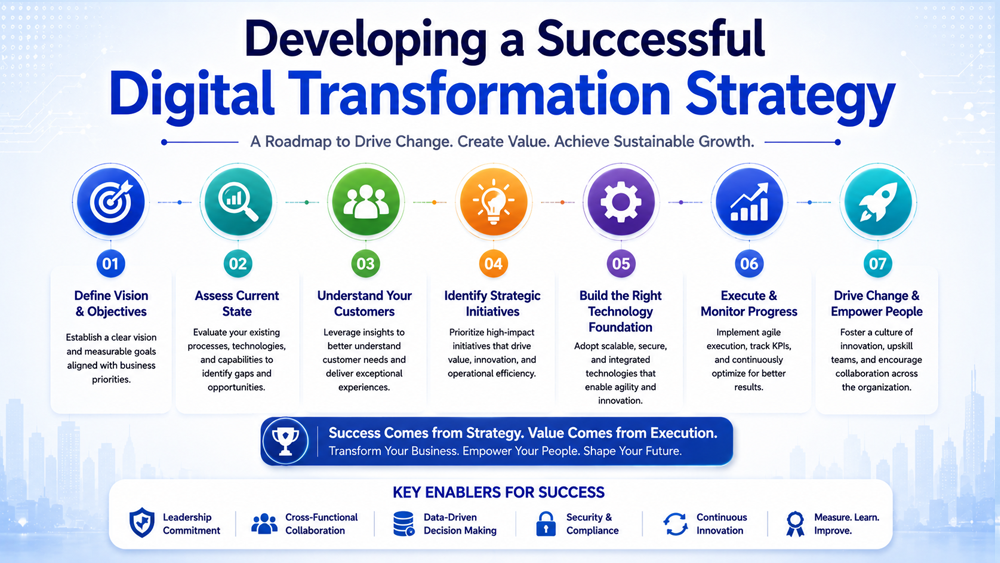
Developing a Successful Digital Transformation Strategy
Establishing Clear Business Objectives
Successful digital transformation begins with clearly defined business goals. Organizations must identify specific challenges they want to solve and measurable outcomes they aim to achieve. Whether the objective is improving customer satisfaction, reducing operational costs, increasing productivity, or accelerating revenue growth, having clear goals ensures alignment across all transformation initiatives. Furthermore, clearly defined objectives help organizations prioritize investments and measure success effectively.
Assessing Current Technology Infrastructure
Before implementing new technologies, enterprises must evaluate their existing systems, processes, and capabilities. This assessment helps identify operational inefficiencies, technology gaps, security vulnerabilities, and integration challenges. Consequently, organizations can develop realistic transformation roadmaps that align with business needs.
Creating a Digital Transformation Roadmap
A comprehensive roadmap provides structure and direction throughout the transformation journey. Rather than attempting large-scale changes simultaneously, organizations should implement transformation initiatives in manageable phases. This approach minimizes disruption while ensuring continuous progress toward strategic objectives.
The Role of Cloud Computing in Digital Transformation
Cloud computing serves as a foundational component of modern digital transformation strategies. Unlike traditional on-premises infrastructure, cloud platforms provide flexibility, scalability, and accessibility that support business growth.
Enhancing Business Agility
Cloud technologies enable organizations to deploy applications quickly and adapt to changing business requirements. Consequently, enterprises can respond faster to market opportunities and customer demands.
Supporting Remote and Hybrid Work Models
Modern work environments increasingly rely on remote and hybrid collaboration. Cloud-based applications provide secure access to business systems from any location. Therefore, employees can remain productive regardless of their physical location.
Reducing Infrastructure Costs
Cloud adoption eliminates many hardware and maintenance expenses associated with traditional infrastructure. As a result, organizations can allocate resources toward innovation and growth initiatives.
Leveraging Artificial Intelligence for Business Growth
Artificial Intelligence has become one of the most transformative technologies driving digital transformation. AI enables organizations to analyze large volumes of data, automate workflows, improve forecasting accuracy, and enhance decision-making.
AI-Powered Decision Intelligence
Business leaders often face complex decisions involving multiple variables. AI algorithms analyze historical trends, operational data, customer behavior, and market conditions to provide actionable recommendations. Consequently, organizations can make more informed strategic decisions.
Intelligent Process Automation
Many business processes involve repetitive and time-consuming activities. AI-powered automation reduces manual effort while improving accuracy and consistency. Therefore, employees can focus on higher-value activities that contribute directly to business growth.
Predictive Analytics and Forecasting
Predictive analytics helps organizations anticipate future outcomes based on historical data patterns. As a result, enterprises can optimize inventory levels, forecast demand, manage resources more effectively, and identify growth opportunities.
Data-Driven Transformation and Business Intelligence
Data has become one of the most valuable assets for growing enterprises. However, raw data alone provides limited value unless organizations can transform it into actionable insights. Business Intelligence platforms help organizations visualize data, monitor performance, identify trends, and support strategic decision-making. Consequently, leaders gain greater visibility into operations and market dynamics. Furthermore, real-time analytics enable organizations to respond proactively to emerging challenges and opportunities.
Enhancing Customer Experience Through Digital Transformation
Customer experience remains one of the most significant drivers of business success. Digital transformation enables organizations to deliver personalized, consistent, and responsive customer interactions.
Personalization at Scale
Customers increasingly expect personalized recommendations and tailored experiences. Digital technologies help organizations analyze customer preferences and behaviors, thereby enabling more relevant interactions.
Faster Customer Service
Automated customer support solutions, self-service portals, and intelligent chatbots improve response times and service quality. As a result, customer satisfaction and retention rates increase significantly.
Omnichannel Engagement
Customers interact with businesses through websites, mobile applications, social media, email, and other channels. Digital transformation ensures consistent experiences across all touchpoints, thereby strengthening customer relationships.
Strengthening Cybersecurity During Digital Transformation
As organizations become more digital, cybersecurity becomes increasingly important. Cyber threats continue to evolve, making proactive security measures essential. Digital transformation strategies should incorporate advanced security frameworks that include encryption, multi-factor authentication, threat monitoring, identity management, and compliance controls.
Furthermore, AI-powered cybersecurity solutions help organizations detect and respond to threats more effectively. Consequently, enterprises can protect sensitive data while maintaining customer trust.
Enterprise Resource Planning as a Digital Transformation Enabler
ERP solutions play a crucial role in digital transformation by integrating core business functions into a unified platform. Finance, inventory, procurement, human resources, sales, and operations become interconnected through centralized data management. As a result, organizations gain real-time visibility, improve collaboration, and streamline workflows. Moreover, modern ERP platforms incorporate AI, automation, and advanced analytics capabilities that further enhance business performance.
Building a Digital-First Organizational Culture
Technology alone cannot drive successful transformation. Organizations must also cultivate a culture that embraces innovation, collaboration, continuous learning, and adaptability. Leadership teams play a critical role in communicating transformation objectives and encouraging employee engagement. Furthermore, providing adequate training ensures employees can effectively utilize new technologies. Consequently, organizations achieve higher adoption rates and greater transformation success.
Measuring Digital Transformation Success
Measuring progress is essential for ensuring transformation initiatives deliver business value. Organizations should establish Key Performance Indicators that align with strategic objectives. These metrics may include operational efficiency improvements, customer satisfaction scores, revenue growth, productivity gains, cost reductions, and technology adoption rates. Regular performance evaluations help organizations identify opportunities for continuous improvement.
Future Trends Shaping Digital Transformation
Several emerging technologies will continue influencing digital transformation strategies. Artificial Intelligence will become increasingly integrated into business processes and decision-making frameworks. Machine Learning will enhance predictive capabilities and operational optimization.
Internet of Things technologies will improve real-time visibility across supply chains and operational environments. Advanced analytics will provide deeper business insights and support more accurate forecasting. Furthermore, hyperautomation will streamline increasingly complex workflows across multiple business functions. Organizations that proactively embrace these innovations will remain better positioned for long-term success.
Conclusion
Digital transformation is no longer optional for growing enterprises seeking sustainable growth, operational excellence, and competitive differentiation. By integrating cloud computing, artificial intelligence, automation, business intelligence, cybersecurity, and enterprise applications into a cohesive strategy, organizations can overcome operational challenges while unlocking new opportunities for innovation and expansion.
Moreover, successful digital transformation requires a balanced approach that aligns technology investments with business objectives, customer expectations, and organizational culture. Enterprises that prioritize digital transformation gain greater agility, improved decision-making capabilities, enhanced customer experiences, and stronger operational performance.
As markets continue to evolve and technological advancements accelerate, organizations that embrace strategic digital transformation initiatives will be better equipped to achieve long-term growth, profitability, and market leadership.
Frequently Asked Questions
What is digital transformation?
Digital transformation involves integrating digital technologies into business operations to improve efficiency, customer experiences, and overall performance.
Why is digital transformation important for growing enterprises?
It helps organizations improve productivity, reduce costs, enhance customer satisfaction, strengthen competitiveness, and support scalable growth.
How does AI support digital transformation?
AI improves automation, forecasting, decision-making, customer engagement, and operational efficiency through intelligent data analysis.
What role does cloud computing play in digital transformation?
Cloud computing provides scalability, flexibility, accessibility, and cost efficiency while supporting modern business operations.
How can enterprises measure digital transformation success?
Organizations can track operational efficiency, revenue growth, customer satisfaction, productivity improvements, and technology adoption rates.