Best ERP for Snack Manufacturers in India: Complete Buyer’s Guide

Choosing the best ERP for snack manufacturers in India is not simply about replacing accounting software. For a snack business, the real challenge is connecting raw-material purchasing, recipes, production, quality, batch traceability, inventory, sales, distribution and finance without losing control over cost, shelf life or product quality.
This matters because snack manufacturing operates on tight margins and fast-moving inventory. Oil, potatoes, flour, spices, packaging materials and other ingredients can change in price, while finished products have limited shelf life. At the same time, distributors expect quick deliveries, retailers expect consistent supply, and management needs accurate information before making purchasing or production decisions.
India’s snack market was estimated at ₹46,571 crore in 2025 and is projected to reach ₹1,01,811 crore by 2033, according to IBEF. The same source reports that the namkeen segment is expected to add significant value by 2029. Consequently, manufacturers are operating in a market where production efficiency, distribution reach and product consistency increasingly matter.
So, what should a snack manufacturer actually look for when buying ERP software?
What Is ERP for Snack Manufacturing and Why Do Spreadsheets and Tally Fall Short?
A snack manufacturing ERP connects manufacturing and business operations through a common system. Instead of maintaining separate spreadsheets for raw materials, production, batches, sales, distributor balances and finance, the ERP creates a connected flow of information.
Tally can remain useful for accounting and statutory financial processes. However, accounting alone does not tell a production manager how much edible oil is required for tomorrow’s production run, which potato lot went into a particular batch, how much yield was actually achieved or which finished-goods batches are approaching expiry.
Spreadsheets create another problem. They depend heavily on manual data entry and individual employee discipline. Consequently, one incorrect formula, delayed update or duplicated file can affect purchasing, production planning or inventory reporting.
The issue is therefore not whether Excel or accounting software is “bad”. The issue is whether they can provide the operational visibility required as a snack manufacturer becomes more complex. A manufacturing ERP brings those processes together so management can move from retrospective reporting to connected operational decision-making.
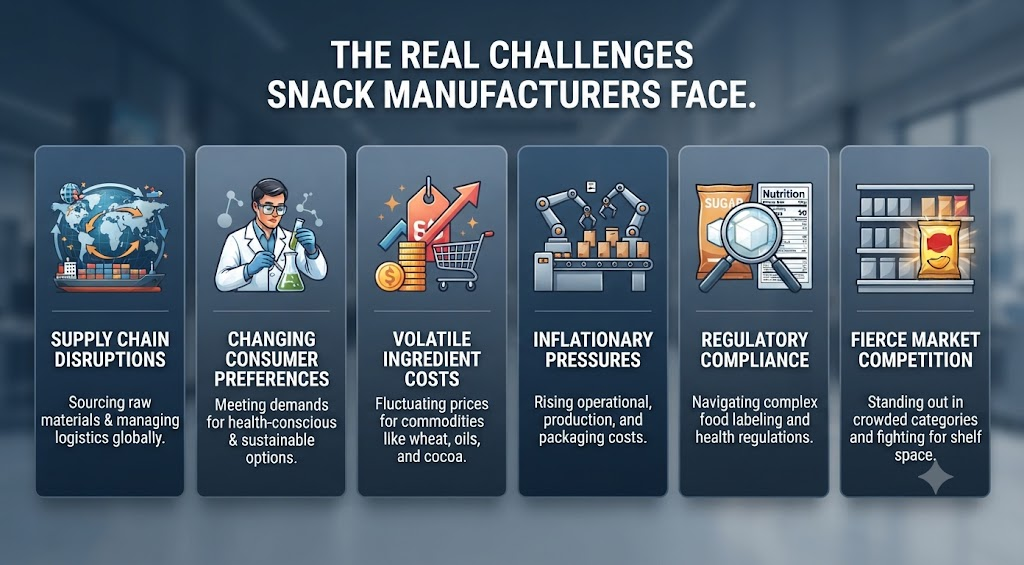
The Real Challenges Snack Manufacturers Face
Short Shelf Life Creates an Inventory Problem
Snack manufacturers cannot treat every kilogram of inventory as interchangeable. Finished namkeen, chips, wafers, mixtures and other packaged snacks have best-before dates. Therefore, inventory that remains in the warehouse for too long can become a financial loss even when the stock quantity appears healthy.
An ERP with expiry-aware inventory can track manufacturing dates, batch numbers and expiry information. With FEFO, or First Expiry, First Out, the system can help warehouse teams prioritize stock that expires earlier instead of simply issuing the oldest stock based on receipt date. That difference can directly improve inventory discipline.
Batch Traceability Cannot Depend on Memory
Food manufacturers need to know where ingredients came from and where finished products went. FSSAI guidance requires food businesses to maintain traceability systems using codes or lot numbers for incoming materials, packaging materials and finished products. FSSAI’s food recall regulations also require detailed records relating to recalled products, including batch or lot information, pack size, manufacture date and best-before or expiry information.
Therefore, batch traceability should not be treated as an optional reporting feature. A suitable ERP should allow a manufacturer to trace a finished-product batch backward to the relevant raw-material lots and forward to customers, distributors or sales transactions. This creates a much stronger foundation for quality investigations and recall readiness.
Raw-Material Prices Can Change the Product Cost
Oil, potatoes, flour, spices, pulses and packaging materials can influence the cost of a snack significantly. Suppose the recipe remains unchanged while edible-oil prices increase. The product may continue selling at the same price, but its margin can gradually decline. An ERP can connect purchase prices, inventory consumption, recipes and production costs. Consequently, management can monitor changes in material costs and understand how they affect product profitability.
Wastage and Yield Loss Can Remain Hidden
Snack production rarely converts every kilogram of raw material into saleable finished goods. Cleaning losses, frying losses, moisture changes, breakage, rejected pieces, processing losses and packaging variations can affect actual yield.
If the standard recipe says that a particular production quantity should produce a specific output, the ERP should allow actual production to be compared with expected yield. That makes abnormal wastage easier to investigate instead of allowing small losses to disappear into monthly accounts.
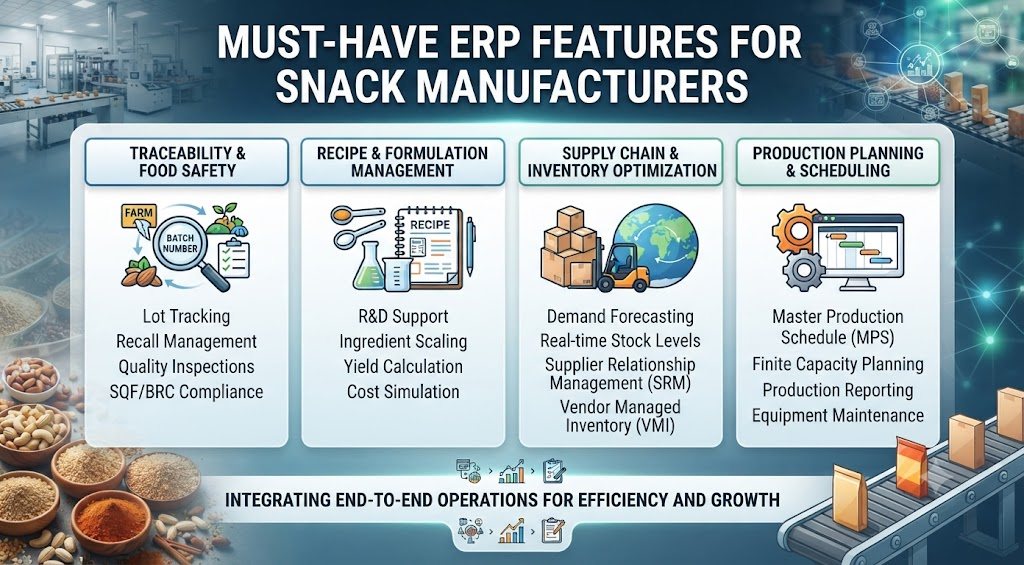
Must-Have ERP Features for Snack Manufacturers
Recipe and BOM Management With Yield Tracking
Recipe management should go beyond storing ingredient names. A snack manufacturing ERP should connect recipes or Bills of Materials with production quantities, raw-material consumption, packaging materials, expected output and actual yield. For example, if a manufacturer produces multiple flavours of the same snack, the system should support controlled recipe versions rather than forcing employees to maintain separate spreadsheets.
When production quantities change, the system should calculate material requirements accordingly. This provides a stronger foundation for production planning and costing.
Batch and Lot Traceability
Every important material and finished product should have an identifiable batch or lot relationship. The ERP should capture supplier lot information, production batch, manufacturing date, expiry or best-before date and finished-goods movement. Therefore, if a quality issue occurs, the manufacturer can investigate the affected material and finished-product batches much faster.
This is particularly important because FSSAI’s recall framework emphasizes documentation and traceability of affected food products.
Expiry-Based Inventory and FEFO
A normal stock report may show that a warehouse has 10,000 packets available. However, management also needs to know how much of that stock is nearing expiry. An ERP should therefore provide expiry-aware inventory visibility and FEFO-based picking. This helps warehouse teams prioritize products according to expiry rather than relying only on receipt dates.
FSSAI-Oriented Quality and Process Records
Quality checks should be connected to the production process. Depending on the manufacturer’s operation, the ERP can capture incoming-material inspections, in-process checks, finished-product quality results, rejected quantities and corrective actions. The objective is not simply to create more records. Instead, it is to make quality information available alongside production and batch information.
GST Billing and E-Invoicing
Snack manufacturers selling through distributors and business customers need reliable GST billing and invoicing processes. The current GST e-invoicing framework applies to notified taxpayers with aggregate annual turnover of ₹5 crore and above, subject to applicable rules and exemptions. The official e-invoice portal records the ₹5 crore threshold from 1 August 2023.
Therefore, an ERP should support GST-ready invoicing and integration with the applicable e-invoicing process rather than forcing the accounts team to repeatedly transfer information between systems.
Distributor, Route and Van Sales Management
For snack companies, manufacturing is only one side of the business. Products must move through distributors, wholesalers, retailers and sometimes direct van-sales teams. Consequently, an ERP should provide visibility into customer orders, distributor stock, sales routes, outstanding balances and delivery requirements. When sales information connects with inventory, production and finance, management can understand demand more accurately and reduce the disconnect between the factory and the market.
Trade Schemes and Promotions
Snack manufacturers often work with distributor margins, retailer incentives, promotional schemes and volume-based offers. If these calculations remain outside the ERP, profitability can become difficult to measure.
A suitable ERP should therefore connect schemes and commercial terms with sales transactions so management can understand the financial impact of promotions rather than evaluating sales volume alone.
Production Planning and Machine or Line Scheduling
Production planning becomes increasingly difficult when several products compete for the same machines, frying lines, packing machines or labour. ERP-based production planning can connect demand with available materials, production capacity and scheduling requirements.
AI-assisted forecasting can further help identify demand patterns, unusual sales movements and potential stock shortages. However, AI should support management decisions rather than replace operational controls or human validation.
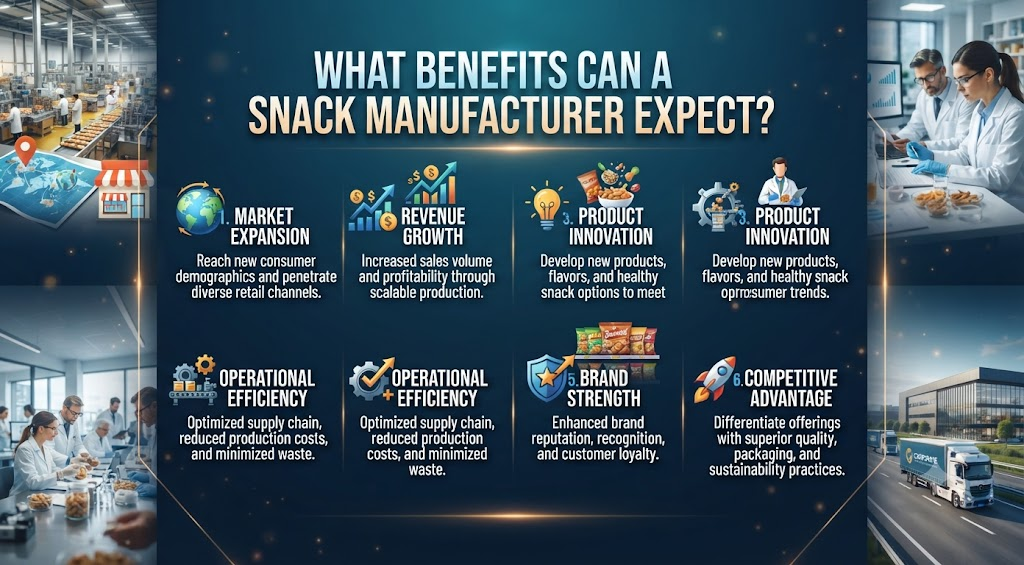
What Benefits Can a Snack Manufacturer Expect?
The value of ERP should be measured through operational outcomes rather than the number of modules purchased. For example, reducing avoidable wastage by even a small percentage can matter when a manufacturer purchases large volumes of edible oil, potatoes, flour, spices and packaging materials.
Likewise, faster order-to-delivery processing can improve distributor service, while better inventory visibility can reduce situations where one product is overstocked and another is unavailable. The exact percentage improvement will vary from company to company. Therefore, manufacturers should calculate their own baseline before implementation.
A useful business case can compare current wastage, stockouts, inventory ageing, order-processing time, production variance and accounting reconciliation time against the expected post-ERP performance.
How Much Does ERP Cost for Snack Manufacturers in India?
ERP pricing varies considerably depending on the number of users, modules, manufacturing complexity, number of locations, integrations, customization and deployment model. For a small or growing manufacturer, cloud ERP subscriptions can commonly start in the lower thousands of rupees per month, while more comprehensive manufacturing ERP implementations can move into several lakhs of rupees when implementation, customization, integrations, migration and training are included.
Instead of choosing an ERP only because it has a low monthly price, calculate the complete cost of ownership. For example, ask whether recipe management, batch traceability, production planning, distributor management, GST integration, mobile access, reports, support and future customization are included.
A ₹5,000 monthly system that requires multiple external tools may ultimately cost more than a connected ERP with a higher subscription price.
How to Choose the Best ERP for Your Snack Manufacturing Business
The best ERP is not necessarily the one with the longest feature list. It is the system that matches your actual production and distribution processes. Start by documenting how a typical product moves from raw-material purchase to production, quality inspection, packing, warehouse storage, distributor order and final sale. Then ask the ERP vendor to demonstrate that exact workflow.
Do not accept a generic presentation showing dashboards and screenshots. Ask the vendor to demonstrate a real snack-manufacturing scenario involving a recipe, raw-material batch, production order, actual yield, finished-product batch, expiry date, distributor order, GST invoice and accounting entry. This approach exposes gaps much faster.
Also evaluate implementation capability. A technically strong ERP can still fail when master data is incomplete, employees are not trained or business processes are poorly defined.
ERP Implementation Timeline and Common Mistakes
A straightforward snack manufacturing ERP implementation may take several weeks, while larger multi-location or heavily customized projects can take several months. The timeline normally depends on data preparation, process complexity, integrations, number of locations and customization requirements.
One common mistake is attempting to migrate every historical spreadsheet without cleaning the data first. Another is customizing the ERP before understanding whether the existing process itself needs improvement. Manufacturers should also avoid implementing finance first and leaving production for later when manufacturing visibility is the primary business requirement.
Instead, production, inventory, quality, sales and finance should be designed as connected processes.
Can AI Improve ERP for Snack Manufacturers?
Yes, but AI should solve practical problems rather than exist as a marketing label. For example, AI-assisted analytics can identify unusual consumption patterns, compare expected and actual production yields, flag abnormal inventory movements and help forecast demand using historical sales patterns.
AI can also support management by highlighting products that are selling faster than expected or materials whose consumption differs significantly from standard recipes. However, the underlying ERP data must be accurate first. Poor master data combined with AI does not create reliable business intelligence.
Therefore, the strongest approach is structured ERP data first, automation second and AI-driven decision support on top.
Frequently Asked Questions About ERP for Snack Manufacturers
Which ERP is best for snack manufacturers in India?
The right ERP should support recipe and BOM management, batch traceability, expiry-based inventory, production planning, quality management, GST, distributor sales and financial integration. The final choice should depend on the manufacturer’s production process, number of locations, distribution model, budget and customization requirements.
Can ERP replace Tally for a snack manufacturing company?
An ERP can integrate accounting with manufacturing, inventory, sales and operations. Whether it should completely replace an existing accounting system depends on the company’s current processes and the ERP’s accounting capabilities.
Does snack manufacturing ERP support batch tracking?
A manufacturing ERP can track raw-material lots, production batches and finished-product movements. This can support backward and forward traceability and make investigations or recalls more manageable.
What is FEFO in snack manufacturing?
FEFO means First Expiry, First Out. It prioritizes inventory with the earliest expiry or best-before date, making it particularly relevant for food and snack manufacturers.
How much does ERP cost for a snack manufacturer in India?
ERP costs vary based on users, modules, locations, customization, integrations and implementation requirements. Cloud subscriptions may start at a few thousand rupees per month, while comprehensive implementations can cost several lakhs. Vendors should provide a complete cost estimate rather than only quoting the subscription fee.
How long does it take to implement snack manufacturing ERP?
A smaller implementation can take several weeks, while complex multi-location or highly customized implementations can take several months. Data readiness and process complexity have a major influence on the timeline.
The Final Buying Decision Should Start With Your Factory
A snack manufacturer does not need ERP simply because competitors are adopting digital systems. The stronger reason is operational visibility. If your team is still calculating production requirements in spreadsheets, checking expiry manually, reconciling distributor information separately, tracking batch details across different files or discovering production-cost changes only after month-end closing, the business has already reached the point where disconnected systems can create unnecessary operational risk.
The right ERP should connect the factory floor with inventory, sales, distribution and finance. For growing snack manufacturers, that connection can create a much clearer view of what is being purchased, what is being produced, what is being wasted, what is approaching expiry, what is being sold and where the money is going. Before making a purchase, ask for a live demonstration using your own snack manufacturing workflow. That single step can reveal far more than a standard ERP presentation.
Ready to evaluate ERP for your snack manufacturing business? Book a free ERP consultation and ask the vendor to demonstrate recipe management, batch traceability, FEFO inventory, production planning, GST billing and distributor management using a realistic snack-manufacturing scenario.