ERP Implementation Case Study: How a Manufacturing Company Reduced Operating Costs by 35%

Manufacturing businesses are under constant pressure to produce more, reduce waste, improve quality, and respond faster to changing customer demands. Unfortunately, many companies continue to rely on disconnected software, spreadsheets, manual reporting, and outdated processes that increase operating costs instead of reducing them.
The result is predictable. Production delays become common. Inventory costs continue to rise. Decision-makers struggle to access real-time business data. Employees spend valuable hours on repetitive administrative work instead of focusing on production efficiency and customer satisfaction.
This ERP implementation case study explains how a mid-sized manufacturing company successfully reduced its operating costs by 35% through a carefully planned ERP implementation. More importantly, it highlights practical lessons that manufacturers can apply regardless of their industry.
If your organization is searching for ways to improve operational efficiency, increase profitability, and prepare for Industry 4.0, this guide provides actionable insights backed by current manufacturing trends and ERP best practices.
Why Manufacturing Companies Are Looking Beyond Traditional ERP Systems
Manufacturing has become significantly more complex over the last few years. Customer expectations have increased while profit margins continue to shrink. Supply chain disruptions, rising labor costs, fluctuating raw material prices, and growing compliance requirements make operational efficiency more important than ever.
According to recent industry research, manufacturers are increasingly investing in cloud ERP, AI-powered automation, predictive analytics, and real-time production monitoring because these technologies help improve operational visibility while reducing unnecessary expenses.
However, technology alone does not solve business problems.
Many ERP projects fail because companies automate inefficient processes instead of redesigning them. Therefore, successful ERP implementation begins with understanding existing operational challenges before introducing new technology.
The Company’s Challenge: Rising Costs Across Every Department
Consider a medium-sized discrete manufacturing company with approximately 250 employees producing industrial components for domestic and international customers. Although customer demand continued to increase, profitability steadily declined. Management discovered several recurring problems.
Production planning depended heavily on spreadsheets, causing frequent scheduling conflicts. Inventory records rarely matched actual warehouse stock, leading to excess inventory for slow-moving products while critical raw materials frequently ran out. Procurement teams struggled because supplier information remained scattered across multiple systems. Consequently, purchase orders took longer to process, and emergency purchases significantly increased procurement costs.
Meanwhile, finance teams spent several days every month consolidating reports manually. Since business data existed in separate software applications, managers rarely had access to accurate real-time information when making strategic decisions.
Furthermore, quality inspections relied on manual documentation. As a result, identifying the root cause of defects required considerable time and effort. Although every department worked hard, disconnected business processes created unnecessary operational expenses throughout the organization.
Identifying the Root Causes Instead of Treating Symptoms
Rather than purchasing software immediately, company leadership conducted a detailed operational assessment. The findings revealed that technology was not the primary issue. Instead, inefficient workflows, duplicate data entry, delayed approvals, poor production visibility, and inconsistent reporting contributed to rising operational costs. For example, warehouse staff manually updated inventory after production batches. Consequently, inventory data remained outdated throughout the day.
Similarly, production managers could not accurately predict machine utilization because maintenance schedules existed separately from production planning. Sales teams often promised unrealistic delivery dates because they lacked access to live production capacity. Each problem appeared isolated. Nevertheless, together they created significant financial losses across procurement, manufacturing, inventory management, finance, and customer service.
Recognizing these interconnected challenges became the foundation for a successful ERP implementation.
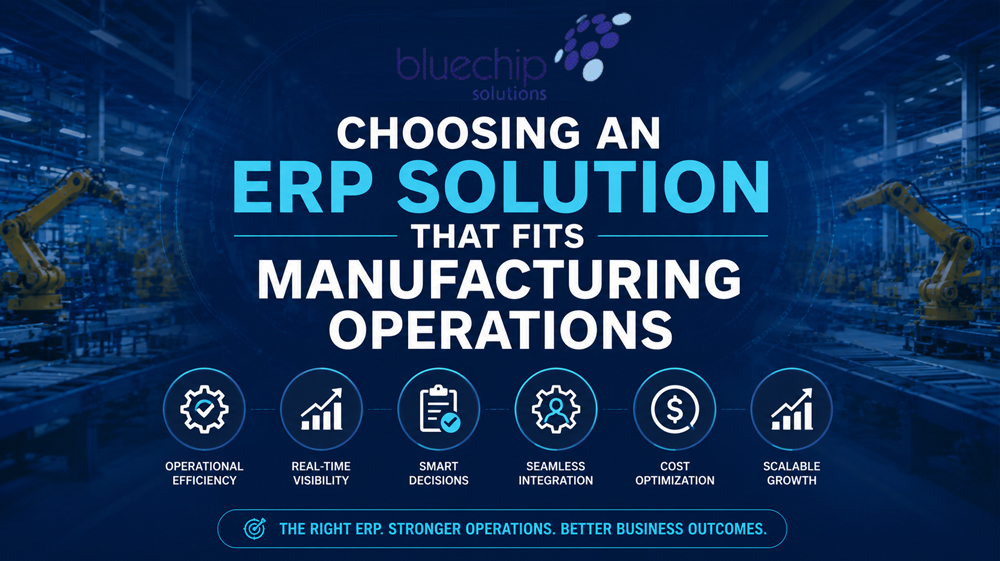
Choosing an ERP Solution That Fits Manufacturing Operations
Instead of selecting an ERP solely based on brand recognition, the company evaluated solutions according to business requirements. The chosen ERP platform provided integrated modules for production planning, inventory management, procurement, sales, finance, quality control, maintenance, human resources, and business intelligence.
More importantly, the system allowed workflow customization without expensive software redevelopment, enabling the organization to adapt processes as business requirements evolved. Cloud deployment also reduced infrastructure costs while allowing secure access from multiple manufacturing locations.
Because all departments now shared a centralized database, duplicate information disappeared, and reporting accuracy improved dramatically.
ERP Implementation Strategy That Minimized Business Disruption
One of the biggest concerns during ERP implementation is production downtime. Instead of deploying every module simultaneously, the company followed a phased implementation approach. Initially, inventory, procurement, and finance modules were implemented. Once these departments stabilized, production planning, quality management, maintenance, and sales modules were integrated.
Employee training remained a continuous process rather than a one-time event. Department managers actively participated in system design, workflow validation, and user acceptance testing. Consequently, employees felt involved instead of forced into organizational change. This significantly improved user adoption while reducing implementation risks.
How ERP Reduced Manufacturing Operating Costs by 35%
Better Inventory Visibility Reduced Holding Costs
Before ERP implementation, warehouse teams frequently overstocked raw materials because inventory accuracy remained unreliable. After implementing barcode-enabled inventory management with real-time stock updates, purchasing decisions became data-driven instead of assumption-based.
Safety stock levels were optimized automatically. Warehouse carrying costs decreased substantially because excess inventory gradually reduced while stock availability improved. Consequently, inventory investment generated better returns without affecting production continuity.
Intelligent Production Planning Improved Resource Utilization
Production scheduling previously depended on manual planning. Consequently, machines frequently remained idle while operators waited for materials or production approvals. ERP introduced automated production scheduling based on machine capacity, material availability, workforce allocation, and customer priorities. As a result, production utilization improved significantly.
Manufacturing lead times shortened while overtime expenses declined. Furthermore, production managers gained complete visibility into bottlenecks before they affected delivery commitments.
Procurement Automation Reduced Purchasing Expenses
Procurement teams previously contacted suppliers manually for every purchase requirement. Price comparisons required considerable administrative effort. ERP centralized supplier management, purchase requests, quotation comparisons, approval workflows, and purchase order generation.
Therefore, procurement teams negotiated better pricing while eliminating unnecessary emergency purchases. Supplier performance metrics also enabled better sourcing decisions over time.
Predictive Maintenance Reduced Equipment Downtime
Unexpected machine failures had previously interrupted production schedules. Maintenance teams usually responded only after equipment problems occurred. Following ERP implementation, preventive maintenance schedules became automated. Machine health indicators generated timely alerts before failures developed into expensive breakdowns. Consequently, equipment availability improved while maintenance costs gradually decreased. Production disruptions also reduced considerably.
Real-Time Business Intelligence Improved Decision Making
Managers previously waited until month-end to understand business performance. By then, many operational issues had already affected profitability. ERP dashboards now provide real-time KPIs covering production efficiency, inventory turnover, order fulfillment, procurement performance, quality metrics, and financial performance.
Since decision-makers receive live operational insights, they respond to business challenges immediately instead of reacting weeks later. This faster decision-making directly contributes to cost reduction and improved profitability.
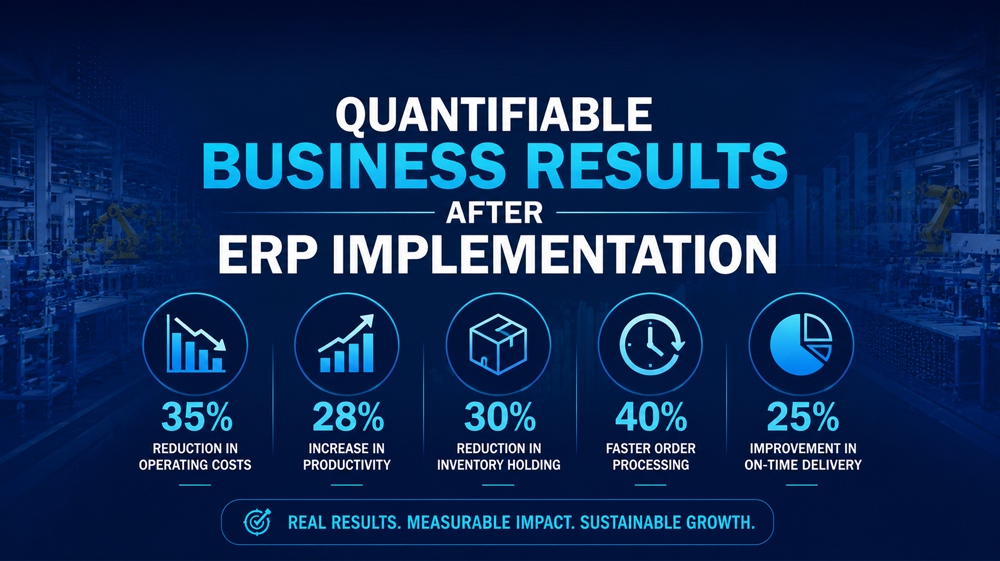
Quantifiable Business Results After ERP Implementation
Within twelve months of ERP implementation, measurable business improvements became evident. Operating costs reduced by approximately 35% through lower inventory expenses, optimized procurement, improved production planning, reduced administrative effort, and minimized equipment downtime. Production efficiency increased because scheduling became more accurate.
Order fulfillment improved due to better inventory visibility. Financial reporting that previously required several days became available almost instantly through automated dashboards. Customer satisfaction also increased because delivery commitments became more reliable. Perhaps most importantly, management gained complete confidence in business data, enabling strategic decisions supported by accurate information rather than assumptions.
Common Manufacturing Pain Points ERP Solves
Many manufacturing companies continue experiencing similar operational challenges. Production planning often becomes difficult because departments operate independently. Inventory discrepancies lead to unnecessary purchases and production delays. Manual approval workflows slow procurement activities. Quality issues remain hidden until customer complaints arise.
Financial reports take too long to generate. Business leaders lack visibility into operational performance. Modern ERP platforms eliminate these challenges by integrating every business function into a single digital ecosystem. Instead of managing departments individually, organizations begin managing end-to-end business processes. That shift creates sustainable operational efficiency rather than temporary improvements.
Emerging ERP Trends Every Manufacturer Should Know
Manufacturing ERP continues evolving rapidly with AI and intelligent automation becoming standard business capabilities. Artificial Intelligence now helps predict production bottlenecks, forecast inventory demand, recommend procurement quantities, detect quality deviations, and optimize production schedules. Machine Learning continuously improves forecasting accuracy by analyzing historical production data.
Internet of Things (IoT) integration enables real-time monitoring of manufacturing equipment, helping organizations reduce downtime through predictive maintenance. Generative AI also assists employees by simplifying report generation, workflow recommendations, and operational analysis.
Meanwhile, no-code ERP platforms allow businesses to customize workflows much faster while reducing implementation costs compared to traditional software development. Organizations adopting these technologies are positioning themselves for greater agility, resilience, and long-term competitiveness.
How to Ensure ERP Implementation Success
Technology alone does not guarantee successful digital transformation. Organizations should first document business processes before selecting ERP software. Executive leadership must actively support organizational change throughout implementation. Employees should receive practical role-based training instead of generic software demonstrations. Implementation partners should understand manufacturing operations rather than simply installing software.
Continuous performance measurement ensures that ERP delivers measurable business improvements long after deployment. Companies that combine technology with process improvement consistently achieve stronger returns on ERP investments.
Is Your Manufacturing Business Ready to Reduce Operating Costs?
If your manufacturing company still relies on disconnected software, spreadsheets, manual reporting, or outdated production planning, operational costs will likely continue increasing. A modern ERP solution helps unify production, inventory, procurement, finance, sales, quality, maintenance, and management reporting into one intelligent platform. Rather than reacting to problems after they occur, manufacturers gain the visibility needed to prevent inefficiencies before they impact profitability.
The companies achieving sustainable growth are not necessarily producing more. Instead, they are operating smarter with integrated business processes, AI-powered insights, and data-driven decision-making.
Conclusion
Reducing manufacturing operating costs is no longer about cutting resources. Instead, it is about eliminating inefficiencies, improving visibility, and enabling faster decisions through integrated digital operations.
This case study demonstrates that the right ERP implementation can reduce operating costs by 35% while improving productivity, inventory accuracy, customer satisfaction, and overall business performance.
Manufacturers that invest in scalable, AI-ready ERP platforms today will be better prepared for future market challenges, changing customer expectations, and increasingly competitive global markets.
Whether you are planning your first ERP implementation or replacing an outdated legacy system, choosing a flexible, industry-focused solution can become one of the most valuable long-term investments for your manufacturing business.
Ready to Transform Your Manufacturing Business?
Looking for an ERP solution designed specifically for manufacturers?
Book a FREE ERP Consultation and discover how your business can:
- Reduce operating costs by up to 35%
- Improve production planning and inventory accuracy
- Automate procurement, finance, and quality management
- Gain AI-powered business insights
- Scale faster with a modern No-Code ERP platform
Request a Personalized Demo: https://bluechipsolutions.in/contact-us.php