How AI Agents Are Transforming ERP Systems: The Future of Intelligent Business Automation

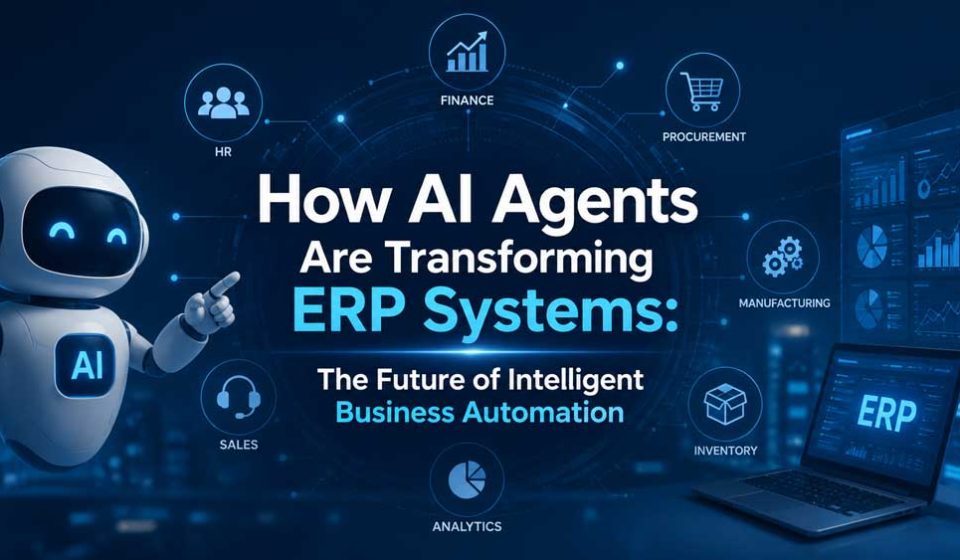
Enterprise Resource Planning (ERP) systems have long served as the backbone of modern business operations, integrating finance, inventory, manufacturing, sales, procurement, human resources, and customer service into a single platform. However, despite investing in ERP software, many organizations continue to face challenges such as slow decision-making, manual approvals, repetitive tasks, inaccurate forecasting, and disconnected workflows. This is where AI Agents are transforming ERP systems, enabling businesses to automate complex processes, deliver real-time insights, improve operational efficiency, and make faster, data-driven decisions. By combining intelligent automation with predictive analytics, AI-powered E
Artificial Intelligence (AI) Agents are changing this reality. Unlike traditional automation that follows predefined rules, AI Agents can understand business context, analyze large volumes of data, make intelligent recommendations, initiate workflows, and continuously improve through learning. As businesses demand faster execution, lower operational costs, and better customer experiences, AI-powered ERP systems are becoming a competitive necessity rather than a future investment.
This comprehensive guide explains how AI Agents are transforming ERP systems, the challenges they solve, their real-world applications, and why organizations are rapidly adopting AI-driven ERP solutions to achieve operational excellence.
What Are AI Agents in ERP Systems?
AI Agents are intelligent software assistants that can perform business tasks autonomously or semi-autonomously within an ERP ecosystem. They combine technologies such as Machine Learning (ML), Large Language Models (LLMs), Natural Language Processing (NLP), predictive analytics, workflow automation, and enterprise data integration to assist employees in making faster and more accurate decisions.
Unlike conventional ERP automation, AI Agents understand business objectives, interpret user requests, analyze historical data, predict future outcomes, and execute approved actions across multiple departments.
For example, instead of generating a monthly inventory report, an AI Agent can identify products likely to run out of stock, recommend reorder quantities, negotiate supplier priorities based on historical performance, and notify procurement teams before production is affected. This shift transforms ERP from a passive transaction management system into an active business intelligence platform.
Why Traditional ERP Systems Are No Longer Enough
Many organizations invested heavily in ERP software expecting complete operational efficiency. While ERP successfully centralizes business data, several operational challenges continue to impact productivity.
Managers often spend hours reviewing reports before making decisions. Employees manually enter data across multiple modules. Purchase approvals move slowly because they depend on email communication. Inventory planning frequently relies on assumptions instead of predictive insights. Customer service teams struggle to access complete information quickly.
As businesses grow, manual processes become increasingly expensive, time-consuming, and vulnerable to human error, leading to operational inefficiencies and delayed decision-making. How AI Agents Are Transforming ERP Systems is evident in their ability to automate repetitive tasks, analyze business data in real time, and deliver intelligent recommendations that improve productivity, enhance accuracy, and drive better business outcomes across every department.
How AI Agents Transform ERP Systems
AI Agents Enable Intelligent Decision-Making
Traditional ERP systems provide data, but users must analyze it themselves. AI Agents continuously evaluate business performance, compare historical trends, identify anomalies, and recommend actions before problems escalate.
For example, if production costs increase unexpectedly, the AI Agent can analyze supplier pricing, raw material consumption, labor costs, machine utilization, and delivery schedules simultaneously. Instead of waiting for monthly reports, managers receive immediate recommendations explaining why costs increased and how to reduce them.
Consequently, executives make faster decisions supported by real-time intelligence rather than assumptions.
AI Agents Automate Complex Business Workflows
Business workflows rarely involve only one department. A customer order may require inventory verification, production planning, procurement approval, logistics scheduling, invoice generation, and customer notification. Traditional ERP systems automate only predefined steps.
AI Agents monitor the entire workflow, identify bottlenecks, communicate with different departments, escalate pending approvals, and automatically execute the next business process when predefined conditions are satisfied. As a result, organizations reduce operational delays while improving customer satisfaction.
Predictive Inventory Management Eliminates Stock Problems
Inventory management remains one of the biggest operational challenges across manufacturing, distribution, retail, and wholesale industries. Excess inventory increases storage costs, whereas inventory shortages delay customer deliveries.
AI Agents analyze historical sales, seasonal demand, supplier lead times, production schedules, market trends, customer purchasing behavior, and external business conditions simultaneously. Instead of reacting after inventory issues occur, businesses receive predictive recommendations for procurement, warehouse optimization, and production planning.
This proactive inventory management significantly improves cash flow while reducing waste.
AI-Powered Financial Management Improves Accuracy
Finance departments often spend considerable time reconciling transactions, preparing reports, reviewing expenses, and identifying anomalies. AI Agents automatically categorize financial transactions, detect unusual spending patterns, identify duplicate invoices, forecast cash flow, monitor outstanding receivables, and generate financial insights.
Additionally, how AI Agents are transforming ERP systems becomes evident in financial management, where AI-powered ERP solutions analyze historical financial data to predict future revenue trends, improve cash flow forecasting, and help organizations prepare more accurate budgets. As a result, finance teams spend less time on repetitive accounting activities and more time on strategic planning, financial optimization, and data-driven business decisions.
Intelligent Procurement Reduces Purchasing Costs
Supplier management has become increasingly complex due to global supply chain disruptions. AI Agents continuously evaluate supplier performance by analyzing delivery timelines, product quality, pricing history, contract compliance, and procurement trends. Rather than selecting suppliers based solely on price, AI Agents recommend vendors offering the best overall business value. Furthermore, AI Agents notify procurement teams when supplier risks increase, allowing organizations to avoid production interruptions.
AI Agents Optimize Manufacturing Operations
Manufacturing organizations generate enormous volumes of operational data every day. Machine performance, production schedules, quality inspections, maintenance logs, labor productivity, and raw material usage all influence manufacturing efficiency.
AI Agents monitor production continuously and detect inefficiencies before they impact output. For instance, AI Agents can predict equipment failures based on sensor data, recommend preventive maintenance schedules, optimize machine utilization, and balance production workloads automatically. As a result, manufacturers experience lower downtime, improved product quality, and increased production capacity.
Customer Service Becomes Faster and More Personalized
Customer expectations continue to rise. Customers expect immediate responses regarding orders, invoices, product availability, delivery schedules, warranty status, and service requests. AI Agents integrated with ERP systems provide instant access to customer information across departments.
Instead of transferring customers between teams, AI Agents retrieve order history, shipment tracking, payment status, previous interactions, and support records within seconds. Consequently, businesses resolve customer queries faster while improving customer loyalty.
AI Agents Across Different ERP Modules
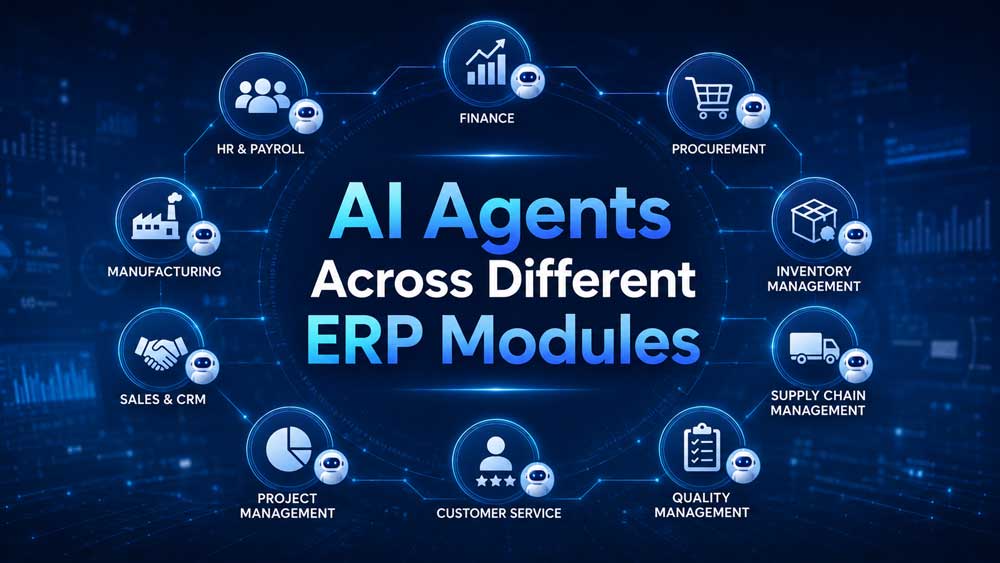
AI Agents create value across every department because they operate on unified enterprise data. Within Finance, they forecast cash flow, identify fraud risks, automate reconciliations, and improve budgeting accuracy. Within Inventory Management, they optimize stock levels, predict shortages, and automate replenishment. Inside Manufacturing, they monitor production efficiency, predict maintenance, and improve quality control.
Within Human Resources, AI Agents screen resumes, automate employee onboarding, answer HR policy questions, and identify workforce trends. Sales teams benefit from lead prioritization, sales forecasting, pricing recommendations, and customer behavior analysis. Meanwhile, Procurement departments receive intelligent supplier recommendations, contract monitoring, and purchasing optimization. This enterprise-wide intelligence creates a connected organization where every department benefits from AI-powered insights.
Real-World AI Agent Use Cases in ERP
Across industries, organizations are already using AI Agents to improve operational performance. Manufacturers use AI Agents to predict machine failures and optimize production schedules. Retail businesses forecast customer demand with greater accuracy to reduce inventory costs. Construction companies monitor project budgets, labor utilization, equipment allocation, and procurement schedules through intelligent ERP assistants.
Healthcare organizations automate patient scheduling, inventory planning, compliance monitoring, and procurement management. Financial institutions use AI Agents to automate document verification, compliance checks, and financial reporting. These implementations demonstrate that AI-powered ERP is delivering measurable business value today rather than remaining a future concept.
Business Benefits of AI-Powered ERP Systems
Organizations implementing AI Agents within ERP environments consistently achieve significant operational improvements.
Routine manual work decreases because repetitive processes become automated. Decision-making accelerates since AI continuously analyzes business data. Forecast accuracy improves through predictive analytics. Operational costs decline as inefficiencies are identified earlier. Customer satisfaction increases because responses become faster and more accurate. Employee productivity rises because teams focus on strategic responsibilities instead of repetitive administrative tasks.
Furthermore, businesses gain greater visibility into every operational process, enabling executives to make confident decisions based on real-time intelligence rather than outdated reports.
Challenges Businesses Should Prepare For
Although AI Agents provide remarkable advantages, successful implementation requires careful planning. High-quality data remains essential because AI models depend on accurate business information. Organizations should eliminate duplicate records, standardize master data, and improve data governance before deployment.
Additionally, employees should receive adequate training to work alongside AI-powered systems rather than viewing automation as a replacement. Strong cybersecurity measures, role-based access controls, and AI governance policies also become increasingly important as organizations automate critical business operations.
Companies that combine AI technology with effective change management typically achieve the highest return on investment.
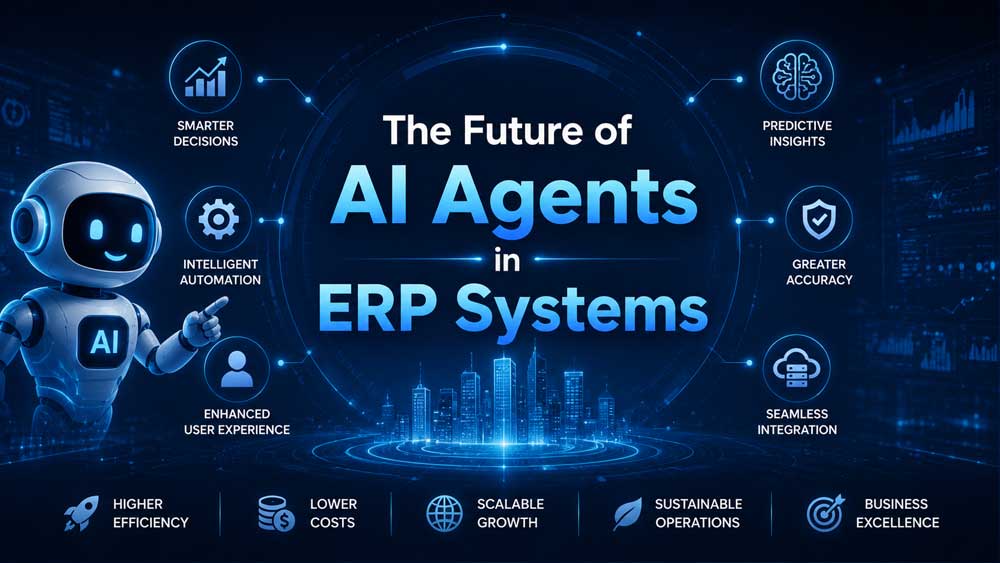
The Future of AI Agents in ERP Systems
According to industry analysts, AI-powered ERP platforms are evolving rapidly as Generative AI, autonomous agents, predictive analytics, and intelligent workflow automation become standard enterprise capabilities. Businesses are increasingly adopting AI to streamline operations, improve forecasting, and enhance decision-making, while major ERP vendors continue embedding AI assistants and agentic capabilities directly into their platforms.
Future ERP systems will not simply record transactions.
They will recommend business strategies, negotiate with suppliers through intelligent workflows, coordinate production schedules, optimize logistics, detect operational risks, generate executive summaries, and support employees using conversational interfaces.
As AI Agents continue learning from enterprise data, ERP software will evolve into a continuously improving digital business partner. Organizations adopting AI-powered ERP early will gain a substantial competitive advantage through increased agility, operational efficiency, and data-driven decision-making.
Why Businesses Should Invest in AI-Powered ERP Now
Waiting to modernize ERP often results in higher operational costs, slower decision-making, and missed growth opportunities. Organizations that adopt AI Agents today position themselves to respond faster to market changes, improve customer experiences, optimize resources, and scale with confidence.
An AI-powered ERP is no longer just software for recording transactions. It is an intelligent business platform that continuously analyzes operations, predicts future challenges, recommends improvements, and automates complex processes across the enterprise.
Businesses that embrace AI-driven ERP will be better equipped to compete in an increasingly data-driven economy.
Ready to Transform Your Business with AI-Powered ERP?
If your organization is struggling with manual processes, disconnected systems, delayed decisions, or inefficient workflows, now is the time to explore an AI-powered ERP solution.
Bluechip Solutions’ ProfitPlus Cloud ERP combines advanced ERP capabilities with AI-driven automation, intelligent analytics, workflow optimization, and industry-specific solutions to help businesses improve productivity and accelerate growth.
Book a Free ERP Demo to discover how AI Agents can automate your business processes, reduce operational costs, and improve decision-making.