
Manufacturing growth can create a difficult operational paradox: more orders generate more revenue potential, but they also create more production complexity. As order volumes increase, spreadsheets become harder to control, inventory information becomes less reliable, production schedules change more frequently, and management spends more time asking for updates instead of making decisions.
That is why choosing the right manufacturing ERP software is no longer simply an IT decision. It is an operational decision that directly affects production efficiency, inventory investment, delivery performance, quality, and profitability.
Recent manufacturing research reinforces this shift. KPMG’s 2026 industrial manufacturing technology report found that 49% of surveyed executives already have AI use cases delivering business value, while 76% still identify unreliable data as a major AI risk. Meanwhile, PwC’s 2026 research highlights a growing need for real-time intelligence as connected plants become more dependent on rapid operational decisions.
For growing manufacturers, therefore, the question is not simply, “Do we need an ERP?” The more important question is, “Does our ERP give us the control and intelligence we need as production becomes more complex?”
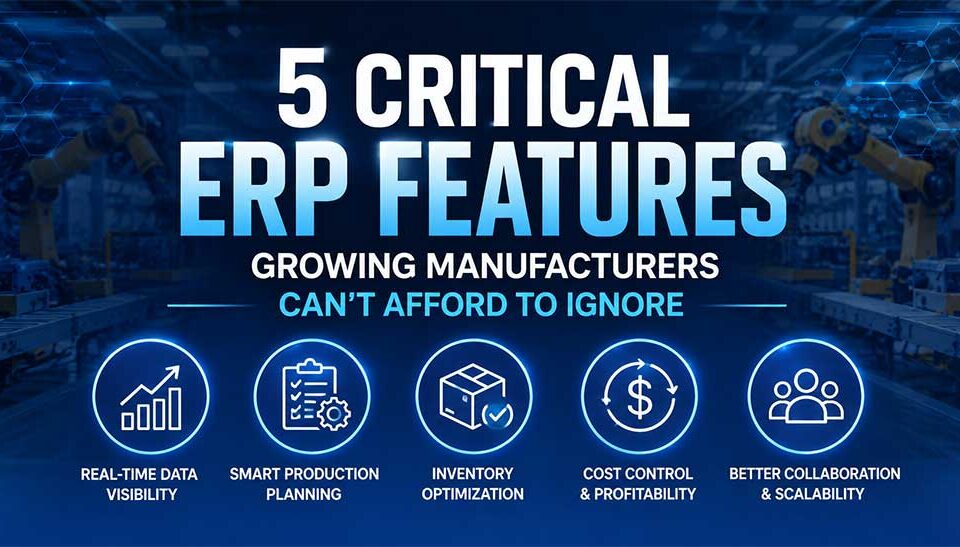
Here are five critical ERP features manufacturers should evaluate before their current systems become a growth constraint.
1. Real-Time Production Planning and Scheduling
One of the biggest problems manufacturers face while scaling is the difference between the production plan on paper and what is actually happening on the shop floor. A production schedule may look perfectly achievable in the morning. However, a machine can become unavailable, a supplier can delay material, an urgent customer order can arrive, or an operator shortage can change the situation within hours.
If planners are working with spreadsheets or manually updated reports, they may discover the problem only after production has already fallen behind. A modern manufacturing ERP should therefore provide real-time production planning and scheduling that connects customer demand, material availability, machine capacity, work orders, labour availability, and production progress.
Why real-time scheduling matters
Suppose a manufacturer receives an urgent order that needs to be delivered within five days. The sales team sees the order, but the production planner needs to determine whether raw materials are available, whether the required machine has capacity, whether existing orders can be moved, and whether the revised schedule will affect other commitments.
Without integrated ERP data, this becomes a chain of phone calls, spreadsheets and manual calculations. With connected ERP data, the planner can evaluate the impact much faster. AI is also making this capability more valuable. Modern ERP and MES solutions are increasingly using AI-supported sequencing to evaluate different production sequences and recommend schedules based on capacity, workload and changing order conditions.
The solution: Look for an ERP that provides live production status, capacity visibility, work-order tracking, material availability and what-if planning rather than simply displaying a static production calendar.
2. Intelligent Inventory and Material Requirements Planning
Inventory problems rarely appear as simply “too much stock” or “too little stock.” Growing manufacturers usually experience both at the same time. A company might have excess inventory of slow-moving materials while production stops because one critical component is unavailable. Consequently, working capital increases while customer deliveries are still delayed.
This is where ERP inventory management and MRP become essential. A manufacturing ERP should connect sales demand with bills of materials, existing stock, open purchase orders, supplier lead times, minimum stock levels and production requirements. This allows planners to understand not only what is currently available but also what will be required next.
Moving from inventory visibility to inventory intelligence
Traditional inventory software answers questions such as:
“How much stock do we have?” A stronger manufacturing ERP should also help answer:
“What will we need?” “When will we need it?” “Which production orders could be affected?” “Which materials are becoming critical?” “Where is excess inventory accumulating?”
That distinction is increasingly important because supply-chain volatility continues to affect manufacturing costs and delivery commitments. Deloitte has identified supply-chain agility, digital planning and better visibility as continuing priorities for manufacturers.
AI can further strengthen this process by analysing historical consumption, demand patterns, lead times and purchasing behaviour. However, AI is only useful when the underlying ERP data is accurate. KPMG’s 2026 research specifically highlights unreliable data as a major barrier to scaling AI in industrial manufacturing.
The solution: Choose an ERP that combines inventory management, BOMs, MRP, purchasing and production requirements in one connected data environment. The objective should be lower stock risk without creating material shortages.
3. End-to-End Traceability and Quality Management
As manufacturers grow, quality problems become more expensive. A small production issue that was once resolved informally can become a major business problem when the company is serving multiple customers, operating several production lines or supplying regulated industries.
For example, if a customer reports a defective batch, management should be able to identify the relevant raw-material lot, supplier, production order, machine or process, inspection result and shipment history without spending hours searching through paper records. This makes manufacturing traceability one of the most important ERP capabilities for growing businesses.
Why batch, lot and serial traceability matters
A strong ERP should create a digital chain from incoming material to finished product. That means the system should connect purchasing, goods receipt, batch or lot information, production consumption, quality inspections, finished-goods inventory and customer shipment. This creates both forward and backward traceability.
If a supplier’s material is later discovered to have a quality issue, the manufacturer should be able to identify which products used that material. Similarly, if a finished product fails in the field, the manufacturer should be able to trace it back through production and material records.
Modern ERP selection guidance increasingly treats lot and serial control, genealogy, quality workflows and digital audit trails as core manufacturing capabilities rather than optional extras. The solution: Select an ERP with integrated quality management, batch or serial tracking, inspection records, revision control and complete production history. This does more than support compliance. It reduces investigation time, improves customer confidence and helps manufacturers identify recurring process problems before they become expensive.
4. Real-Time Shop-Floor Visibility and Performance Analytics
Management cannot improve what it cannot see. Yet many growing manufacturers still depend on supervisors manually collecting production figures and sending reports at the end of a shift. By the time management receives the information, the opportunity to correct the problem may already have disappeared.
For example, if a production line is running below its expected output at 10:00 a.m., management needs to know then—not at the end of the day. A modern manufacturing ERP should therefore connect business processes with shop-floor visibility and real-time manufacturing analytics.
From reports to actionable decisions
A useful manufacturing dashboard should make it easy to understand production status, planned versus actual output, work-order progress, downtime, rejection, scrap, capacity utilisation and delivery risks. However, dashboards alone are not enough. The real value comes when the ERP connects the information to business processes.
If production falls behind, the system should help identify the affected orders and if material consumption is higher than expected, management should be able to investigate the relevant product or process. If quality rejection increases, the business should be able to identify where the variance originated.
This is also where AI can move ERP from passive reporting toward decision support. Recent manufacturing developments show ERP platforms increasingly being used to support production planning, warehouse decisions and supply-chain responses rather than simply recording transactions.
The solution: Prioritise ERP platforms that provide real-time operational dashboards, mobile access, alerts, exception reporting and analytics connected directly to transactional data. The goal is simple: managers should spend less time collecting information and more time acting on it.
5. AI-Ready Integration, Automation and Scalability
An ERP can work perfectly today and still become a problem tomorrow if it cannot adapt to business growth. Growing manufacturers frequently add new products, machines, locations, customers, suppliers, workflows and reporting requirements. Consequently, an ERP that requires expensive custom development for every change can become increasingly difficult to maintain. This is why ERP scalability, integration and AI readiness deserve serious attention during ERP selection.
Why AI-ready ERP matters
AI is rapidly moving beyond experimental projects. McKinsey’s recent analysis describes a shift toward AI being integrated into ERP and enterprise workflows rather than remaining isolated in small use cases. However, manufacturers should not choose an ERP simply because a vendor says it has AI. The more important question is whether the ERP has the data foundation required for useful AI.
For example, AI-based demand forecasting requires reliable sales and inventory history. Predictive maintenance requires dependable equipment and production data. Intelligent scheduling requires accurate capacity, routing and order information. Therefore, integration, APIs, structured data, workflow automation and configurable processes are becoming increasingly important.
No-code and low-code flexibility can reduce the growth barrier
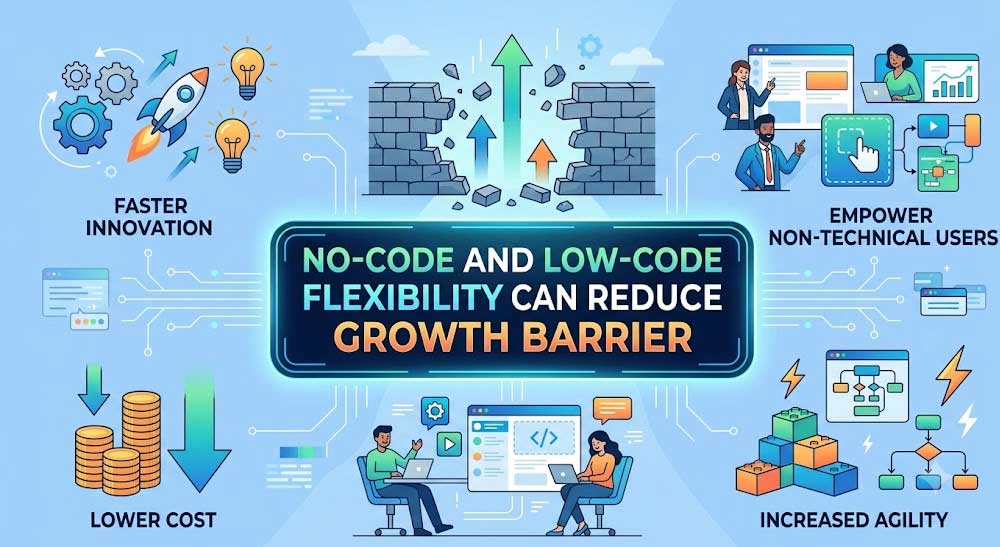
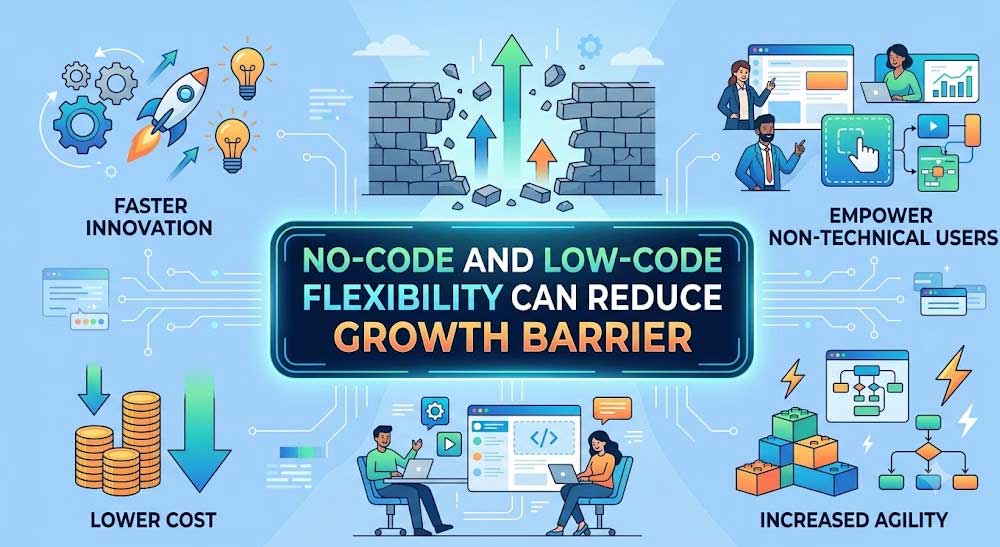
Manufacturers often have processes that are unique to their business. A standard ERP workflow may cover 80% of the requirement while the remaining 20% contains the processes that actually differentiate the company. A flexible no-code or low-code ERP approach can allow businesses to adapt workflows, forms, approvals, reports and applications without repeatedly rebuilding the underlying system.
This becomes particularly valuable when the business is growing quickly and cannot afford long development cycles for every operational change. The solution: Evaluate whether the ERP supports APIs, integrations, configurable workflows, automation, mobile access, analytics and AI-ready data structures. Scalability should mean more than handling additional users; it should mean adapting to new business requirements without constantly restarting implementation projects.
How These 5 ERP Features Work Together
The real advantage does not come from purchasing five independent features. It comes from connecting them.Imagine a customer order arrives. The ERP identifies demand, checks inventory, calculates material requirements, evaluates production capacity, schedules the work, tracks shop-floor progress, records quality information and updates costing.
If a material shortage occurs, purchasing can see it also production falls behind, planning can react and If quality problems emerge, traceability can identify affected batches. If demand changes, AI-assisted planning can help evaluate the impact. That connected workflow is what turns an ERP from an accounting or reporting system into a manufacturing management platform.
PwC’s 2026 research similarly points toward manufacturing architectures that combine stable systems of record with rapidly evolving intelligence and AI layers, reflecting the growing importance of real-time decision-making in connected plants.
How to Know If Your Current ERP Is Becoming a Growth Constraint
Your ERP may need attention if planners regularly maintain production schedules in Excel, inventory numbers require manual reconciliation, production reports arrive hours or days late, quality investigations depend on paper records, or management cannot quickly determine the financial impact of a production problem.
Another warning sign is excessive dependence on manual workarounds. When employees repeatedly export ERP data into spreadsheets, manually combine reports or maintain separate production databases, the organisation is effectively building another ERP around the ERP. That increases operational risk and makes future AI adoption more difficult.
What Should Manufacturers Look for When Choosing an ERP?
The best manufacturing ERP is not necessarily the system with the longest feature list. Instead, manufacturers should evaluate whether the system solves their actual operational problems. Ask whether production planning reflects real capacity. Check whether inventory is updated in real time. Test whether batch and serial traceability works end to end. Verify how shop-floor data reaches management dashboards. Examine how easily the platform integrates with existing applications. Finally, understand how the system can adapt when your manufacturing processes change.
Most importantly, ask the vendor to demonstrate these scenarios using your own business processes rather than relying only on generic presentations.
Frequently Asked Questions About Manufacturing ERP
What are the most important ERP features for manufacturing?
The five most critical capabilities are real-time production planning, intelligent inventory and MRP, end-to-end traceability and quality management, real-time shop-floor visibility, and scalable AI-ready integration and automation.
Why is real-time data important in manufacturing ERP?
Real-time data allows manufacturers to respond to production delays, material shortages, capacity constraints and quality issues while there is still an opportunity to correct them. This can reduce reactive decision-making and improve operational control.
Can AI improve manufacturing ERP?
Yes. AI can support demand forecasting, production sequencing, anomaly detection, predictive maintenance, procurement and decision support. However, reliable and well-structured ERP data is essential for useful AI outcomes.
Is ERP suitable for growing manufacturing companies?
Yes. A manufacturing-focused ERP can help growing companies connect production, inventory, purchasing, sales, quality and finance. The key is selecting a platform that can scale operationally and adapt to changing processes.
Should manufacturers choose a no-code ERP?
A no-code or low-code ERP can be valuable when a manufacturer expects frequent workflow changes or needs faster customisation. However, manufacturers should evaluate security, scalability, integration, data architecture and implementation capability before choosing a platform.
The Bottom Line: Choose an ERP That Grows With Your Factory
Manufacturing growth should not mean adding more spreadsheets, more manual reconciliation and more meetings to understand what is happening on the shop floor. The right manufacturing ERP software should create a connected operational environment where production, materials, inventory, quality, finance and customer commitments work from consistent information.
More importantly, the ERP should help the business move from reacting to problems toward anticipating them. That is where real-time data, automation, analytics and AI become genuinely valuable. For growing manufacturers, the strongest ERP investment is therefore not the system with the most features. It is the system that gives people the right information at the right time, supports better decisions and continues adapting as the factory becomes more complex.
Want to know whether your current ERP can support your next stage of manufacturing growth?
Book a free manufacturing ERP consultation and identify the production, inventory, planning and automation gaps that may be limiting your business.
Lead Magnet: Get the “Manufacturing ERP Readiness Checklist 2026” to evaluate production planning, MRP, inventory, traceability, shop-floor visibility, AI readiness and ERP scalability before selecting or upgrading your ERP.