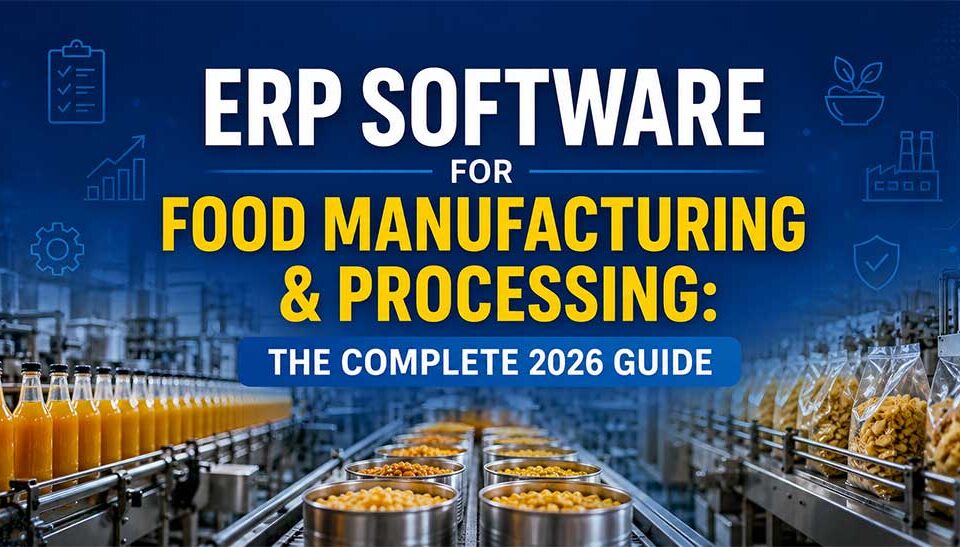

Food manufacturers are dealing with a difficult combination of problems: fluctuating raw-material prices, short shelf lives, batch-level traceability, production wastage, quality checks, changing customer demand, inventory pressure and increasingly complex compliance requirements. At the same time, many businesses are still managing critical information through Excel sheets, separate accounting software, manual production registers and disconnected warehouse systems.
That approach becomes increasingly risky as the business grows.
A modern food manufacturing ERP connects procurement, production, quality, inventory, sales, finance, warehouse and distribution in one system. More importantly, an effective ERP for food processing gives management a clear view of what was purchased, what was produced, which batch was used, what passed quality inspection, what was dispatched and how profitable the final product actually was.
For Indian food businesses, this visibility is particularly important because food safety and compliance cannot be treated as separate administrative activities. FSSAI requires food businesses to implement an effective Food Safety Management System based on HACCP and appropriate prerequisite programmes, including GMP and GHP requirements.
What Is Food Manufacturing ERP Software?
Food manufacturing ERP software is an integrated business management system designed to control the complete food production lifecycle, from raw-material procurement through manufacturing, quality testing, packaging, inventory, sales and financial reporting.
Unlike a basic accounting application, food production ERP understands manufacturing relationships between ingredients, formulations, batches, production orders, yields, wastage, expiry dates and finished goods.
For example, consider a company manufacturing packaged snacks. A customer order may trigger production planning. Production planning then determines ingredient requirements. Procurement checks supplier availability, while inventory verifies existing stock and applicable batches. Production consumes the required ingredients, quality control records inspection results and finished goods are transferred into the warehouse.
Consequently, finance can connect the production activity with actual costs and sales revenue. That connected flow is the real value of ERP for food processing companies.
Why Food Manufacturers Are Moving Away From Spreadsheets
The problem with spreadsheets is not that they are inherently bad. The problem is that they become difficult to control when multiple departments, warehouses, products, batches and production lines depend on the same information. A purchase team may maintain one spreadsheet while the warehouse maintains another. Meanwhile, production may record consumption manually, and finance may receive information several days later.
As a result, management often discovers problems only after they have already affected margins. A raw-material shortage can stop production. An incorrect stock figure can result in unnecessary purchasing. A missed expiry date can create avoidable inventory losses. Furthermore, when batch information is scattered across multiple records, tracing the source of a quality problem becomes slower.
A centralized ERP addresses this problem by creating a common operational database. Bluechip Solutions, for example, positions its ERP framework around integrated manufacturing, supply-chain, finance and AI/ML capabilities, with centralized data, KPI dashboards, integrations and configurable enterprise applications.
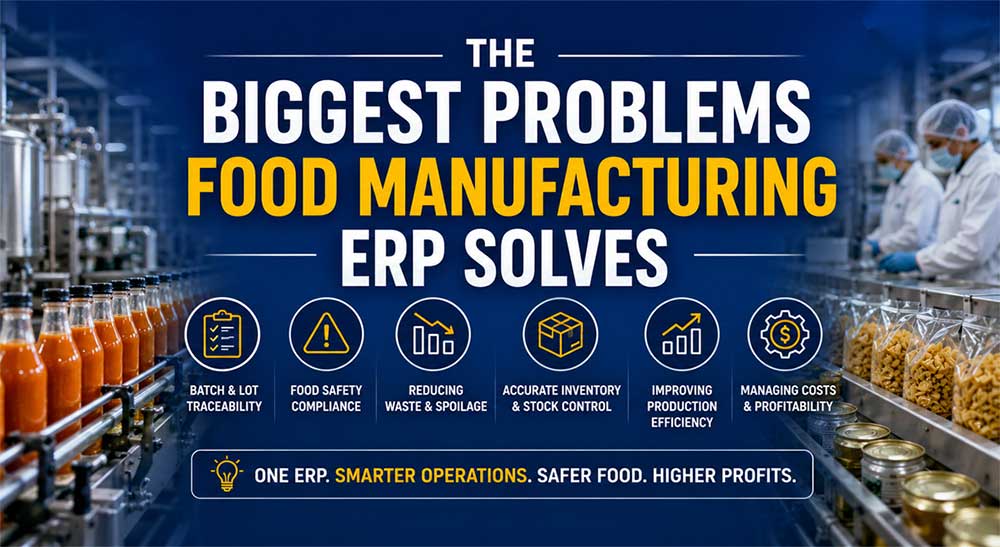
The Biggest Problems Food Manufacturing ERP Solves
Batch Traceability Becomes a Business Requirement
Batch traceability is one of the most important capabilities for food manufacturers. When a finished product has a quality issue, the company needs to determine which raw materials went into that batch, which supplier supplied them, when they were received, what production process was followed and where the finished products were dispatched.
Without integrated traceability, employees may spend hours searching through registers and spreadsheets. With a properly configured ERP solution for the food industry, batch information can remain connected throughout procurement, inventory, production, quality and dispatch.
Therefore, instead of asking, “Where did this batch go?”, management can quickly move from the finished product back to the relevant production and material records.
Expiry Management Reduces Avoidable Inventory Loss
Food inventory cannot be managed purely on quantity. A warehouse may technically have sufficient stock while still facing a shortage of usable stock because some materials are approaching expiry. This is why a food manufacturing ERP should support batch and expiry tracking. The system can help warehouse teams identify ageing inventory, prioritize appropriate stock movement and reduce the possibility of expired materials remaining unnoticed.
For businesses handling dairy products, frozen foods, beverages, bakery products, spices, ready-to-eat products or other time-sensitive materials, this capability can directly influence inventory efficiency.
Production Planning Needs More Than a Sales Forecast
Food production is rarely as simple as producing a fixed quantity every day. Demand changes. Raw materials arrive late. Machines require maintenance. Production capacity varies. Certain ingredients may have limited availability. At the same time, finished products have shelf-life considerations.
Therefore, production planning needs to consider materials, capacity, existing inventory, sales demand and production priorities together. A capable food production ERP can connect these factors so planners are not forced to make decisions using disconnected spreadsheets. The result is better coordination between purchasing, production and warehouse teams.
What Features Should a Food Manufacturing ERP Have in 2026?
Recipe, Formula and Bill of Materials Management
Food products depend heavily on formulations. A recipe may contain multiple ingredients with specific quantities, tolerances and processing requirements. Consequently, the ERP should allow manufacturers to maintain controlled formulas and connect them directly to production orders. This becomes particularly valuable when a company manages multiple SKUs, pack sizes or product variants.
Batch and Lot Tracking
Every important material movement should remain traceable. A modern system should connect incoming raw-material batches with production consumption and finished-product batches. This creates an operational history that can support quality investigations, recalls and compliance activities. FSSAI continues to maintain regulations covering food-product standards, additives, contaminants, packaging and labelling, among other areas.
Quality Control at Multiple Stages
Quality should not happen only after production. Raw materials may require inspection when received. Work-in-progress may require process checks. Finished products may require final quality approval before dispatch. Consequently, ERP solutions for the food industry should allow quality checks to be integrated with purchasing, production and inventory rather than operating as a completely separate process. This creates a stronger connection between operational activity and quality outcomes.
Inventory Management Across Warehouses
Food manufacturers often manage raw materials, packaging materials, semi-finished products and finished goods simultaneously. Furthermore, multiple warehouses can make stock visibility even more complicated. An integrated ERP can provide a centralized view of inventory across locations while retaining batch-level information.
This helps answer practical questions such as: What is available? Which batch is available? Where is it stored? What is committed to production? What is approaching expiry?
Procurement and Supplier Management
The cost and quality of ingredients directly affect profitability. Therefore, procurement should not operate independently from production and inventory. An ERP can connect purchase requirements with production planning and supplier information. Over time, this also allows companies to evaluate purchasing patterns, supplier performance and material costs.
Production Costing and Profitability
A product may appear profitable based on its selling price while generating a much lower margin after considering ingredients, packaging, labour, wastage, processing costs and other overheads. This is one reason food manufacturers need ERP-integrated costing. When production and finance share the same data, management can get a more realistic view of product-level and order-level profitability.
How AI Is Changing Food Manufacturing ERP in 2026
AI is becoming useful in ERP when it helps people make better operational decisions rather than simply adding an “AI” label to existing software. For food manufacturers, AI can support demand forecasting, inventory prediction, anomaly detection, production planning and management reporting.
For example, historical sales patterns can help identify likely demand changes. Inventory data can highlight materials that may become critical. Production data can reveal unusual wastage patterns. Similarly, AI-assisted analytics can help management identify relationships between production performance, material consumption and profitability.
The important point, however, is that AI should work on reliable business data. If purchasing, inventory and production information are fragmented or inaccurate, sophisticated analytics will still produce unreliable conclusions. That is why the stronger 2026 approach is ERP first, connected data second, AI intelligence third.
Recent Indian manufacturing digitalisation initiatives also illustrate this direction, with manufacturers increasingly connecting ERP, shop-floor data, IoT and AI to move from reactive reporting toward predictive decision-making.
ERP and FSSAI Compliance: What Food Businesses Should Know
Compliance requirements are an important consideration when selecting an ERP system. FSSAI’s current framework includes requirements around food safety management, hygiene, product standards and other regulatory areas. Importantly, regulatory requirements can change. In March 2026, FSSAI announced major reforms, including approval of perpetual validity for FSSAI registrations and licences and revised turnover thresholds effective April 1, 2026.
Therefore, companies should avoid choosing ERP software simply because a vendor says it is “FSSAI compliant.” Instead, businesses should verify exactly how the software supports their processes, documentation, traceability, quality controls and reporting requirements. The ERP should support compliance workflows; it should not be treated as a substitute for the company’s legal or food-safety responsibilities.
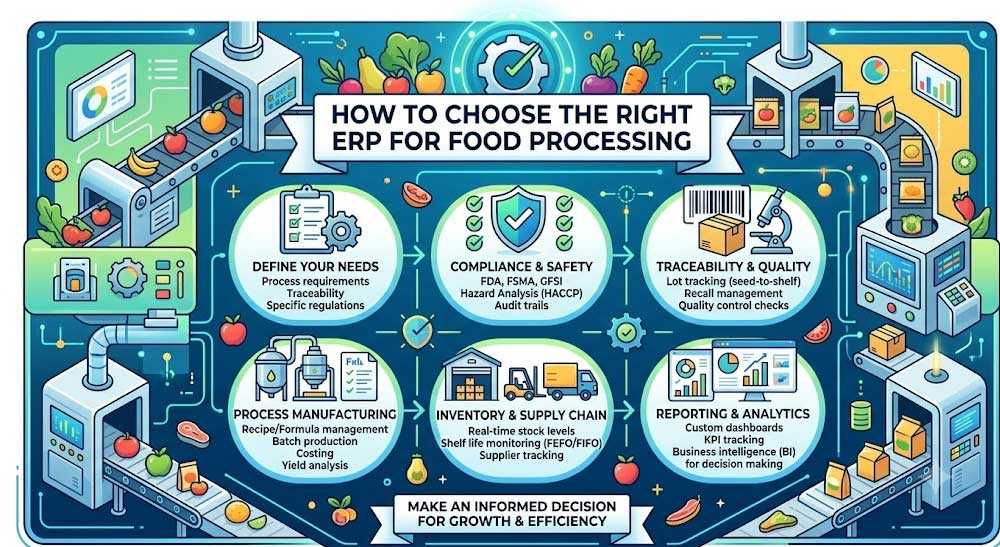
How to Choose the Right ERP for Food Processing
The best ERP for food processing is not necessarily the system with the largest number of features. Instead, the right system is the one that fits the company’s actual production model. A manufacturer should evaluate whether the ERP can handle recipes, batch tracking, expiry management, production planning, quality control, inventory, procurement, costing, finance and reporting without forcing employees to maintain duplicate records.
Customization is equally important. Food businesses frequently have unique production processes, approval structures, formulations, packaging requirements and reporting needs. A rigid ERP can therefore create the same operational problem it was supposed to solve. A configurable or no-code ERP architecture can provide greater flexibility when processes change.
Bluechip Solutions states that its AUVIT framework supports ERP, web, mobile, data and AI/ML applications, while its manufacturing solutions include inventory, quality, production, MRP, finance, maintenance and integration capabilities.
Cloud ERP vs On-Premise ERP for Food Manufacturers
Cloud ERP can provide easier remote access, centralized updates and lower infrastructure requirements. This can be particularly useful when management needs visibility across multiple plants or warehouses. On-premise ERP, meanwhile, can be preferable for organizations with specific infrastructure, security or integration requirements.
However, deployment model alone should not determine the decision. The more important question is whether the system can securely support the company’s production, inventory, quality and financial processes while remaining scalable as operations expand.
What Does Food Manufacturing ERP Cost?
ERP cost varies significantly according to the number of users, modules, locations, integrations, customization requirements, implementation complexity and deployment model. Therefore, quoting a single “food ERP price” without understanding the business is misleading. Instead, companies should calculate the total cost of ownership.
That includes software licensing, implementation, data migration, integrations, training, customization, support and future changes. A cheaper ERP can become expensive if employees continue using spreadsheets because the system cannot accommodate actual business processes. Likewise, an expensive ERP can deliver poor ROI if the implementation is unnecessarily complicated.
The better approach is to compare business fit, implementation risk and long-term ownership cost, not just the initial software price.
Why the Right ERP Can Improve Food Manufacturing Profitability
ERP does not automatically increase profits. However, it can make the causes of profit leakage visible. When management can see material consumption, wastage, production output, inventory ageing, purchase prices, sales performance and product costs in one environment, decisions become more evidence-based.
For instance, excessive wastage may indicate a production issue. Repeated material shortages may indicate weak planning. High inventory ageing may indicate purchasing or demand-forecasting problems. Consequently, ERP becomes more than an accounting or reporting application. It becomes an operational decision platform.
Frequently Asked Questions About Food Manufacturing ERP
What is the best ERP software for food manufacturing?
The best food manufacturing ERP is one that supports batch traceability, recipe and formula management, production planning, quality control, inventory, procurement, costing, finance and compliance-related workflows while remaining adaptable to the company’s processes.
Is ERP suitable for small food processing companies?
Yes. Small and growing food processors can benefit from ERP when spreadsheets and disconnected applications start creating operational delays. However, the system should be scalable so the business does not pay for unnecessary complexity from the beginning.
Does food ERP support batch and expiry tracking?
A food-specific ERP should support batch or lot tracking and expiry management because food inventory decisions depend on more than quantity alone.
Can AI be integrated with food manufacturing ERP?
Yes. AI and machine learning can support demand forecasting, predictive inventory analysis, anomaly detection, production insights and management decision-making when sufficient high-quality operational data is available.
How long does food ERP implementation take?
Implementation time depends on business size, modules, data migration, integrations, customization and user readiness. A proper implementation assessment should be completed before a vendor commits to a timeline.
The Bottom Line: Food ERP Is Becoming an Operational Necessity
Food manufacturing has little room for uncontrolled processes. A missed batch record, inaccurate inventory figure, delayed quality decision or unnoticed expiry can quickly become a financial and operational problem. Therefore, the purpose of a modern food manufacturing ERP is not simply to replace spreadsheets. It is to connect the entire business so that procurement, production, quality, inventory, sales and finance work from the same operational information.
In 2026, the stronger ERP strategy is also moving toward predictive intelligence. Companies are increasingly looking for systems that can combine centralized data with automation, analytics and AI to identify problems earlier and support faster decisions.
For food manufacturers evaluating ERP today, the most important question is therefore not, “Which ERP has the most features?”
It is:
“Which ERP can accurately represent our production process, protect traceability, improve visibility and continue adapting as our food business grows?”
That is where the right ERP solution for the food industry can create long-term value.
Ready to Evaluate ERP for Your Food Manufacturing Business?
If your company is struggling with production planning, batch traceability, inventory visibility, quality control, costing or disconnected business data, an ERP assessment can identify where automation can deliver the highest impact. Bluechip Solutions provides AI-powered ERP and enterprise application capabilities for manufacturing and growing businesses, including manufacturing, inventory, quality, MRP, finance, integrations, dashboards and configurable/no-code application development.
Get a Free Food Manufacturing ERP Consultation and discover how your current processes can be digitized, integrated and made more scalable. Download the 2026 Food Manufacturing ERP Evaluation Checklist to compare batch tracking, production planning, quality management, inventory, costing, AI capabilities, integrations, implementation and total ownership cost before selecting an ERP vendor.