
Choosing an ERP company in Bangalore can look simple until the quotations start arriving. One vendor offers a low-cost package. Another promises “complete customization.” A third shows an impressive demo with dozens of modules. However, the real cost often appears only after implementation begins: additional customization, data migration, integrations, training, support charges, new user licences and change requests.
That is how a seemingly affordable ERP project can become a ₹10 lakh mistake. For Bangalore manufacturers, distributors, traders, construction companies and growing SMEs, the smarter approach is therefore not to ask, “Which ERP is cheapest?” Instead, ask, “Which ERP company can solve our actual business problems within a predictable total cost?”
Current Indian ERP market benchmarks show just how wide the investment range can be. Depending on company size, modules, customization and implementation complexity, 2026 ERP projects can range from a few lakh rupees for smaller businesses to ₹20 lakh–₹60 lakh or more for complex mid-market implementations. Moreover, implementation itself can represent a substantial share of the first-year budget.
Therefore, choosing the right ERP company in Bangalore requires looking beyond the software demo and the initial quotation.
Why Businesses in Bangalore End Up Paying More Than Expected for ERP
The most common mistake is comparing ERP vendors using only the licence or subscription price. For example, a company may receive an ERP quotation that appears affordable. However, after the project starts, the business discovers that its approval workflow is not standard. Then, another customization is required for production planning. Next, the finance team requests a different report. After that, management asks for integration with an existing application.
Consequently, the original budget keeps increasing. Data migration can create another problem. If your existing information is stored across Tally, Excel files, legacy software and separate databases, moving clean and usable data into the new ERP requires planning. Poor migration can result in duplicate customers, incorrect opening balances, missing inventory history and unreliable reports.
Similarly, training is frequently underestimated. An ERP does not create value simply because the software has been installed. Employees need to understand the new process, managers need accurate dashboards, and finance teams need confidence in the numbers. Therefore, the real ERP cost should include software, implementation, customization, migration, integrations, training, support and future scalability.
What Should You Check Before Choosing an ERP Company in Bangalore?
The first thing to evaluate is whether the ERP company understands your industry rather than simply selling software. A manufacturing company, for instance, may need production planning, BOM management, material consumption, work orders, quality processes, inventory control and costing. A distributor may instead prioritize purchasing, warehouse management, sales orders, stock visibility, pricing and receivables.
Consequently, an ERP vendor that is excellent for one business may be completely unsuitable for another. Ask the vendor to demonstrate your actual workflow. Do not accept a generic presentation showing accounting, dashboards and menus. Instead, provide a real business scenario: quotation to sales order, purchase order to receipt, raw material to production, production to finished goods, or invoice to payment.
Then watch how the ERP handles it. This simple approach can reveal more than a polished sales presentation.
Verify the ERP Company’s Implementation Experience
A strong ERP product does not automatically mean a strong ERP implementation. Implementation experience matters because your vendor must understand requirements gathering, process mapping, configuration, data migration, testing, training, go-live and post-implementation support.
Therefore, ask how many similar projects the ERP company has completed and, more importantly, whether those projects resemble your business. For example, if you operate a Bangalore manufacturing unit, ask whether the vendor has implemented ERP for manufacturing companies with similar production complexity.
Also ask who will actually implement your project. Sometimes the sales team demonstrates the software, but a completely different implementation team handles the project later. That difference can create communication gaps. A reliable ERP company should clearly explain who is responsible for project management, implementation, support and escalation.
Do Not Choose an ERP Company Based Only on the Lowest Quotation
Price matters, but total cost of ownership matters more.
Suppose Vendor A quotes ₹4 lakh and Vendor B quotes ₹7 lakh. At first glance, Vendor A appears better. However, imagine Vendor A charges separately for customization, migration, integrations, additional reports, training and annual support. Meanwhile, Vendor B includes these services within a clearly defined implementation scope.
Suddenly, the cheaper ERP may become the more expensive option. This is why every Bangalore business should request a complete commercial proposal before making a decision. The proposal should clearly explain what is included, what is excluded, what counts as customization, how change requests are charged, what support covers and what future costs may arise.
Recent Indian ERP cost analyses also emphasize that implementation, migration, training and support can significantly affect total ERP expenditure rather than the licence alone.
Check Whether the ERP Can Handle Indian Business Requirements
An ERP for an Indian company must do more than manage invoices and inventory. GST compliance, taxation, financial reporting and e-invoicing can directly affect day-to-day operations. For example, the Government of India reduced the e-invoicing applicability threshold to ₹5 crore of aggregate annual turnover from 1 August 2023 for covered taxpayers. Therefore, businesses evaluating ERP software should verify whether the system can properly support applicable GST and e-invoicing workflows.
Furthermore, do not simply ask, “Does your ERP support GST?” Instead, ask the vendor to demonstrate the actual process. Can the system generate the required invoice information? Can it integrate with the relevant e-invoicing process? Can users correct errors without creating accounting confusion? Can management track compliance-related information?
The answer should come from a working demonstration rather than a brochure.
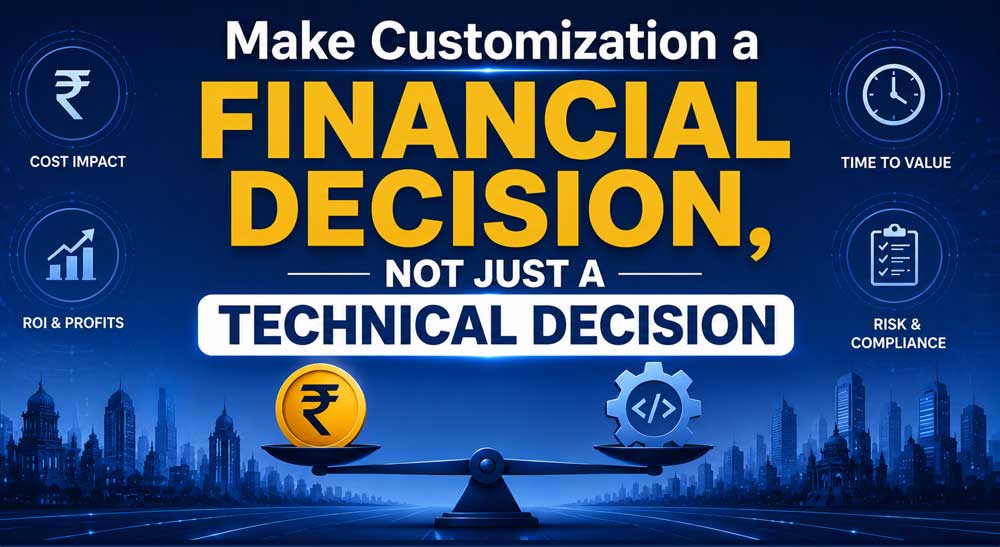
Make Customization a Financial Decision, Not Just a Technical Decision
Customization is one of the biggest reasons an ERP budget can grow unexpectedly. Businesses naturally want the new ERP to work exactly like their old system. However, reproducing every old process inside a new ERP can become expensive. Therefore, every requested customization should answer one question:
Does this change create measurable business value?
If the answer is no, the business may be better off adapting the process to the standard ERP workflow. On the other hand, genuinely unique business processes may justify customization. Modern no-code and low-code ERP approaches can also reduce the effort required for certain business-specific changes, depending on the platform architecture and scope. However, businesses should still evaluate whether customization remains maintainable after upgrades.
The objective is not to eliminate customization completely. The objective is to prevent unnecessary customization from turning into a permanent cost.
Examine Data Migration Before Signing the Contract
Data migration is often treated as a technical task. In reality, it is a business risk. Your company may have years of customer records, supplier information, item masters, opening balances, inventory records, purchase history and sales data. If the master data is inconsistent, the new ERP can inherit the same problems.
Therefore, an experienced ERP company should first assess the quality and structure of your existing data. Ask how historical data will be migrated, what information will be cleaned, what will be archived and how opening balances will be validated. Most importantly, insist on a migration test before final go-live. It is far better to discover a migration problem during testing than after the finance team starts using the new ERP for live transactions.
Evaluate Support After Go-Live
The ERP project does not end when the system goes live. In fact, the first few weeks after go-live can be when users need the most help. Employees may have questions about transactions. Managers may request reports. Finance teams may identify configuration issues. Production teams may discover workflow gaps.
Therefore, ask the ERP company what happens after implementation. Is support available through phone, email, ticketing or an online portal? What is the response time? Is onsite support available in Bangalore when required? Is there a dedicated support team? Are upgrades included? What happens when a critical issue affects business operations?
These questions matter because an ERP is not simply software. It becomes part of your operational infrastructure.
Look for Scalability Instead of Buying More Software Than You Need
A growing company does not necessarily need every ERP module on day one. Instead, the better strategy can be to implement the most important processes first and expand as the business grows. For example, a growing manufacturer might initially prioritize finance, inventory, purchasing, sales and production. Later, the company may add advanced dashboards, CRM, HR, additional warehouses or integrations.
This approach can reduce unnecessary upfront investment while keeping the ERP aligned with business growth. However, scalability should be verified before signing. Ask whether new users, branches, warehouses, modules and integrations can be added without replacing the entire system.
Use a Structured ERP Vendor Evaluation Process
A practical ERP selection process should begin with your business problems. First, document where your current system is failing. Perhaps inventory visibility is poor. Perhaps management reports take several days. Perhaps purchase approvals happen through WhatsApp. Perhaps finance spends hours reconciling information between systems.
Next, define what the ERP must improve. Then shortlist ERP companies based on industry experience, functionality, implementation capability, customization approach, integration capability, support and total cost. After that, conduct scenario-based demonstrations. Finally, compare vendors using the same requirements.
This prevents the common mistake of choosing the vendor with the most impressive presentation rather than the vendor that solves the most important operational problems.
The ₹10 Lakh ERP Mistake Usually Starts Before the Contract
The biggest ERP mistake is rarely one enormous invoice. Instead, it is usually a series of small decisions. A vague scope creates change requests. Change requests create additional costs. Poor migration creates rework. Insufficient training creates low adoption. Weak support creates operational delays.
Eventually, the project becomes significantly more expensive than originally expected. Therefore, the best way to protect your investment is to make the ERP company’s responsibilities, implementation scope, customization costs, migration plan and support commitments clear before signing.
How Much Should You Budget for an ERP in Bangalore in 2026?
There is no universal ERP price for Bangalore. A small company with standard finance and inventory requirements may have a very different investment from a multi-location manufacturer requiring production planning, integrations and extensive customization.
Recent 2026 Indian market estimates place SME ERP investments broadly in the several-lakh range, while medium and complex implementations can move into ₹10 lakh, ₹20 lakh or significantly higher territory depending on scope. Consequently, instead of asking an ERP company for a price before explaining your requirements, request a requirement-based ERP estimate. The more accurately your requirements are defined, the more meaningful the quotation becomes.
What Makes a Good ERP Company in Bangalore?
A good ERP company should do more than demonstrate features. It should understand your business process, identify operational gaps, explain what should be standardized, recommend where customization is genuinely necessary, provide transparent pricing and remain accountable after go-live.
Most importantly, the vendor should be willing to tell you when a feature is unnecessary. That is a strong buying signal. A company that tries to sell every module may be focused on increasing the deal size. A company that focuses on solving your actual business problems is more likely to build a sustainable ERP relationship.
Frequently Asked Questions About Choosing an ERP Company in Bangalore
How do I choose the best ERP company in Bangalore?
Start by evaluating industry experience, implementation capability, product functionality, customization, integration, data migration, support and total cost of ownership. Then compare vendors using your actual business workflows rather than generic product demonstrations.
How much does ERP implementation cost in Bangalore?
ERP implementation costs vary according to users, modules, customization, integrations, migration and business complexity. Current 2026 Indian market estimates show that SME projects can range from a few lakh rupees, while more complex mid-market implementations can reach ₹10 lakh–₹50 lakh or more.
What is the biggest hidden ERP cost?
Implementation-related work is one of the biggest areas to investigate because data migration, customization, integrations, training and support can materially increase the total investment beyond the software licence.
Should I choose a cheap ERP vendor?
Not necessarily. The cheapest quotation may become expensive if important implementation services are excluded. Compare the complete first-year cost and longer-term total cost of ownership instead.
How long does ERP implementation take?
The timeline depends heavily on scope. A relatively straightforward implementation may take weeks, whereas manufacturing, multi-location and highly customized ERP projects can require several months. The vendor should provide a realistic project plan after requirements analysis.
Before You Sign: Get Your ERP Cost and Scope Checked
If your company is comparing ERP companies in Bangalore, do not wait until the quotation becomes a contract to discover hidden costs. A structured ERP assessment can help identify the modules you actually need, the workflows that should be customized, the data that needs migration and the implementation effort required.
Book a free ERP consultation with Bluechip Solutions to discuss your business requirements, implementation scope and ERP roadmap before committing your budget. You can also use this article as a practical checklist when comparing ERP vendors and ask every shortlisted company to respond to the same requirements.
The goal is simple: choose an ERP that solves your business problems—not an ERP quotation that creates new ones.