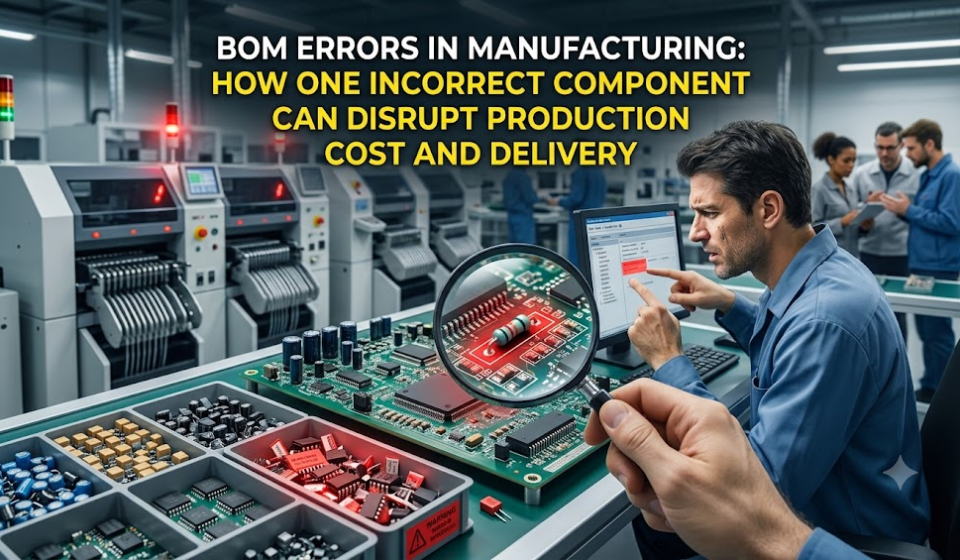
BOM Errors in Manufacturing: How One Incorrect Component Can Disrupt Production Cost and Delivery

A manufacturing order can look profitable on paper and still lose money on the production floor. Sometimes, the problem is not a machine breakdown, a supplier delay, or an unexpected customer change. Instead, it starts with one incorrect quantity, an outdated drawing revision, or a component missing from the Bill of Materials (BOM).
For example, imagine a manufacturer preparing 500 industrial pump assemblies. The approved design requires four seals per unit, but the BOM lists only three. Consequently, production begins with insufficient materials, procurement must arrange an urgent purchase, and assembly workers wait for the missing components. Meanwhile, dispatch deadlines approach, labour costs increase, and the expected profit begins to shrink.
This is why Bill of Materials (BOM) Management Software matters to manufacturers. It helps connect product specifications with material requirements, purchasing, inventory, production planning, and costing. Moreover, when manufacturers integrate BOM management with ERP software, they can identify discrepancies earlier and make better-informed decisions before errors affect customer deliveries.
For manufacturing CEOs, plant heads, production managers, and procurement teams, the real objective is straightforward: build the correct product, use the correct materials, control costs, and deliver orders on time.
What Is a Bill of Materials (BOM) in Manufacturing?
A Bill of Materials is a structured record of the raw materials, purchased components, subassemblies, quantities, and other items required to manufacture a finished product. Depending on the manufacturing process, it can also include material specifications, units of measurement, approved alternatives, and relevant production information.
For instance, an electrical control panel may require a metal enclosure, circuit breakers, wiring, relays, connectors, and mounting accessories. The BOM specifies the components and quantities needed to assemble the panel correctly.
However, a BOM is more than a component list. Production planning uses it to calculate material requirements, procurement uses it to prepare purchasing requirements, and costing teams use it to estimate material expenses. Similarly, inventory teams depend on accurate BOM data to understand which materials production will consume.
Therefore, an incorrect BOM can affect several departments simultaneously. BOM Management Software helps manufacturers maintain structured component information, manage revisions, and connect material requirements with their wider manufacturing operations.
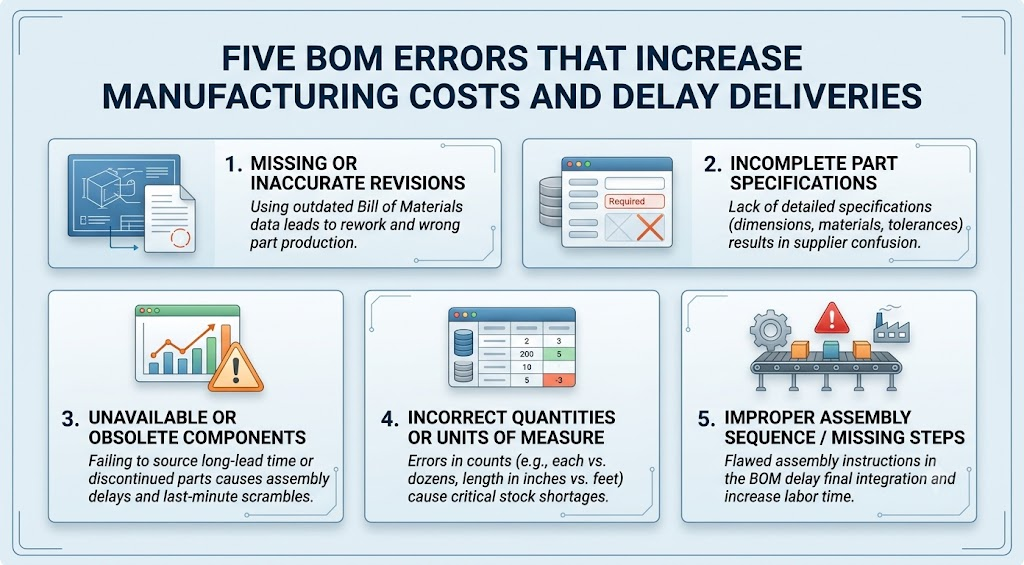
Five BOM Errors That Increase Manufacturing Costs and Delay Deliveries
1. Incorrect Component Quantities Create Material Shortages
Quantity errors are among the most direct ways a BOM can disrupt production. A component requirement might be entered incorrectly during product design, copied from an older product version, or calculated without considering the actual assembly requirements.
Consider a manufacturer producing 300 machines, each requiring 12 mounting brackets. The correct requirement is 3,600 brackets. However, if the BOM specifies 10 brackets per machine, the production plan accounts for only 3,000. As a result, the factory faces a shortage of 600 brackets unless someone identifies the discrepancy before production begins. Furthermore, the problem may extend beyond procurement. Production supervisors might reschedule work, employees could remain idle, and the dispatch team may need to revise delivery commitments.
To prevent these issues, manufacturers should validate component quantities against approved engineering drawings, assembly requirements, and production specifications. They should also verify units of measurement, such as pieces, metres, kilograms, and litres, because incorrect conversions can create substantial material discrepancies.
With Bill of Materials (BOM) Management Software, teams can maintain standard component quantities and connect them with production planning. Consequently, the system can calculate expected material requirements more consistently, while exception reports and approval workflows help teams investigate unusual quantities before releasing work orders.
2. Outdated BOM Revisions Cause Production and Quality Problems
Product specifications rarely remain unchanged throughout a product’s lifecycle. Engineering teams may replace a component, modify a dimension, change a material grade, or introduce a customer-specific configuration. However, problems arise when the engineering team updates the design but procurement or production continues using an older BOM. As a result, employees may purchase obsolete materials or assemble products using components that no longer match the approved specification.
For example, a machinery manufacturer might replace a standard bearing with an upgraded version to meet revised load requirements. If the production team receives the previous BOM, workers could install the old bearing even after the design change has been approved. This mismatch can lead to rework, additional inspection, wasted inventory, and potentially serious product-quality concerns.
BOM revision control addresses this issue by recording approved changes, revision identifiers, effective dates, and relevant approval details. Before releasing a production order, teams should verify that the selected BOM matches the applicable engineering specification and product configuration.
Furthermore, manufacturers should define how existing work orders will be handled when a revision changes. Some orders may continue under the previous approved revision, while others may require updated components or additional review. A structured manufacturing ERP system can help maintain revision history and connect approved BOM information with production orders. As a result, teams gain better visibility into which specifications apply to current and future production.
3. Missing Components Interrupt Assembly at the Worst Possible Time
Some BOM errors are difficult to detect because the missing component appears insignificant. A fastener, connector, gasket, spacer, or cable may represent only a small proportion of the product’s total cost. Nevertheless, the finished product may be impossible to complete without it.
For instance, an industrial control panel may contain all its major electrical components, yet remain incomplete because a specific connector was omitted from the BOM. The purchasing team may not order the connector because the system does not recognise the requirement. Consequently, assembly stops even though most materials are available. This situation becomes more expensive when the missing component has a long supplier lead time or requires a specialised specification.
To reduce such disruptions, manufacturers should compare BOM records with approved drawings, assembly instructions, and product specifications before releasing production orders. They should also establish a review process for new products, engineering changes, and frequently modified assemblies. Additionally, BOM validation should cover small components, consumables, and approved alternatives where applicable. Teams should not assume that a component is optional simply because it is inexpensive.
When BOM data connects with inventory and procurement, manufacturers can identify material shortages earlier and initiate purchasing activities before the scheduled production date. Therefore, Bill of Materials (BOM) Management Software can help reduce avoidable interruptions and improve production readiness.
4. Inaccurate Material Costing Hides Profit Leakage
A product may meet its delivery target and still generate less profit than expected. One possible reason is inaccurate BOM costing. Material estimates become unreliable when the BOM contains incorrect quantities, outdated purchase prices, duplicate components, or missing items. In addition, manufacturers may overlook material wastage, scrap allowances, and unit-of-measure differences when calculating production requirements.
Suppose a manufacturer estimates that a product requires ₹8,000 worth of materials. However, the actual requirement is ₹9,200 because the BOM excludes a component and uses an outdated price for another. Across 400 units, the difference amounts to ₹4,80,000 in additional material expenditure compared with the original estimate.
This example is illustrative rather than an industry-wide benchmark, but it demonstrates how a small per-unit discrepancy can become a significant financial issue at scale. To improve costing accuracy, manufacturers should maintain reliable component records, review purchase prices regularly, and calculate material requirements using approved BOM quantities. Where relevant, they should also account for scrap, expected yield, and approved substitutes.
A manufacturing ERP system with BOM and costing integration can help teams calculate estimated material costs, compare planned and actual consumption, and investigate variances. However, accurate results still depend on reliable source data and appropriate costing rules. Consequently, BOM accuracy becomes an important part of margin protection, quotation preparation, and financial planning rather than merely an engineering responsibility.
5. Poor Multi-Level BOM Control Creates Hidden Material Gaps
Many manufactured products contain multiple assemblies and subassemblies. For example, an industrial machine may consist of a drive assembly, electrical assembly, control panel, and structural frame. Each assembly may have its own components and lower-level subassemblies. This structure creates a challenge when teams manage every level separately without maintaining the relationships between them.
Suppose a manufacturer changes a motor assembly but fails to update the parent product’s material requirements or purchasing plan. Consequently, the factory may calculate an incorrect requirement for the finished machine, overlook a newly required component, or misunderstand where a shared component is used.
Multi-level BOM management helps manufacturers maintain the relationships between finished products, subassemblies, and individual components. It also allows teams to review material requirements across the product structure rather than checking each assembly in isolation.
With suitable software, manufacturers can expand a multi-level BOM to understand total component requirements and examine where a particular component is used. They can then assess the impact of an engineering change before updating production plans or procurement requirements. Therefore, multi-level BOM control is particularly valuable for machinery manufacturers, automotive component suppliers, electrical equipment manufacturers, and businesses producing configurable or engineer-to-order products.
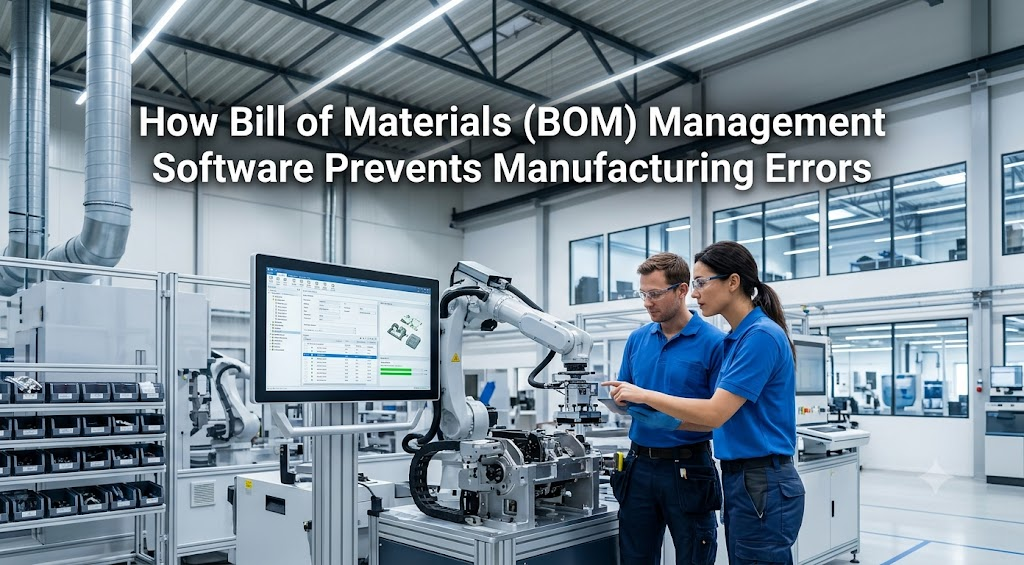
How Bill of Materials (BOM) Management Software Prevents Manufacturing Errors
Correcting BOM errors after production starts is usually more disruptive than identifying them during planning. For this reason, manufacturers need a consistent process that connects product information with purchasing, inventory, production, and costing.
Centralise BOM Information Across Departments
When engineering, procurement, and production maintain separate spreadsheets, teams may work with different component descriptions, quantities, or revision numbers. Consequently, even a simple product change can create confusion.
A centralised BOM record gives authorised teams a common reference for approved product structures. When integrated with manufacturing ERP software, this information can support material planning, purchasing, inventory allocation, and work-order preparation. However, manufacturers should also establish ownership of critical data fields and define who can create, modify, approve, and release BOM records.
Introduce BOM Validation and Approval Workflows
A BOM should not move directly from initial preparation to production without suitable verification. Instead, manufacturers should establish checks for missing components, duplicate part numbers, invalid quantities, incorrect units, and incomplete specifications.
Furthermore, engineering changes should follow a defined approval process. Depending on the product and risk level, the process may involve engineering, quality assurance, procurement, production, and costing teams. Workflow automation can notify the appropriate employees when a BOM requires review or approval. As a result, teams can address discrepancies before they become production problems.
Connect BOM Data With Inventory and Production Planning
An accurate BOM is only useful when material planning reflects the same requirements. Therefore, manufacturers should connect BOM data with inventory availability, open purchase orders, supplier lead times, and scheduled production orders. For example, if a planned order requires 2,000 components but only 1,200 are available, the system should help planners identify the shortfall and determine the additional purchasing requirement.
Nevertheless, inventory reservations, existing commitments, scrap allowances, and alternative materials must be considered when calculating actual shortages. By integrating these processes, manufacturers can improve production readiness and make more informed scheduling decisions.
Monitor Planned Versus Actual Material Consumption
Even a carefully prepared BOM cannot eliminate every production variance. Material damage, process losses, design changes, and shop-floor errors may affect actual consumption. Consequently, manufacturers should compare expected material usage with actual issues and consumption recorded against production orders. Significant differences can trigger investigations into quantity errors, incorrect specifications, waste, or inaccurate inventory records.
Over time, this information helps teams improve their BOM standards and identify recurring operational problems.
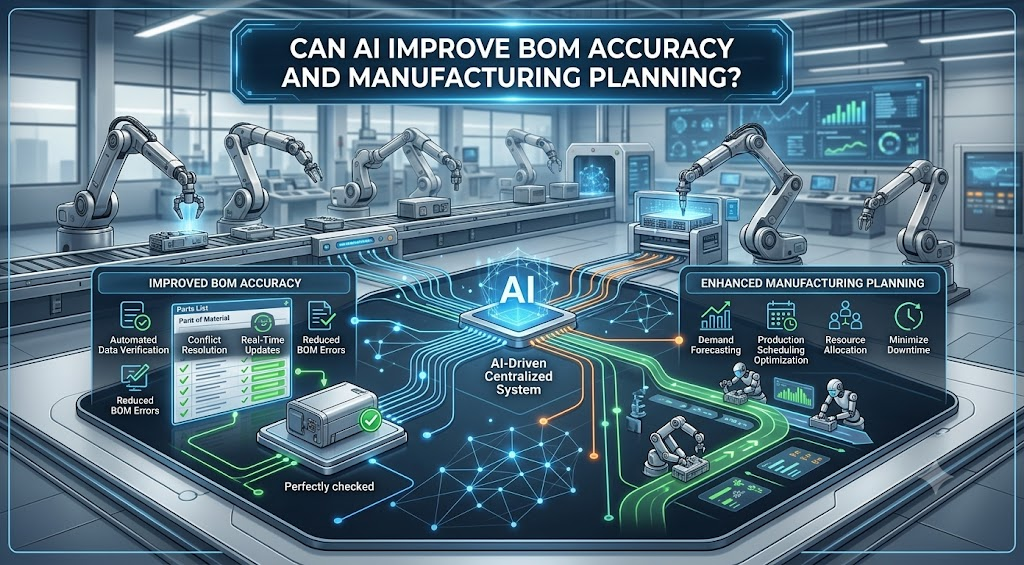
Can AI Improve BOM Accuracy and Manufacturing Planning?
AI can support BOM management by helping manufacturers identify unusual patterns, flag potential data inconsistencies, and prioritise records that require human review. However, AI should complement engineering validation rather than replace it. For example, a suitably configured system could flag a component quantity that differs significantly from previous approved versions. It might also highlight duplicate part descriptions, identify recurring material shortages, or help teams examine historical consumption patterns.
Similarly, AI-assisted document processing may help extract component information from drawings or engineering documents. Nevertheless, extracted quantities and specifications must be checked against authoritative source documents before approval. The quality of these capabilities depends on data completeness, system integration, validation rules, and the reliability of the underlying models. Therefore, manufacturers should treat AI-generated flags as decision-support signals, not automatic proof that a BOM is incorrect.
The most practical starting point is to establish clean component masters, consistent revision control, reliable inventory data, and documented approval workflows. Once these foundations are in place, AI-enabled analysis can add further value.
Why Manufacturing SMEs Need Integrated BOM and ERP Management
Manufacturing SMEs often operate with limited planning resources. Engineers may maintain product specifications, procurement teams track supplier quotations, and production supervisors coordinate material availability using separate spreadsheets or disconnected applications.
Although this approach may work for simple products, it becomes harder to control as product variants, customer requirements, and production volumes increase. Integrated ERP software helps connect BOM records with inventory, purchasing, production planning, costing, and reporting. Consequently, decision-makers can understand material requirements more clearly and identify potential disruptions before they affect delivery commitments.
For growing manufacturers, the objective is not simply to replace spreadsheets. Instead, it is to establish a controlled process in which approved product information supports consistent execution across departments. Bluechip Solutions provides ERP solutions designed to help businesses connect operational information and improve process visibility. Through its Auvit No-Code ProfitPlus ERP approach, businesses can explore workflow automation and process customisation aligned with their operational requirements.
The appropriate configuration depends on each manufacturer’s product complexity, existing systems, approval requirements, and reporting needs. Therefore, businesses should evaluate BOM capabilities against their actual production processes before selecting a solution.
A Practical BOM Accuracy Strategy for Manufacturing Leaders
Manufacturers should begin by reviewing their most frequently produced products and identifying where BOM discrepancies create the greatest operational risk. These may include high-value assemblies, products with frequent engineering changes, components with long lead times, or items responsible for repeated production shortages.
Next, teams should verify the corresponding component quantities, revision history, units of measurement, material specifications, and costing assumptions. They should also identify duplicate records and establish clear ownership for approving future changes. After correcting the source data, manufacturers can introduce standard validation procedures and connect BOM information with purchasing, inventory, and production planning.
Finally, management should monitor measurable indicators such as BOM-related material shortages, production orders delayed by missing components, material cost variance, emergency purchase frequency, and rework associated with incorrect specifications. These indicators help determine whether the improvements are producing meaningful operational results. More importantly, they allow management to address recurring problems rather than repeatedly correcting individual production orders.
Frequently Asked Questions About Bill of Materials (BOM) Management Software
What is Bill of Materials (BOM) Management Software?
Bill of Materials (BOM) Management Software helps manufacturers organise product components, quantities, subassemblies, and revision information. When integrated with ERP software, it can connect approved BOM data with procurement, inventory, production planning, and material costing.
How do BOM errors affect manufacturing costs?
BOM errors can create excess purchases, material shortages, production stoppages, rework, and inaccurate product cost estimates. Consequently, manufacturers may experience higher operating expenses and lower-than-expected profit margins.
How can manufacturers prevent BOM revision errors?
Manufacturers can reduce revision errors by maintaining controlled BOM versions, documenting engineering changes, defining approval responsibilities, and checking the applicable revision before releasing production orders.
What is a multi-level BOM?
A multi-level BOM represents a product’s structure across several levels, including the finished product, subassemblies, and individual components. It helps manufacturers understand how materials relate to one another and calculate requirements across complex product structures.
Can ERP software automate BOM management?
Yes. Depending on the software and configuration, ERP systems can support BOM creation, revision control, material requirement calculations, costing, approval workflows, and integration with inventory and production orders. However, manufacturers must maintain accurate source data and appropriate controls.
How does BOM management improve on-time delivery?
Accurate BOM information helps production planners identify material requirements earlier, while inventory and procurement integration helps teams address shortages before scheduled production. Consequently, manufacturers can reduce avoidable delays and improve production readiness.
Prevent BOM Errors Before They Affect Your Next Production Order
A single incorrect component quantity, outdated revision, or missing material can create problems across procurement, production, costing, and customer delivery. However, manufacturers can reduce these risks by improving BOM accuracy and connecting product information with their wider operational processes.
With structured Bill of Materials (BOM) Management Software, businesses can establish better revision control, strengthen material planning, improve cost visibility, and identify discrepancies before they disrupt production.
Is your manufacturing team still managing BOMs through disconnected spreadsheets?
Explore how Bluechip Solutions can help your business connect BOM management, production planning, inventory, and costing through an integrated ERP approach.
Request a Free ERP Demo or Manufacturing ERP Consultation to discuss your current BOM challenges and identify practical opportunities to improve production control.
Visit: https://bluechipsolutions.in/
Get a Manufacturing BOM Accuracy Checklist to review component quantities, revision control, missing materials, costing accuracy, and multi-level BOM structures before releasing your next production order.