
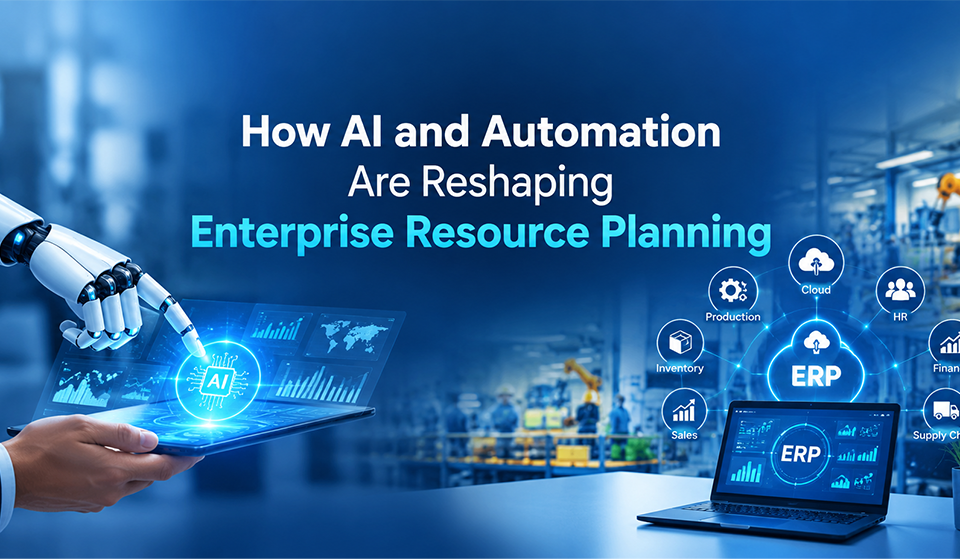

A delayed purchase order, an unexpected material shortage, or an inaccurate financial forecast can cost an enterprise far more than the value of a single transaction. These problems often begin with disconnected systems, delayed information, and business decisions based on outdated reports. Although traditional Enterprise Resource Planning (ERP) software helps organizations manage their operations, businesses increasingly need systems that can do more than record what has already happened.
This is where AI and automation in ERP are changing enterprise management. By combining operational data, predictive analytics, intelligent workflows, and automated decision support, modern ERP systems help businesses identify problems earlier, reduce repetitive work, and respond to changing conditions faster.
According to McKinsey’s August 2026 State of AI research, 89% of respondents reported regular AI use in at least one business function, while 44% reported that AI was scaling across their enterprises. However, only 37% reported an impact on enterprise-level earnings before interest and taxes (EBIT). This gap highlights an important challenge: adopting AI does not automatically create business value. Organizations must connect AI capabilities to real operational workflows and measurable outcomes.
For enterprise leaders, the real opportunity is not simply to introduce another AI tool. Instead, it is to build a connected business environment where ERP data, automation, and human expertise work together to improve profitability, operational control, and customer satisfaction.
What Does AI-Powered ERP Mean for Modern Enterprises?
An AI-powered ERP system combines traditional enterprise resource planning capabilities with artificial intelligence, machine learning, predictive analytics, and business process automation. Consequently, it can help organizations move from recording transactions to identifying patterns, forecasting potential problems, and recommending appropriate actions.
Traditional ERP software typically records sales, purchases, inventory movements, production activities, and financial transactions. Employees then review reports and decide what to do next. An intelligent ERP system can go further by analyzing historical and current business data to identify unusual patterns, estimate future requirements, and trigger predefined workflows.
Consider a manufacturing company experiencing repeated production delays. Its conventional ERP system might show that materials were unavailable when a production order was scheduled. However, an AI-enabled ERP system could analyze historical consumption, supplier delivery performance, current stock, and upcoming demand to identify the likelihood of another shortage.
When this prediction is connected to an automated workflow, the system can notify the procurement team, recommend a replenishment quantity, and initiate an approval request. Therefore, the business can address the risk before it disrupts production.
The important distinction is that AI provides intelligence, while automation helps execute the next step. When both operate within a well-governed ERP environment, businesses can make faster, more consistent decisions without removing necessary human oversight.
Why Traditional ERP Systems Struggle With Today’s Business Complexity
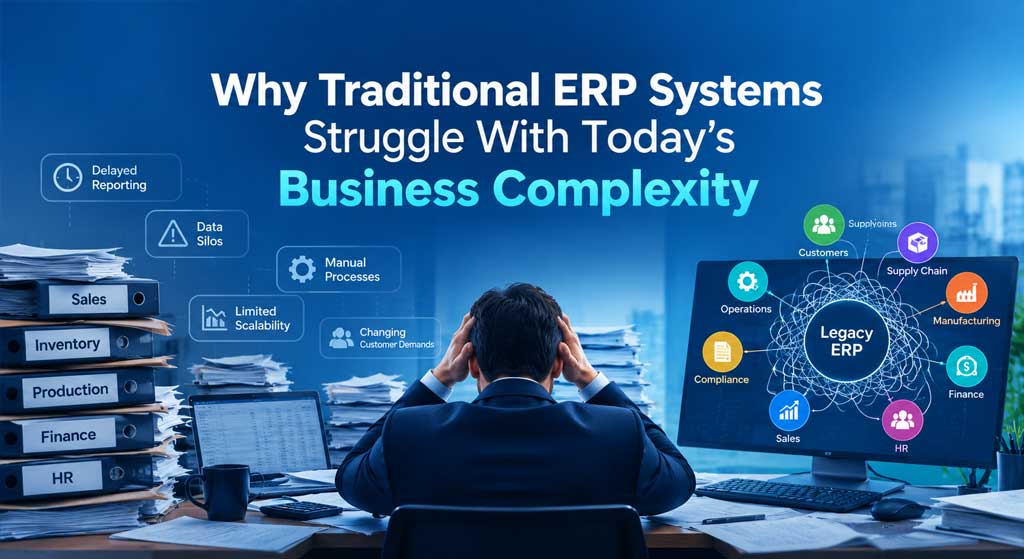
Many enterprises already have ERP software, yet they continue to experience operational inefficiencies. The problem is not always the absence of technology. Instead, it often lies in disconnected processes, incomplete data, manual approvals, and limited visibility across departments.
Disconnected Business Data Creates Costly Blind Spots
When sales, procurement, inventory, production, and finance operate with inconsistent information, decision-makers cannot easily understand the complete business situation. A sales team may confirm an order without knowing that a critical component is unavailable, while finance may struggle to explain why material costs have increased.
AI cannot reliably solve this problem if the underlying data is incomplete or contradictory. Therefore, enterprises should first establish consistent master data, clear business rules, and dependable integrations between their systems. Once these foundations are in place, AI-driven ERP analytics can deliver more relevant recommendations and improve cross-functional visibility.
Manual Approvals Slow Down Business Execution
Purchase requests, supplier invoices, expense claims, credit approvals, and production changes frequently move through email chains and spreadsheets. As a result, employees spend time chasing approvals instead of managing higher-value activities.
ERP workflow automation can route requests according to predefined approval limits, notify responsible employees, and escalate overdue actions. AI can additionally help classify incoming documents, identify missing information, and flag unusual transactions for review. This combination reduces avoidable administrative delays while preserving accountability.
Historical Reports Reveal Problems Too Late
Month-end reports can explain why costs increased last month, but they may not prevent the same problem from occurring again. Similarly, inventory reports may reveal excess stock only after working capital has already been tied up.
Predictive analytics in ERP helps organizations examine patterns in demand, purchasing, equipment performance, and operating costs. Consequently, managers can investigate emerging risks earlier and take corrective action before they affect delivery schedules or margins.
Five Ways AI and Automation Are Reshaping ERP Operations
1. Predictive Inventory Management and Intelligent Procurement
Inventory decisions directly influence cash flow, customer service, and production continuity. Excess inventory increases storage costs and ties up working capital, whereas insufficient stock can delay orders and force expensive emergency purchases.
AI-enabled inventory management can analyze historical demand, current stock, supplier lead times, seasonal variations, and consumption trends to estimate future material requirements. When combined with ERP automation, these insights can generate low-stock alerts, suggest replenishment quantities, and initiate purchase requisitions according to business rules.
For example, if a component has a long supplier lead time and demand is increasing, the system can alert procurement before the material reaches its minimum stock level. Nevertheless, planners should validate exceptional demand patterns and supplier constraints rather than accepting every prediction automatically.
The business outcome is more informed purchasing, better inventory availability, and improved control over working capital.
2. AI-Driven Production Planning and Shop-Floor Visibility
Manufacturers must coordinate material availability, machine capacity, workforce schedules, quality requirements, and customer delivery commitments. Even a small disruption can affect multiple production orders when these activities are planned separately.
AI-driven manufacturing ERP can help planners identify scheduling conflicts, forecast material shortages, and evaluate alternative production sequences. When connected to reliable shop-floor data, the system can also highlight deviations between planned and actual production.
Suppose a critical machine experiences repeated downtime. An intelligent ERP environment can combine maintenance records, production schedules, and order priorities to help planners understand which deliveries are at risk. Automated alerts can notify maintenance and production teams, while managers decide whether to reschedule jobs or allocate alternative capacity.
As a result, enterprises gain better coordination between planning and execution instead of relying exclusively on end-of-shift reports.
3. Automated Finance, Invoice Processing, and Cash-Flow Forecasting
Finance teams frequently manage large volumes of invoices, payment requests, reconciliations, expense claims, and outstanding receivables. Manual processing creates delays and increases the risk of duplicate payments, incorrect entries, and missed collection opportunities.
AI-powered ERP automation can extract information from invoices, compare transaction details with purchase orders and goods receipts, and flag discrepancies for review. Meanwhile, rules-based workflows can route exceptions to the appropriate approver.
Predictive analytics can also help finance teams estimate cash-flow pressure by examining receivables, payment history, committed purchases, and expected expenses. Consequently, CFOs can identify potential liquidity gaps earlier and investigate corrective options.
However, financial automation should include approval controls, transaction logs, access restrictions, and exception handling. AI-generated recommendations must not bypass financial authorization policies or statutory requirements.
4. Intelligent Supply Chain Risk Management
Supplier delays, fluctuating material prices, transportation disruptions, and changing customer demand make supply chain planning increasingly complex. When procurement teams depend on manually updated spreadsheets, emerging risks may remain unnoticed until delivery commitments are affected.
AI-enabled ERP analytics can compare supplier performance, purchasing trends, inventory exposure, and order commitments to identify potential disruptions. Automated workflows can then notify procurement managers when a supplier misses a delivery milestone or when a critical material falls below its required coverage.
For example, if a supplier repeatedly delivers late, the system can flag the performance trend and help managers evaluate alternative sourcing options. However, supplier replacement decisions should also consider quality, contractual obligations, approved vendor status, and total landed cost.
This approach helps businesses move from reactive purchasing towards risk-aware supply chain management.
5. AI Assistants and Natural-Language Business Intelligence
Business leaders should not have to depend on multiple spreadsheets or specialist reports to answer routine operational questions. AI assistants connected securely to ERP data can make business information easier to explore through natural-language queries.
A CFO might ask which product categories are experiencing declining margins, while a plant head might investigate why actual material consumption differs from the production plan. Depending on the ERP platform and its integration capabilities, an AI assistant can retrieve relevant information, summarize trends, and suggest areas requiring investigation.
Nevertheless, these answers are useful only when the system understands the company’s reporting definitions, data permissions, and business context. Organizations should validate calculations and restrict access to confidential information.
When implemented correctly, conversational ERP analytics can shorten the distance between identifying a business question and obtaining actionable evidence.
From AI Insights to Automated Actions: The Role of Business Process Automation
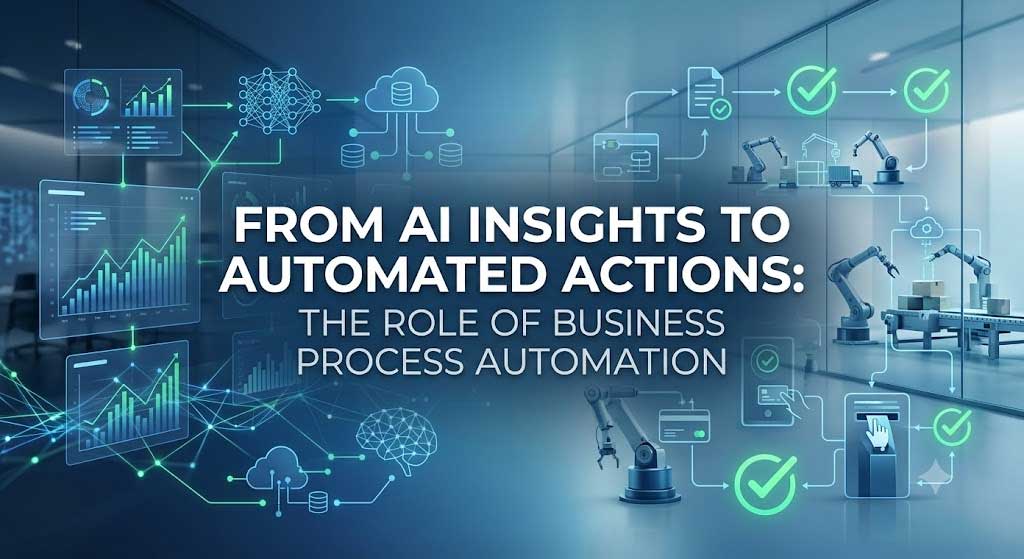
AI can identify a likely problem, but the business still needs a reliable process for responding to it. This is why Business Process Automation (BPA) is an important part of intelligent ERP transformation.
Consider an automated procurement workflow. First, the ERP system identifies an upcoming material shortage. Next, the workflow checks stock availability, open purchase orders, and approval policies. It then creates a purchase requisition or recommends an action for the procurement team. If the request exceeds the authorized spending limit, it moves to the designated approver. Finally, the system records the decision and tracks the purchase order through its subsequent stages.
This connected process reduces manual coordination and creates a traceable record of each action. More importantly, it prevents valuable AI insights from remaining unused in a dashboard.
For enterprises with changing operational requirements, a configurable no-code or low-code BPA platform can also help teams adapt workflows without rebuilding the entire ERP system for every process change. However, customization must still follow proper testing, security, and change-management procedures.
What Enterprises Must Get Right Before Adopting AI in ERP
AI implementation can create new risks when organizations overlook the quality of their data, the reliability of their integrations, or the responsibilities of human decision-makers. First, businesses need consistent master data across customers, suppliers, products, units of measurement, and financial records. Without this foundation, AI models may generate misleading forecasts or recommendations.
Second, companies should establish clear access controls and governance policies. Sensitive financial, employee, customer, and supplier information must remain protected, while AI-generated actions should be logged and reviewed according to their business impact.
Third, enterprises must distinguish between tasks suitable for full automation and decisions that require human approval. Routine notifications and predefined routing can often be automated safely, whereas significant financial commitments, supplier changes, and high-impact production decisions may require additional authorization.
Finally, businesses should measure results instead of assuming that AI adoption equals success. Relevant indicators include invoice-processing time, inventory carrying costs, forecast accuracy, purchase-order cycle time, production downtime, overdue receivables, and on-time delivery.
By connecting these measures to a clear baseline, management can determine whether an AI-enabled ERP initiative is producing meaningful operational and financial improvements.
How to Build an AI-Ready ERP Strategy Without Disrupting Operations
A practical ERP transformation should begin with a clearly defined business problem rather than a broad ambition to introduce AI everywhere. For example, a company experiencing recurring stock shortages could begin by improving inventory accuracy and integrating purchase-order information. Once reliable data is available, it could introduce demand forecasting and automated replenishment alerts. After validating the results, the business could extend automation to supplier follow-ups and exception management.
This phased approach allows teams to learn from real operational results while controlling implementation risk. It also helps organizations prioritize projects according to business value, data readiness, integration complexity, and employee adoption. Before selecting an ERP platform or AI solution, decision-makers should assess whether it supports the necessary business processes, integrates with existing applications, provides suitable reporting and access controls, and allows workflows to evolve as the organization grows.
For SMEs and growing enterprises, configurable ERP and BPA solutions can be especially useful when processes change frequently. The goal is not to purchase the largest collection of AI features. Instead, it is to establish a dependable operating system that connects data, people, decisions, and execution.

How Bluechip Solutions Can Help Businesses Move Towards Intelligent ERP
Bluechip Solutions focuses on ERP and business process automation to help organizations improve operational visibility and connect business activities through integrated workflows. Its ProfitPlus ERP and Auvit No-Code ERP and Business Process Automation offerings are relevant to businesses seeking to connect functions such as finance, inventory, procurement, production, and reporting. A configurable approach can help organizations align workflows with their operational requirements without treating every process change as a separate software development project.
For businesses exploring AI-ready ERP, the starting point is to identify where information gaps, repetitive approvals, disconnected systems, and delayed reporting are affecting performance. From there, the right combination of ERP integration, workflow automation, reporting, and appropriately governed AI capabilities can be evaluated against measurable business objectives.
The appropriate solution depends on each company’s processes, existing technology, integration requirements, and security needs. Therefore, an ERP assessment should establish the operational priorities before recommending a specific implementation.
Ready to identify the operational bottlenecks holding your business back? Explore how Bluechip Solutions can help connect your business processes and improve ERP visibility.
Book an ERP consultation: Explore Bluechipsolutions
Frequently Asked Questions About AI and Automation in ERP
How is AI changing Enterprise Resource Planning?
AI is making ERP systems more predictive and context-aware by helping businesses analyze operational data, identify anomalies, forecast demand, and recommend actions. When combined with workflow automation, these capabilities can reduce manual work and improve the speed and consistency of business decisions.
What is the difference between ERP automation and AI-powered ERP?
ERP automation executes predefined business rules, such as routing purchase approvals or sending overdue-payment reminders. AI-powered ERP adds capabilities such as pattern recognition, forecasting, classification, and contextual recommendations. Together, they help organizations connect intelligent analysis with controlled business execution.
Can small and medium-sized businesses benefit from AI in ERP?
Yes. SMEs can start with focused applications such as automated invoice processing, inventory alerts, demand forecasting, and approval workflows. A phased implementation allows them to prioritize measurable business problems before expanding into more advanced AI capabilities.
Is AI-powered ERP reliable for financial and operational decisions?
AI-powered ERP can support reliable decisions when it uses accurate data, validated models, appropriate permissions, and clear business rules. However, its outputs should be checked according to their risk, particularly for financial commitments, compliance-sensitive transactions, and critical operational decisions.
How can a company measure the ROI of AI and ERP automation?
Businesses should compare performance before and after implementation using relevant measures such as processing time, inventory costs, forecast accuracy, error rates, production downtime, and on-time delivery. They should also account for implementation costs, integration expenses, ongoing AI usage, training, and maintenance to understand the actual return.
Final Thoughts: Intelligent ERP Must Deliver More Than Faster Processing
AI and automation are reshaping enterprise resource planning by helping businesses connect operational information with timely decisions and repeatable actions. However, the strongest results do not come from adding AI to disconnected processes. They come from improving data quality, redesigning workflows, maintaining human accountability, and measuring the business outcomes that matter.
For enterprises facing rising operating costs, complex supply chains, production uncertainty, and growing customer expectations, an AI-ready ERP strategy can provide a practical path towards better visibility and more proactive management.
The next step is to identify one operational problem that materially affects your business, establish a measurable baseline, and evaluate how integrated ERP, automation, and AI can solve it. Start with a business outcome, validate the results, and scale what works.