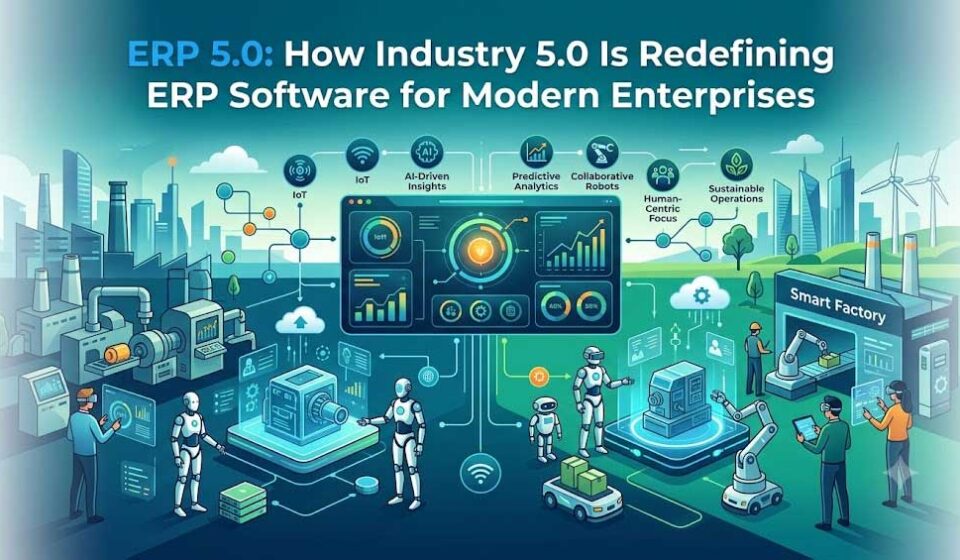

Businesses are facing growing pressure from changing customer demand, supply-chain disruptions, rising operational costs, workforce challenges and increasing sustainability expectations; therefore, traditional ERP systems that mainly record transactions and generate reports are no longer enough for modern enterprises. Industry 5.0 ERP software is changing this approach by combining artificial intelligence, real-time data, intelligent automation, predictive analytics and human decision-making to create more responsive and adaptable operations. In this evolution, ERP 5.0 goes beyond conventional automation by helping businesses predict potential problems, improve production and resource planning, strengthen operational resilience and support faster, data-driven decisions while keeping people at the centre of the process. Consequently, enterprises can move from simply managing what happened to understanding what is happening, anticipating what could happen next and taking timely action, making Industry 5.0 ERP software an important foundation for building smarter, more sustainable and future-ready businesses.
What Is ERP 5.0 and Why Does It Matter?
ERP software has traditionally been responsible for connecting finance, inventory, purchasing, sales, production, HR and other business functions. However, simply connecting departments is no longer enough for enterprises dealing with volatile demand, supply-chain disruption, rising operating costs, skilled-worker shortages and increasing sustainability expectations.
That is where Industry 5.0 ERP software becomes increasingly relevant. The term ERP 5.0 can be used to describe an Industry 5.0-ready ERP approach in which enterprise technology does more than automate processes. Instead, it combines artificial intelligence, real-time data, automation and human decision-making to create operations that are more human-centric, resilient and sustainable.
The European Commission defines Industry 5.0 around three major principles: human-centricity, sustainability and resilience. Therefore, the next generation of ERP needs to support those principles rather than focusing only on automation and efficiency. Moreover, the World Economic Forum’s 2026 outlook highlights a shift from traditional automation toward intelligent, connected and increasingly autonomous industrial operations, with humans and intelligent systems working together in real time.
Consequently, ERP is moving from being a system that records what happened to becoming a system that helps businesses understand what is happening, predict what could happen and decide what should happen next.
How Industry 5.0 Is Changing the Role of ERP Software
Industry 4.0 transformed enterprises by connecting machines, systems and data. Nevertheless, many businesses discovered that having more data does not automatically result in better decisions. A production manager may have machine data, an ERP may contain inventory information, the sales team may have changing customer requirements and finance may have cost information. Yet, if these systems remain disconnected, employees still have to manually compare information before taking action.
This creates one of the biggest operational pain points for modern enterprises: data is available, but decision-making remains fragmented. Industry 5.0 addresses this gap by putting people and intelligent technology into the same decision-making framework. Recent research also describes Industry 5.0 as the integration of human-centricity, sustainability and resilience into industrial value creation.
Therefore, ERP 5.0 should not mean replacing employees with automation. Instead, it should mean giving employees better information, better predictions and better tools so they can make faster and more informed decisions.
AI-Powered ERP Moves from Reporting to Decision Support
Traditional ERP reporting primarily answers questions such as what was sold, what was purchased, how much inventory is available and what production was completed. However, modern enterprises increasingly need answers to more practical questions.
Why is production falling behind schedule? Which orders are likely to be delayed? and Which materials could become critical next week? Which machines may require maintenance? Which customers are at risk of delayed delivery? Where are costs increasing unexpectedly?
AI-powered ERP can help transform historical and real-time business data into predictive and decision-support capabilities. For example, instead of simply showing that inventory has fallen below a predefined level, an AI-enabled ERP could analyse sales trends, production requirements, supplier lead times and existing purchase orders to identify a potential shortage before it affects production.
Similarly, predictive analytics can help businesses identify unusual cost movements, demand patterns and operational risks. This does not mean that AI should automatically make every business decision. In an Industry 5.0 environment, the stronger model is human-in-the-loop intelligence, where AI provides recommendations while employees retain appropriate control over critical decisions.
Recent Industry 5.0 research specifically highlights explainable AI and human-in-the-loop mechanisms as important components of future human-centric production systems.
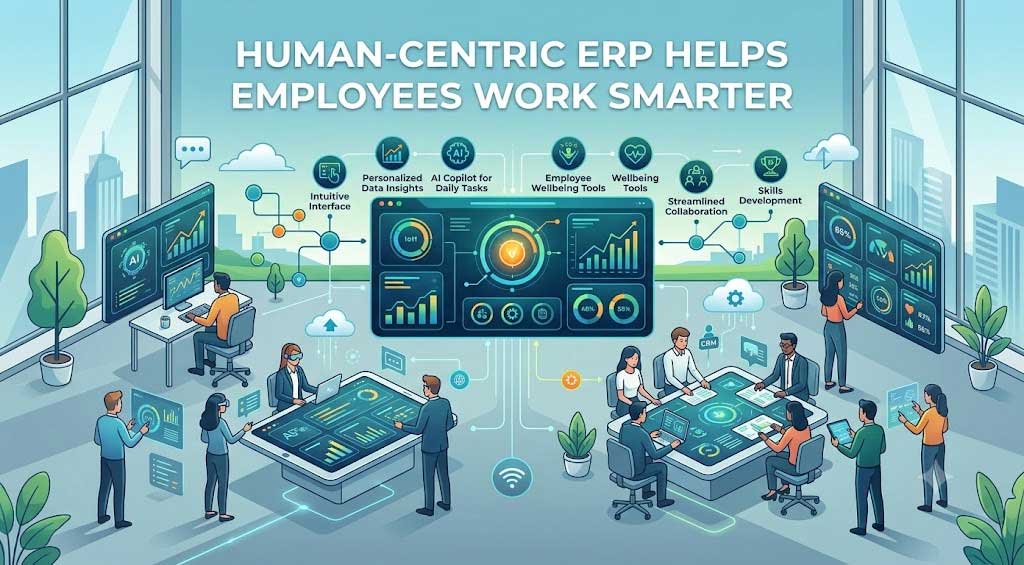
Human-Centric ERP Helps Employees Work Smarter
One of the biggest misconceptions about digital transformation is that successful automation means removing humans from the process. Industry 5.0 takes a different approach. The objective is to use technology to increase human capability rather than simply reduce human involvement. Consequently, ERP interfaces, workflows and alerts should be designed around how employees actually work.
Consider a production supervisor who currently spends hours checking spreadsheets, calling departments and comparing production schedules. A human-centric ERP can consolidate relevant information into a single operational view and highlight exceptions that require attention. Likewise, employees should not need to become data scientists to benefit from AI. Natural-language interfaces and intelligent ERP assistants can make complex business information easier to understand.
For example, a manager could ask, “Which customer orders are most likely to miss delivery this week?” Instead of searching through multiple reports, the system could analyse relevant operational information and present the result in a business-friendly format.
Research into human-centric Industry 5.0 manufacturing places ERP, MES and related enterprise systems at the system level, supporting production planning, resource allocation, inventory and operational flexibility.
Real-Time ERP Data Becomes Critical for Faster Decisions
Delayed information creates delayed decisions. This is particularly dangerous when businesses operate with changing customer demand, short production cycles or complex supply chains. A report generated at the end of the day may already be outdated when the manager receives it.
Therefore, ERP 5.0 increasingly depends on real-time or near-real-time data integration. When sales, inventory, procurement, production, finance and supply-chain information are connected, decision-makers can see the operational impact of changes much earlier. For instance, if a major customer changes an order quantity, the ERP should ideally allow planners to understand the effect on material requirements, production capacity, inventory and delivery commitments.
Consequently, real-time ERP is not simply about displaying dashboards. It is about creating a continuous information flow between business functions so that people can respond before small problems become expensive disruptions.
Sustainable ERP Connects Business Performance with Resource Efficiency
Sustainability is another major difference between traditional ERP thinking and Industry 5.0. Previously, ERP success was often measured through productivity, cost reduction, revenue and operational efficiency. However, modern enterprises increasingly need visibility into energy consumption, waste, resource utilisation, material efficiency and sustainability-related performance.
An Industry 5.0-ready ERP can help connect operational decisions with resource consumption. For example, production planning can consider material availability and resource efficiency alongside delivery requirements. Procurement decisions can incorporate supplier information, while inventory management can help reduce excess stock and avoid unnecessary material waste.
This approach matters because sustainability is no longer separate from business performance. Recent research connects Industry 5.0 with sustainable manufacturing, circular economy practices and the integration of AI and digital technologies into operational decision-making. As a result, sustainable ERP should help companies understand not only how much they produce, but also how efficiently they use the resources required to produce it.
Resilient ERP Helps Enterprises Prepare for Disruption
Supply-chain disruption has demonstrated why operational resilience matters. A supplier delay, sudden demand change, equipment failure or shortage of critical material can quickly affect production, cash flow and customer satisfaction. Traditional ERP systems may show the consequences after they occur. However, Industry 5.0-ready ERP aims to help businesses anticipate and respond to disruption earlier.
AI can analyse historical patterns, supplier performance, inventory levels, production capacity and demand information to identify potential risks. At the same time, ERP can provide alternative scenarios to planners. If one supplier cannot deliver on time, for example, the business can evaluate available inventory, alternative suppliers and revised production schedules before committing to a decision.
The objective is therefore not simply automation. It is adaptive business management. The World Economic Forum’s 2026 industrial outlook similarly identifies resilience, adaptability and human-machine collaboration as important elements of the shift toward intelligent industrial operations.
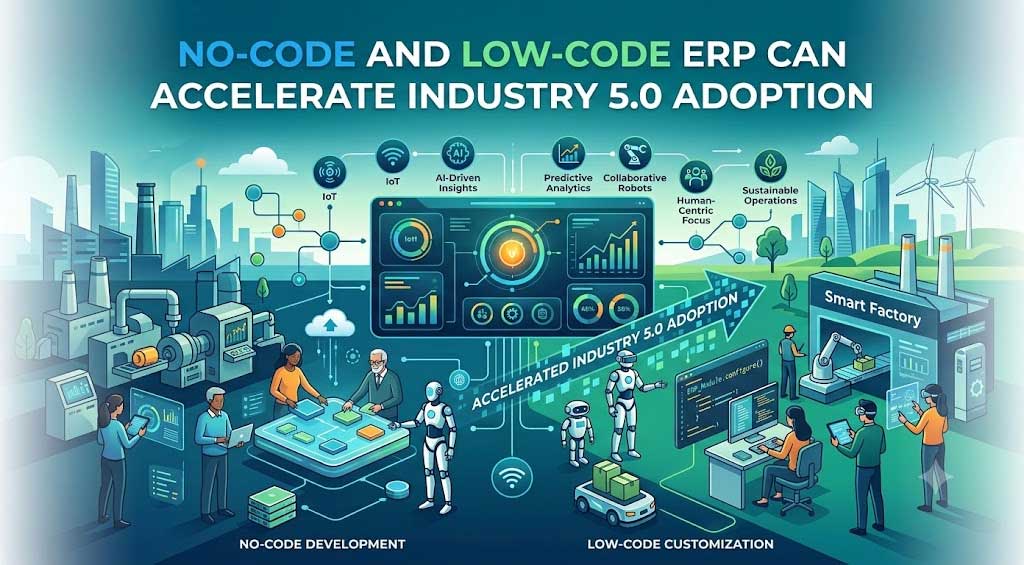
No-Code and Low-Code ERP Can Accelerate Industry 5.0 Adoption
There is another challenge that enterprises cannot ignore: every business has different processes. A standard ERP may work well initially, but organisations often need changes as their products, customers, regulations and operating models evolve. Traditional customisation can become expensive and time-consuming, which creates another barrier to digital transformation.
No-code and low-code ERP platforms can address this challenge by allowing business processes, forms, workflows and applications to be adapted with less dependence on conventional development. This becomes especially valuable for Industry 5.0 because human-centric transformation requires systems to adapt to business users rather than forcing users to adapt to rigid software.
For growing enterprises, therefore, flexibility can become just as important as functionality. An ERP platform that can evolve with changing business requirements gives organisations a practical path toward continuous improvement.
What Should Enterprises Look for in Industry 5.0 ERP Software?
Choosing an ERP for the Industry 5.0 era requires a broader evaluation than checking the number of modules available. The system should provide strong integration across business functions while supporting real-time information, AI-assisted decision-making, flexible workflows, human-centric interfaces and scalable automation.
Furthermore, enterprises should evaluate how easily the ERP can integrate with manufacturing systems, IoT devices, analytics platforms and other business applications. They should also examine data governance, security, auditability and the ability to maintain human oversight over AI-driven recommendations.
Most importantly, organisations should start with business problems rather than technology trends. If production delays are the primary problem, the ERP strategy should improve production planning and visibility. inventory is tying up working capital, the focus should be demand forecasting and inventory optimisation. If employees spend excessive time on repetitive tasks, workflow automation may deliver greater value. That approach makes Industry 5.0 practical rather than theoretical.
ERP 5.0 Is About Better Decisions, Not More Technology
The real transformation behind ERP 5.0 is not another software version. It is a change in how enterprises use technology. Industry 5.0 combines human expertise with AI, automation, connected systems and real-time data to create organisations that can respond faster without losing the human judgement required for complex decisions. Research published in 2025–2026 increasingly frames this transformation around human-centricity, sustainability, collaboration and measurable operational outcomes rather than technology adoption alone.
Therefore, companies should not ask only, “Does this ERP have AI?” A better question is, “Can this ERP help our people make better decisions, respond to disruption faster, use resources more efficiently and continuously improve operations?” That is the real opportunity behind Industry 5.0 ERP software.
Frequently Asked Questions About ERP 5.0
What is ERP 5.0?
ERP 5.0 refers to an Industry 5.0-oriented approach to enterprise resource planning that combines ERP, AI, real-time data, automation and human decision-making while focusing on human-centricity, sustainability and resilience.
Is ERP 5.0 an official ERP software standard?
No. ERP 5.0 is best understood as an emerging way of describing ERP systems aligned with Industry 5.0 principles. Industry 5.0 itself is widely associated with human-centric, sustainable and resilient industry, particularly through the European Commission’s framework.
How does Industry 5.0 differ from Industry 4.0?
Industry 4.0 primarily accelerated automation, connectivity and data-driven manufacturing. Industry 5.0 builds on those capabilities while putting greater emphasis on human-machine collaboration, sustainability and resilience.
How can AI improve ERP software?
AI can help ERP systems move beyond historical reporting by supporting forecasting, anomaly detection, predictive maintenance, demand analysis, risk identification and decision support. However, critical decisions should retain appropriate human oversight.
Can SMEs benefit from Industry 5.0 ERP?
Yes. SMEs do not necessarily need to transform their entire technology environment at once. A practical approach is to identify one high-value business problem, integrate relevant data and gradually introduce automation and AI capabilities as the organisation matures.
Build a More Human-Centric ERP Strategy
Industry 5.0 is changing the definition of a smart enterprise. The strongest organisations will not necessarily be those with the most automation. Instead, they will be the organisations that successfully combine people, data, AI and adaptable processes.
For enterprises struggling with disconnected information, manual workflows, production uncertainty, inventory pressure or slow decision-making, an Industry 5.0-ready ERP can provide a foundation for a more responsive operating model.
The next step is not to replace your existing business with technology. It is to identify where your current ERP is slowing people down and determine how intelligent automation, real-time visibility and flexible workflows can solve those problems.
Ready to explore what an Industry 5.0-ready ERP could look like for your business? Book a free ERP consultation with BlueChip Solutions and identify the processes where AI, automation and real-time ERP visibility can create measurable business value.
Lead Magnet: Download the Industry 5.0 ERP Readiness Checklist to assess your organisation’s AI readiness, real-time data visibility, process automation, workforce enablement, sustainability tracking and operational resilience.
Sources and Evidence
This article incorporates current Industry 5.0 research and 2026 industrial-technology developments, including the European Commission’s Industry 5.0 framework, the World Economic Forum’s Intelligent Industrial Operations Outlook 2026, and recent peer-reviewed research on human-centric manufacturing, AI-enabled ERP, sustainability and human-in-the-loop production systems.