
What Is Global ERP? Complete Guide to Enterprise Resource Planning for Expanding Businesses

Expanding into multiple cities, states, or countries changes how a business manages finance, inventory, procurement, production, taxation, and reporting. As operations grow across different locations, a global ERP system becomes essential for connecting business processes, centralizing data, and maintaining real-time visibility. A company that operates successfully from one location can quickly face serious operational challenges when it adds subsidiaries, warehouses, branches, or international customers. With the right ERP software, businesses can manage multi-country operations more efficiently while supporting multiple currencies, local compliance requirements, consolidated reporting, and sustainable international growth.
Different currencies, tax regulations, accounting standards, languages, time zones and business processes can create fragmented data. Consequently, management may spend more time reconciling information than using it to make decisions. This is where global ERP becomes important.
A global ERP system provides a centralized enterprise resource planning environment that can support businesses operating across multiple locations, entities and countries. Instead of forcing every branch to work independently, it connects financial, operational and administrative processes while allowing each location to follow its applicable local requirements.
For growing organizations, therefore, ERP is not simply about installing another business application. It is about creating an operating foundation that can support expansion without allowing complexity to grow faster than the business.
What Is Global ERP?
Global ERP is an enterprise resource planning system designed to manage business operations across multiple countries, legal entities, branches or geographic markets from an integrated platform.
A conventional ERP may manage finance, inventory, sales, purchasing, production and human resources for one organization. However, a ERP goes further by supporting the complexities created when those operations cross geographical and regulatory boundaries.
For example, an Indian manufacturing company may purchase raw materials from China, manufacture products in India, maintain a warehouse in the UAE and sell products to customers in Europe. Each location may have different currencies, taxes, reporting requirements and operating procedures.
Without an appropriate ERP global architecture, employees may maintain separate spreadsheets and applications for each region. As a result, headquarters can struggle to obtain a reliable consolidated view. A ERP brings those operations together while maintaining the necessary country, entity and currency-level controls.
Why Do Growing Businesses Need a Global ERP?
Business expansion usually creates a data problem before it creates a technology problem. Initially, a company may manage accounting through one application, inventory through spreadsheets and sales through another system. That approach can work when transaction volumes are low and the organization has only one operating location.
However, once the business expands, the weaknesses become increasingly visible. Finance teams may reconcile multiple systems manually. Operations teams may not know the actual inventory available at another warehouse. Management may wait days or weeks for consolidated reports. Furthermore, different branches may follow different processes, making it difficult to compare performance.
ERP addresses this fragmentation by creating a connected operational environment. Instead of asking, “Which spreadsheet contains the latest numbers?”, management can work from a centralized system of record. This becomes particularly valuable when the organization needs faster reporting, better financial control and real-time visibility across locations.
How Does Global ERP Work Across Multiple Countries?
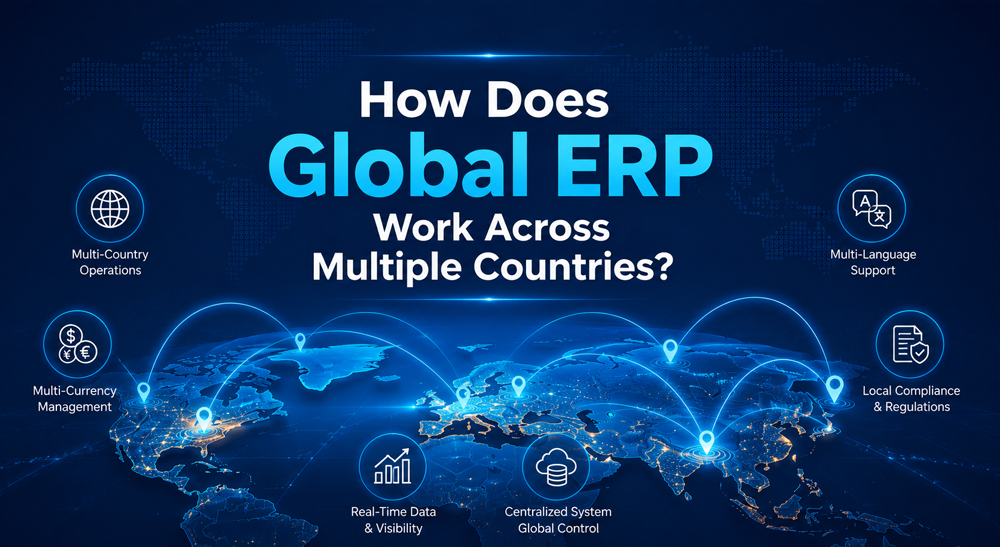
A ERP typically uses a centralized architecture combined with localized configurations. The central system can maintain common master data, workflows, reporting structures and corporate policies. At the same time, individual entities can operate according to their local tax, accounting, currency and regulatory requirements.
This balance is important. A multinational company should not have to build a completely different ERP system every time it enters another country. Instead, the ERP should provide a common operational foundation while allowing appropriate localization. Country-specific requirements can include taxation, statutory reporting, invoicing formats, accounting practices and language requirements. Microsoft, for example, describes localization as adapting ERP functionality to country-specific laws, regulations and commercial requirements.
Therefore, a strong global ERP strategy combines standardization where possible with localization where necessary.
Multi-Currency Management Is a Core Global ERP Requirement
Currency management becomes one of the first challenges when a company expands internationally. Consider a business headquartered in India with subsidiaries in the UAE and United States. The organization may need to conduct transactions in INR, AED and USD while maintaining consolidated financial reporting in its corporate currency.
A ERP should therefore support multiple transaction currencies, exchange rates, currency conversion and consolidated reporting. More importantly, the system should maintain the relationship between the original transaction value and the reporting value. This allows finance teams to understand both local performance and consolidated corporate performance. Consequently, organizations can reduce manual currency calculations and improve financial consistency across entities.
ERP and Tax Compliance
Tax compliance is another area where international expansion can become complicated. Different countries can have different tax structures, reporting requirements, invoice rules and filing processes. Moreover, regulations can change over time. Therefore, a global ERP should provide appropriate localization capabilities rather than assuming that one accounting configuration can work everywhere.
A well-designed system can help organizations maintain country-specific tax configurations while preserving centralized financial visibility. However, businesses should not assume that an ERP automatically guarantees compliance. Compliance depends on the correct configuration, current regulatory requirements, implementation practices and ongoing maintenance. That distinction is particularly important when selecting a global ERP vendor.
ERP for Financial Consolidation
As businesses expand, consolidated financial reporting becomes increasingly important. A parent company may have several subsidiaries, each maintaining its own revenue, expenses, assets, liabilities and operational transactions. Consequently, management needs to combine this information into a consolidated view. A ERP can connect these entities and provide centralized reporting while retaining entity-level visibility.
For example, management could examine the overall group revenue and then drill down into a particular country, subsidiary, branch or business unit. This creates a much clearer connection between local performance and corporate strategy.
Supply Chain Visibility Across Locations
International growth also makes supply chain management considerably more difficult. Inventory may move between factories, warehouses, distributors and customers located in different regions. Meanwhile, procurement may involve international suppliers with different lead times and currencies.
Without integrated information, businesses can experience excess inventory in one location while another location faces shortages. Global ERP helps connect purchasing, inventory, warehouse operations, sales and production. Consequently, decision-makers can gain a more complete view of stock movement and supply requirements. This is especially important for manufacturers and distributors where inventory represents a significant portion of working capital.
Global ERP and AI: Why Intelligent ERP Matters in 2026
Global ERP is also evolving beyond traditional transaction processing. Gartner’s 2026 ERP research highlights three major themes: connected data and flexible ERP architectures, advanced insights and AI-driven autonomous ERP. Similarly, Gartner predicts that cloud ERP finance applications with embedded AI assistants could enable a 30% faster financial close by 2028. Gartner also reports that AI-enabled solutions are expected to account for 62% of cloud ERP spending by 2027, compared with 14% in 2024.
For global businesses, this means AI can increasingly become part of everyday ERP processes rather than remaining a separate analytics tool. AI can help identify unusual transactions, improve forecasting, highlight supply chain exceptions, support financial analysis and automate repetitive workflows.
However, AI should operate on reliable business data and within appropriate governance controls. PwC similarly emphasizes that ERP provides the governed operational foundation while AI adds intelligence, prediction and orchestration. Therefore, companies should first build a strong ERP data foundation and then use AI to enhance decision-making.
Global ERP vs Traditional ERP
The fundamental difference is scale and complexity. Traditional ERP can effectively manage an organization’s core processes. However, global ERP is designed around the additional requirements created by multiple entities, countries and operating environments.
The difference becomes particularly clear in areas such as multi-currency accounting, country-specific taxation, localized reporting, multilingual operations, intercompany transactions and consolidated financial reporting. Therefore, a business should not choose a global ERP simply because it has international ambitions. Instead, it should evaluate whether its operational complexity actually requires these capabilities.
What Problems Can Global ERP Solve?
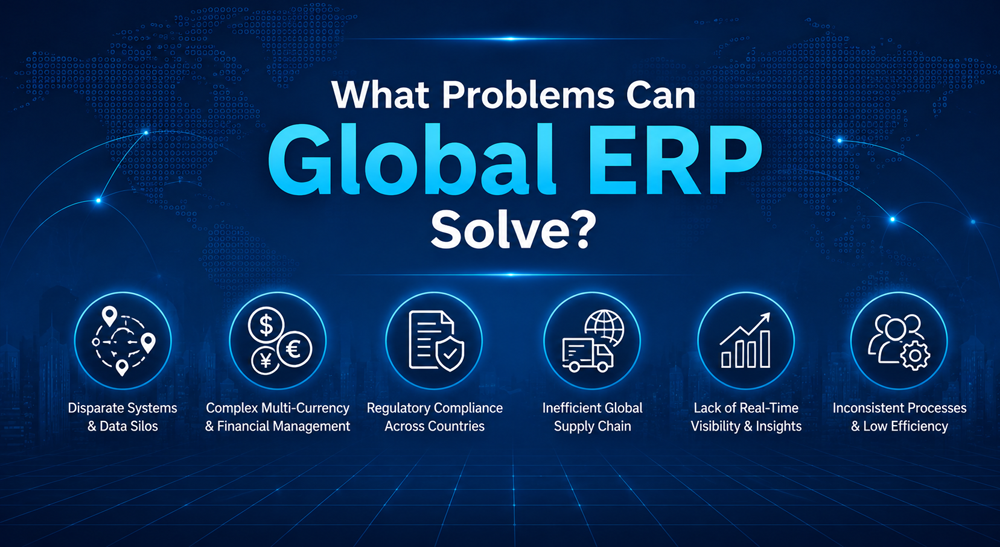
Many businesses begin searching for global ERP only after operational problems have already appeared. Management may notice inconsistent financial figures between branches. Finance teams may spend excessive time consolidating reports. Procurement may lack visibility into group-wide purchasing. Sales teams may not know actual inventory availability. Meanwhile, executives may struggle to understand which markets are genuinely profitable.
These are not isolated problems. They are usually symptoms of disconnected processes and fragmented information. A properly implemented global ERP addresses the underlying problem by connecting business functions through a common operational framework. The objective is not simply to replace spreadsheets. Instead, the objective is to create a reliable flow of information from transaction to analysis and, increasingly, from analysis to action.
How to Choose the Right Global ERP Software
Choosing global ERP requires more than comparing feature lists. First, businesses should examine whether the system genuinely supports their countries, currencies and legal entities. Next, they should evaluate integration capabilities because global operations rarely exist inside a single application. The implementation methodology is equally important.
Gartner warns that more than 70% of recently implemented ERP initiatives are projected to fail to fully meet their original business-case goals by 2027, with up to 25% potentially failing catastrophically. Consequently, the ERP vendor’s implementation expertise, data migration approach, user training, customization strategy and post-go-live support deserve as much attention as the software itself.
Businesses should also consider whether the ERP can adapt as their operating model changes. Flexible, modular and composable architectures are increasingly important because organizations do not remain static after implementation.
Why Flexible and No-Code ERP Can Matter for Global Expansion
International businesses frequently need changes to workflows, approval structures, forms, reports and integrations. However, traditional customization can become expensive and time-consuming. A flexible or no-code ERP approach can allow organizations to adapt business processes without rebuilding the entire application. This can be particularly useful when different entities require localized workflows while the organization still wants a common technology foundation.
Bluechip Solutions, for example, positions its AUVIT framework around no-code enterprise application development, AI/ML integration, scalability and ERP customization. The company also states that it has more than 26 years of experience and provides implementation and managed services for enterprise applications.
For a growing organization, this type of flexibility can help reduce the gap between what the ERP provides out of the box and what the business actually needs.
Is Global ERP Suitable for Small and Medium-Sized Businesses?
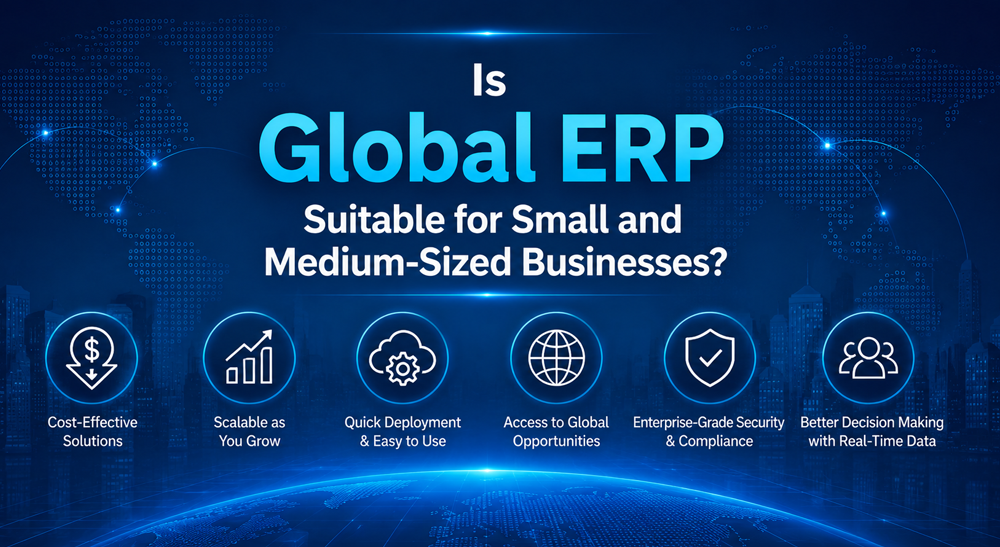
Global ERP is not limited to large multinational corporations. A growing SME can benefit from global ERP when it is preparing to enter new countries, establish subsidiaries, operate multiple warehouses or manage international customers and suppliers.
In fact, implementing the right architecture earlier can prevent the company from accumulating disconnected systems that later become expensive to replace. The key is selecting an ERP that scales with the organization rather than purchasing an unnecessarily complex platform.
Frequently Asked Questions About Global ERP
What is global ERP?
Global ERP is enterprise resource planning software designed to manage operations across multiple countries, entities, branches or locations while supporting requirements such as multi-currency transactions, localization, compliance, consolidated reporting and centralized business management.
What is the difference between global ERP and traditional ERP?
Traditional ERP primarily manages an organization’s core business processes, while global ERP adds capabilities required for geographically distributed operations, including multiple currencies, countries, entities, localized compliance and consolidated reporting.
Does global ERP support multiple currencies?
Yes. A capable global ERP should support transactions in multiple currencies, exchange-rate management, currency conversion and consolidated financial reporting.
Can global ERP handle country-specific tax requirements?
A properly localized global ERP can support country-specific tax and statutory requirements. However, businesses must verify that the chosen ERP supports the specific countries in which they operate and that configurations remain aligned with applicable regulations.
Can AI be integrated into global ERP?
Yes. Modern ERP platforms increasingly incorporate AI for forecasting, anomaly detection, automation, analytics and intelligent decision support. Gartner’s 2026 ERP research specifically identifies AI-driven autonomous ERP and connected data as major areas of development.
When should a growing company move to global ERP?
A company should consider global ERP when multiple locations, entities, currencies, regulatory environments or disconnected systems begin creating reporting delays, operational inefficiencies or control problems. Implementing before complexity becomes unmanageable can make expansion easier.
Build a Global ERP Foundation Before Expansion Becomes Complicated
International growth should create new opportunities, not new spreadsheets. When finance, inventory, procurement, production, sales and reporting operate through disconnected systems, expansion can quickly expose weaknesses that were previously hidden. Global ERP provides a way to establish common processes, centralized visibility and localized control across a growing organization.
Moreover, the next generation of global ERP is moving beyond basic transaction management. Connected data, cloud architecture, automation, AI and intelligent decision support are increasingly becoming part of the ERP environment. Gartner’s latest ERP research reflects this transition toward flexible, connected and AI-enabled enterprise systems.
For businesses evaluating ERP global solutions, the most important question is therefore not simply “Which ERP has the most features?” The better question is:
“Can this ERP manage where our business is today, while adapting to where we plan to operate tomorrow?”
That is the foundation of a sustainable global ERP strategy.
Ready to Evaluate a Global ERP for Your Business?
If your organization is managing multiple locations, international customers, different currencies, disconnected accounting systems or expanding operations, now is the right time to evaluate whether your ERP can support the next stage of growth.
Get a free global ERP consultation from Bluechip Solutions and discuss your business processes, localization requirements, integrations, reporting needs and expansion plans with an ERP specialist.
Explore Bluechip Solutions ERP
Download the Free Global ERP Readiness Checklist: 25 Questions to Ask Before Choosing an ERP for Multi-Country Operations.



Managing operations across multiple countries can quickly become complicated, especially with different currencies, tax rules, and reporting requirements. I found the discussion of standardization, localization, multi-currency management, and AI particularly useful for understanding how global ERP can support business growth. The emphasis on choosing a flexible system that can adapt to future expansion is also an i