
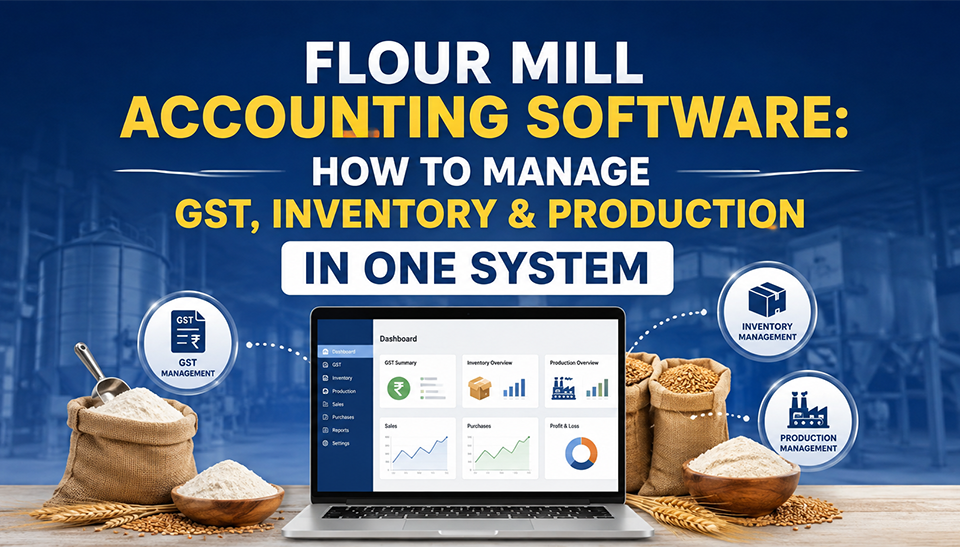
Flour Mill Accounting Software: How to Manage GST, Inventory & Production in One System

Running a flour mill is not simply about buying wheat, processing it and selling flour. Behind every production batch, there are purchasing costs, stock movements, milling losses, by-products, labour expenses, packaging costs, GST calculations, customer orders, payments and profitability decisions. When businesses manage these activities through separate spreadsheets, accounting applications, and production registers, even a small mismatch can make it difficult to determine the actual cost and profit of the business.
That is where flour mill accounting software becomes valuable. Instead of maintaining accounting, inventory and production separately, a connected system can bring financial transactions, raw-material stock, production records, finished goods and GST-related information into one operational flow.
For flour mills in India, this is particularly important because wheat and other cereals move through several stages before becoming saleable products. Therefore, the accounting system should not only record sales invoices. It should also connect purchases, stock consumption, production, wastage, by-products and final sales so that management can see what is actually happening inside the mill.
Why Flour Mills Need More Than Traditional Accounting Software
A conventional accounting package may handle ledgers, invoices, receivables, payables and taxation. However, flour mills have an additional requirement: the financial records must reflect what is physically happening on the production floor.
For example, suppose a mill purchases wheat in large quantities. The wheat enters the warehouse, moves into production, undergoes processing, and produces different outputs such as flour and milling by-products. If the accounting system only records purchases and final sales, management can track the money spent and earned, but it cannot determine whether the production process operates efficiently.
Consequently, flour mill businesses need software that connects accounting with inventory and production management.
This connection becomes even more useful when raw-material prices fluctuate. Since wheat is a major input, even a relatively small change in purchase cost can affect the profitability of the final product. Therefore, management needs accurate information about purchase rates, stock valuation, consumption, production cost and selling price before making pricing decisions.
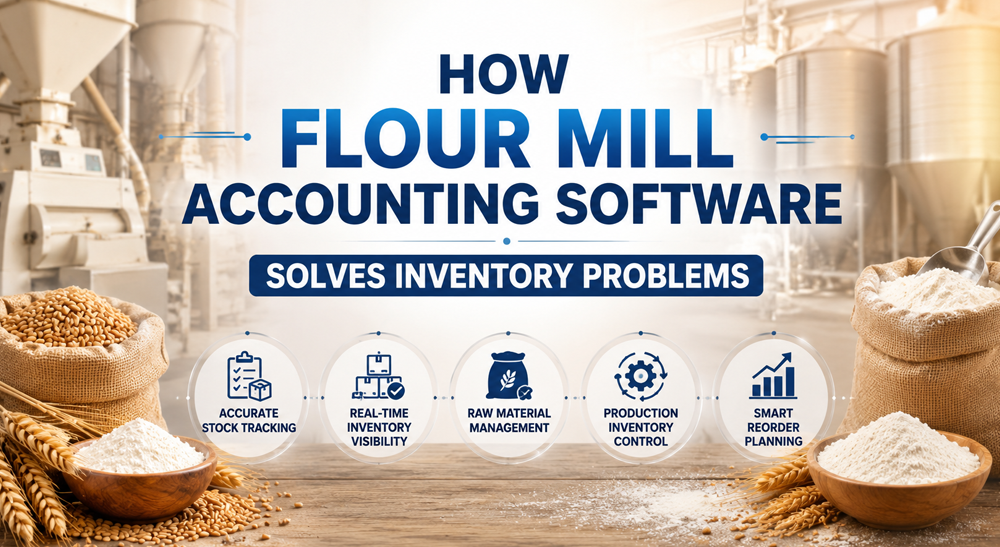
How Flour Mill Accounting Software Solves Inventory Problems
Inventory is one of the biggest operational pain points for flour mills. Wheat may be purchased from different suppliers at different prices, while finished products can include multiple varieties, grades, pack sizes and brands. When stock is maintained manually, discrepancies can appear between physical stock and accounting records. Furthermore, identifying slow-moving inventory becomes difficult when management has to combine information from multiple spreadsheets.
A flour mill inventory management system can create a continuous connection between purchasing, warehouse stock, production consumption and finished-goods inventory.
When wheat is received, the quantity and purchase value can be recorded. Then, when material is issued for production, the system can reduce the corresponding raw-material stock. After production is completed, finished flour can be added to inventory based on the production transaction.
As a result, management gets a clearer picture of how much raw material is available, how much has been consumed and how much finished product is ready for dispatch. More importantly, inventory visibility helps reduce situations where purchasing decisions are made simply because somebody believes stock is running low. Instead, purchasing can be based on actual inventory levels and business requirements.
Managing Flour Production and Milling Yield Accurately
Production management is where a generic accounting application often falls short. A flour mill needs to understand the relationship between input material and output. When wheat enters the milling process, the final output may not simply equal the original input quantity. Processing can produce flour, bran and other residues, while operational losses and variations can also occur.
Therefore, flour production management software should allow the business to define production processes and record actual output.
Consider a mill processing a particular quantity of wheat. The system can record the raw material consumed and the resulting finished products. Consequently, management can compare planned production with actual production and investigate significant differences.
This becomes particularly useful when production yields change over time. If the same quantity of wheat is consistently producing lower-than-expected saleable output, management can investigate whether the issue is related to raw-material quality, machine efficiency, process settings, wastage or another operational factor.
Thus, production data becomes more than a factory record. It becomes a financial decision-making tool.
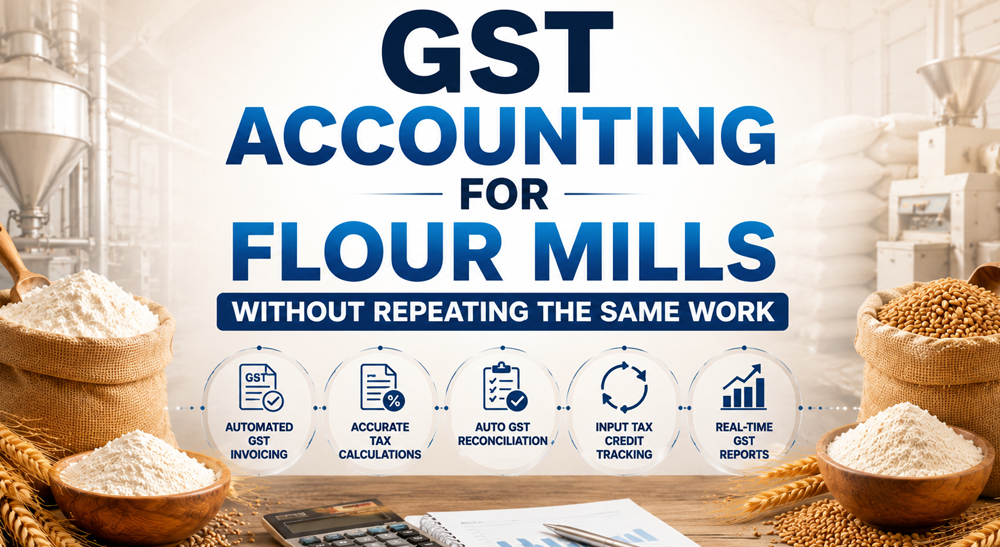
GST Accounting for Flour Mills Without Repeating the Same Work
GST compliance is another area where flour mills need careful control because tax treatment can depend on the exact product, classification and manner of sale.
For example, CBIC’s GST rate schedule includes wheat or meslin flour under heading 1101, with specific treatment based on factors such as packaging and branding. In addition, GST treatment can differ for certain cereal products and milling by-products. CBIC has also issued clarifications concerning GST treatment of products arising from milling activities.
Because tax notifications and classifications can change, a good GST accounting software for flour mills should not rely on hard-coded assumptions. Instead, the business should be able to maintain appropriate HSN, tax-rate and product masters and update them when applicable rules change.
The bigger advantage, however, is eliminating repetitive data entry.
When a purchase invoice is entered, the corresponding accounting and inventory information can flow into the relevant records. Likewise, when a sales invoice is generated, the system can calculate the applicable tax based on the configured product and transaction information.
Consequently, the finance team spends less time transferring information between separate systems and has a better audit trail for reviewing transactions. Tax configuration should always be reviewed against the latest applicable GST notifications and, where necessary, with a qualified tax professional.
Controlling Purchase Costs and Supplier Performance
For a flour mill, purchasing is directly connected to profitability. Two suppliers may offer the same type of wheat at different rates. However, the cheapest purchase price does not necessarily represent the best commercial decision if quality, yield, delivery reliability or payment terms are different.
A connected flour mill ERP software solution can help management examine supplier transactions alongside inventory and production information. Over time, the business can identify purchasing patterns, compare supplier rates and understand how procurement decisions affect production costs.
Furthermore, purchase orders, goods receipts and supplier invoices can be connected. Therefore, discrepancies between ordered quantities, received quantities and invoiced quantities become easier to identify. This provides finance and purchase teams with better control without creating additional manual reconciliation work.
Understanding the Real Cost of Flour Production
One of the most important questions for any flour mill is simple: How much does it actually cost to produce one unit of finished product?
Unfortunately, this question is difficult to answer accurately when raw-material costs, electricity, labour, packaging, production expenses and wastage are recorded separately. A modern flour mill accounting system can bring these costs together to create a more meaningful view of production cost.
For example, raw-material consumption can be connected with production records, while additional manufacturing expenses can be accounted for according to the company’s costing method. As a result, management can move beyond simply asking, “How much did we sell?” and start asking, “How profitable was that production?”
That distinction is critical when flour prices are competitive and margins are under pressure.
Connecting Sales, Receivables and Inventory
Sales teams also benefit when accounting and inventory are connected. When a customer places an order, the business needs to know whether the required product is actually available. If sales information exists separately from inventory, employees may have to call the warehouse or check another spreadsheet before confirming an order.
With integrated software, sales orders, stock availability, invoices and receivables can be connected. Consequently, the business can respond faster to customers while reducing the risk of promising products that are not available. At the same time, the finance team can monitor outstanding customer payments. Therefore, management gets a more complete picture of both sales performance and cash-flow requirements.
How AI Can Improve Flour Mill Business Decisions
The next stage of flour mill accounting software is not simply automation. It is intelligent analysis. AI-assisted ERP systems can analyse historical purchasing, inventory, production and sales information to identify patterns that may otherwise be difficult to notice.
For instance, the system could help identify unusual inventory movements, recurring production variances, slow-moving products or changes in purchasing costs. Similarly, management dashboards can make it easier to identify areas requiring attention instead of manually reviewing large amounts of transactional data.
However, AI should support—not replace—business judgment. The quality of AI-based insights depends on the accuracy, completeness and consistency of the underlying business data. Therefore, the first priority should always be creating reliable accounting, inventory and production records.
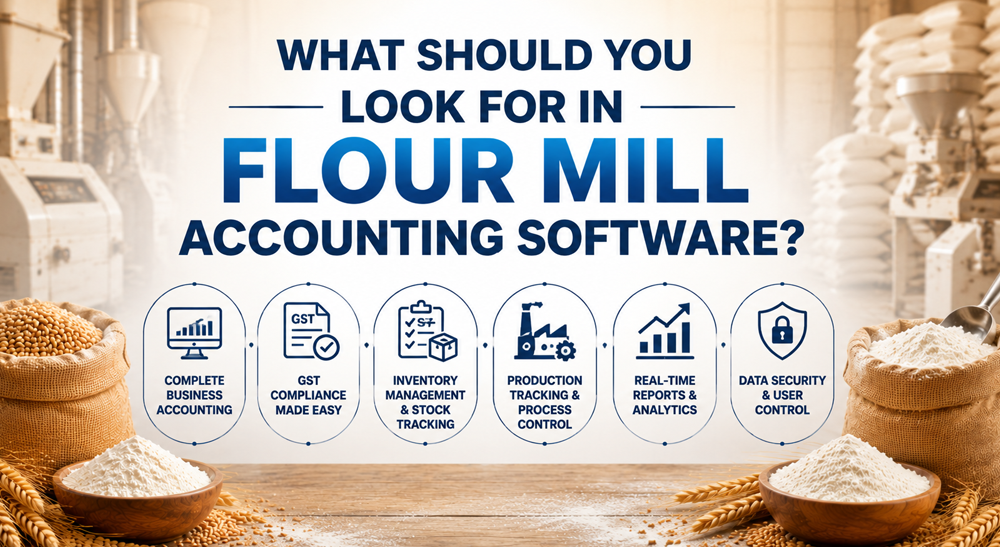
What Should You Look for in Flour Mill Accounting Software?
The right system should fit the way a flour mill actually operates rather than forcing the business to redesign its processes around generic accounting screens. The most important consideration is integration. Accounting, GST, purchasing, inventory, production, sales and reporting should work as connected functions.
Furthermore, the system should provide configurable product and tax masters, production tracking, stock visibility, supplier management, customer receivables and management reporting. It should also provide appropriate audit trails and user controls because financial and production data must remain reliable as more employees begin using the system.
Most importantly, the software should be scalable. A small flour mill may initially require accounting and inventory, but as production capacity, product varieties, warehouses, distributors and branches increase, the software should be capable of supporting that growth.
Why Integrated Flour Mill ERP Is Better Than Multiple Disconnected Systems
Using one application for accounting, another for inventory and spreadsheets for production may appear inexpensive initially. However, the hidden cost is the time spent reconciling information. For example, if the accounting stock says one quantity while the warehouse register shows another, employees must investigate the difference. Similarly, if production data is maintained separately, finance may not immediately understand why product costs have changed.
An integrated flour mill ERP system reduces these information gaps by connecting operational transactions. Therefore, instead of asking three different teams for three different reports, management can work from a common data structure. That creates a more reliable foundation for purchasing, production planning, pricing and profitability decisions.
Frequently Asked Questions About Flour Mill Accounting Software
What is flour mill accounting software?
Flour mill accounting software helps flour mill businesses manage their accounting activities and day-to-day operational requirements in one system Depending on the solution, it can connect GST accounting, purchasing, inventory, production, sales, receivables, payables and reporting in one system.
Can flour mill software manage GST?
Yes. A suitable system can maintain GST-related transaction information, HSN and tax configurations and generate tax-related reports. However, businesses must maintain GST rates and classifications according to the latest applicable rules and notifications.
Can flour mill ERP track wheat consumption and finished flour?
Yes. Production-oriented ERP software can record raw-material consumption and finished-goods production, allowing the business to compare input, output and production variances.
Can the software calculate flour production cost?
It can help calculate production cost by connecting raw-material consumption with relevant manufacturing and operating costs according to the costing method configured by the business.
Is ERP suitable for small and medium-sized flour mills?
Yes. The important factor is scalability and suitability rather than company size. A growing flour mill can start with core accounting, inventory and production requirements and expand the system as its operations become more complex.
The Business Case for Moving to One Connected System
A flour mill does not become more profitable simply because it installs new software. The real value comes when the software solves problems that affect everyday decisions.If you lack reliable stock information, you cannot manage inventory effectively. If you cannot track production costs accurately, you struggle to set the right prices. When GST data remains disconnected from invoices, your team repeats compliance work unnecessarily. If receivables are not visible, cash-flow pressure can arrive unexpectedly.
Therefore, the objective should not be to purchase another accounting application. The objective should be to create a connected business system where money, material and production information tell the same story.
India’s food-processing sector continues to expand, with the food-processing market estimated at ₹33,052.5 billion in FY2025 and projected to reach ₹65,835 billion by FY2034, according to IBEF’s May 2026 industry update. This growth creates opportunities for processors, but it also increases the importance of operational efficiency, traceability and better financial control.
For a flour mill planning to improve margins, reduce manual work and gain better visibility into operations, integrated flour mill accounting software can provide the foundation.
Ready to Bring Accounting, Inventory and Production Together?
If your flour mill is still managing accounts, stock and production through separate applications or spreadsheets, it may be time to evaluate an integrated ERP approach.
Book a free ERP consultation with BlueChip Solutions to understand how accounting, GST, inventory, production and business reporting can be connected in one system.
You can also use a practical Flour Mill ERP Readiness Assessment to identify where your current accounting, inventory and production processes are losing time, accuracy and visibility before selecting a new system.