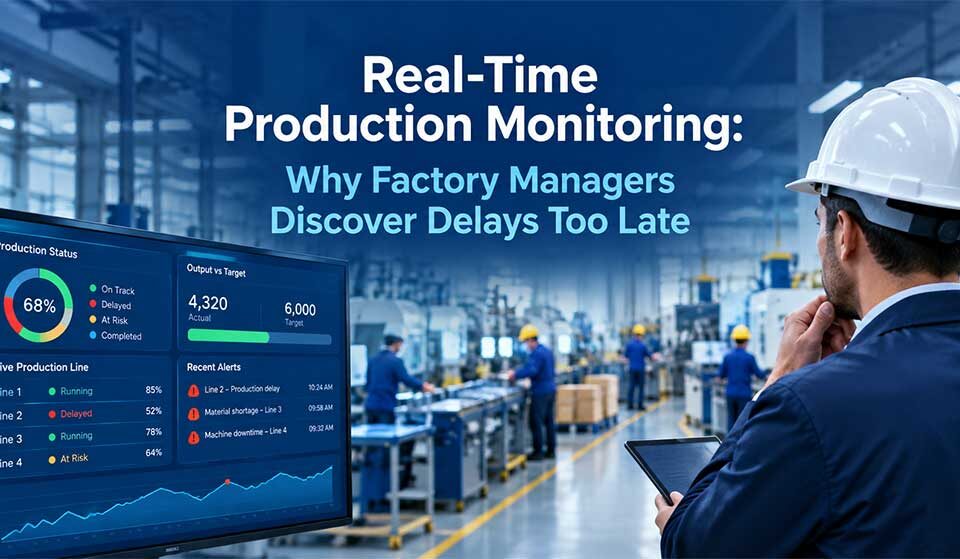
Real-Time Production Monitoring: Why Factory Managers Discover Delays Too Late

A production delay rarely begins when a customer calls to ask where an order is. It usually starts much earlier, when a machine runs below its expected rate, a component fails to arrive, a quality inspection remains pending, or a work order waits unnoticed between two production stages. By the time the factory manager receives the daily report, several small problems may already have become one expensive delivery failure.
For manufacturing companies, the real challenge is not simply increasing production speed. Instead, it is identifying deviations early enough to correct them before they affect output, costs and customer commitments. Real-Time Production Monitoring addresses this problem by connecting live work-order progress, planned production targets, actual output, downtime information and operational alerts in one actionable view.
However, installing a dashboard alone will not solve the problem. Manufacturers need reliable shop-floor data, clear performance thresholds and workflows that help the right person respond when production moves away from plan. When managers connect these capabilities through manufacturing ERP software, they can identify production losses early and control risks before they disrupt operations.
Why Factory Managers Discover Production Delays Too Late
Many factories still depend on shift-end reports, spreadsheets, phone calls and updates collected from supervisors. Although these methods may work when operations are simple, they become unreliable as the number of machines, work orders, product variants and customer commitments increases.
Consider a factory that plans to manufacture 1,000 components during a shift. At the midpoint, the expected output is 500 units. However, the machine has produced only 340 units because of repeated short stoppages. If the supervisor reports the issue at the end of the shift, management loses the opportunity to recover output through an approved schedule adjustment, maintenance intervention or resource reallocation.
The problem becomes more serious when several departments depend on the same production order. A delay in machining can affect assembly, quality inspection, packing and dispatch. Consequently, a small shop-floor issue can turn into overtime expenses, missed delivery dates and unplanned inventory movements.
Industry evidence reinforces the importance of addressing downtime systematically. In its 2025 manufacturing downtime research, L2L reported that six in ten surveyed manufacturing companies experienced annual downtime losses exceeding $250,000. The survey included more than 600 U.S. manufacturing leaders, so manufacturers should not apply these figures directly to every Indian factory. Nevertheless, they demonstrate why delayed visibility deserves management attention.
Therefore, manufacturers need more than frequent reporting. They need production information that reaches decision-makers while corrective action can still make a difference.
What Is Real-Time Production Monitoring in Manufacturing?
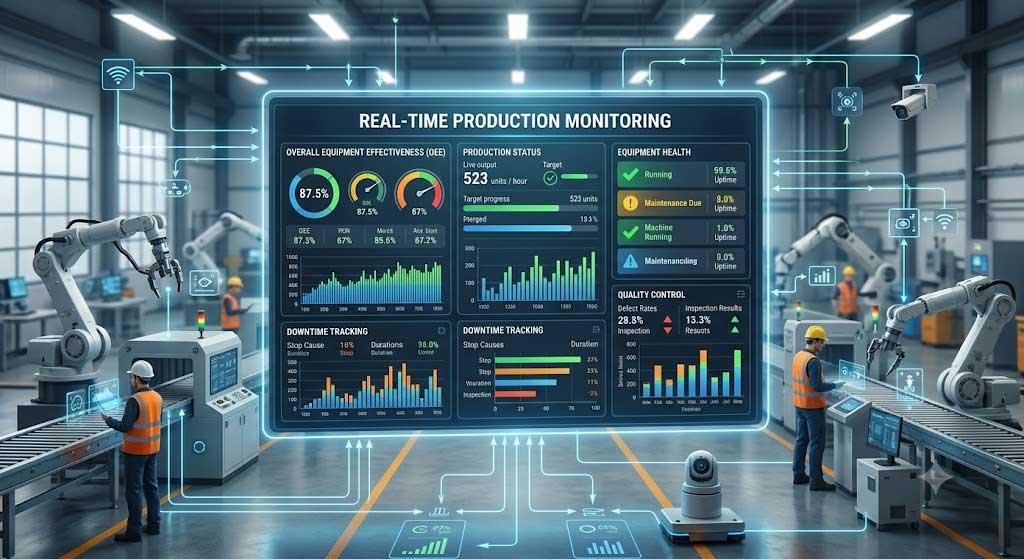
Real-Time Production Monitoring is the continuous or near-real-time tracking of production activities against planned schedules, output targets, machine availability and quality requirements. It helps managers understand what is happening on the shop floor, where performance is deviating from expectations and which action requires immediate attention.
Depending on the factory’s equipment and software, production information may come from machine sensors, programmable logic controllers (PLCs), operator terminals, barcode scans, quality records or ERP transactions. The monitoring platform then organizes these events into meaningful operational information.
For example, a production manager should be able to identify whether a work order has started, how many units have been completed, whether rejected parts are increasing and whether the next operation has sufficient material to continue. Furthermore, the manager should be able to connect that information with planned completion dates and customer delivery commitments.
When monitoring is integrated with manufacturing ERP software, production data can also be related to inventory consumption, material availability, purchase orders, labour allocation and production costs. As a result, managers gain a broader view of the business impact rather than seeing machine performance in isolation.
Five Production Problems Real-Time Monitoring Can Detect Before They Escalate
1. Live Work-Order Status Reveals Hidden Production Delays
A work order can remain open in the ERP system even when the physical job has stopped moving. For example, an operator may finish one operation, but the next workstation may be unavailable. Without timely status updates, the system may show the order as active without revealing that it is waiting.
Real-Time Production Monitoring helps distinguish between work that is running, work that is waiting, work that is blocked and work that has been completed. When operation-level timestamps and completion quantities are recorded consistently, managers can identify where jobs are spending excessive time.
More importantly, connecting work orders to their planned start and finish times makes it easier to identify orders that are at risk of missing their deadlines. Managers can then investigate the cause, check resource availability and adjust priorities before the delay spreads to downstream operations.
2. Production Target vs Actual Output Exposes Performance Gaps
Meeting the daily production target is important, but the end-of-shift total does not explain when performance started to decline. A factory may produce 800 units against a target of 1,000, yet the final figure alone cannot reveal whether the shortfall resulted from slow cycle times, changeovers, material shortages or unplanned stoppages.
A production dashboard should compare planned and actual output by hour, shift, machine, production line and work order. It should also account for scheduled breaks, planned maintenance and other approved production conditions where relevant.
For instance, suppose a line should produce 100 units per hour but consistently produces 75. A live dashboard can highlight the deviation while the shift is still running. The supervisor can then check cycle times, operator availability, tool condition and material supply. Consequently, managers can investigate the reason for the gap instead of pressuring teams to increase output without understanding the underlying constraint.
3. Bottleneck Detection Identifies Where Throughput Is Being Lost
A factory’s slowest production stage often determines how much finished output the entire operation can deliver. However, bottlenecks can move between processes as product mix, machine availability and material supply change. For example, a machining centre may initially constrain production. After maintenance resolves that issue, the bottleneck may move to assembly or inspection. A dashboard that tracks only total factory output may fail to reveal this change.
To address the problem, manufacturers should monitor operation cycle times, queue lengths, waiting periods, work-in-progress levels and downstream capacity. Comparing these measures across connected production stages helps identify where jobs accumulate and why the next stage cannot maintain its expected rate.
Furthermore, historical production records can show whether a bottleneck is recurring during particular shifts, product variants or changeovers. Managers can then evaluate practical corrective actions, such as rescheduling work, balancing workloads, improving material availability or reviewing maintenance plans. The objective is not to keep every machine busy at all times. Instead, it is to improve overall throughput without creating unnecessary work-in-progress, excess inventory or quality risks.
4. Delayed Jobs Become Visible Before Delivery Commitments Are Missed
Not every production delay has the same commercial impact. A job that is running behind schedule may still have sufficient recovery time, whereas a smaller delay on a high-priority customer order could disrupt dispatch. Therefore, effective Production Monitoring Software should connect work-order progress with promised completion dates, operation dependencies, material readiness and dispatch priorities. This enables managers to distinguish between a minor deviation and a delivery-critical exception.
For example, if an order due tomorrow is waiting for a component that has not been issued, the system should help the team identify the missing material, responsible department and required next action. Where appropriate, alerts can notify production planning, stores or procurement rather than leaving the production supervisor to coordinate every issue manually.
As a result, the factory can prioritize recovery actions based on customer impact, resource constraints and delivery risk rather than relying solely on the age of an open work order.
5. Downtime and Quality Alerts Reveal the Real Cause of Lost Output
Low output is not always a scheduling problem. It may result from machine faults, repeated micro-stoppages, excessive setup times, quality rejections or rework that consumes capacity without producing saleable goods.
A useful monitoring system therefore records downtime duration and reason codes alongside production quantities, rejected units and rework. Where machine connectivity is available, equipment signals can capture selected events automatically. Operators can supplement these records with explanations that machines cannot determine independently.
For instance, if output falls after every product changeover, the issue may relate to setup procedures rather than equipment reliability. Similarly, if production volume appears normal but rejected units rise, the factory may be creating a quality problem that will increase costs later.
By connecting downtime and quality information to work orders, production managers can investigate recurring losses with greater accuracy. In turn, maintenance, quality and operations teams can work from the same evidence rather than maintaining separate versions of the problem.
What Should a Real-Time Production Dashboard Actually Show?
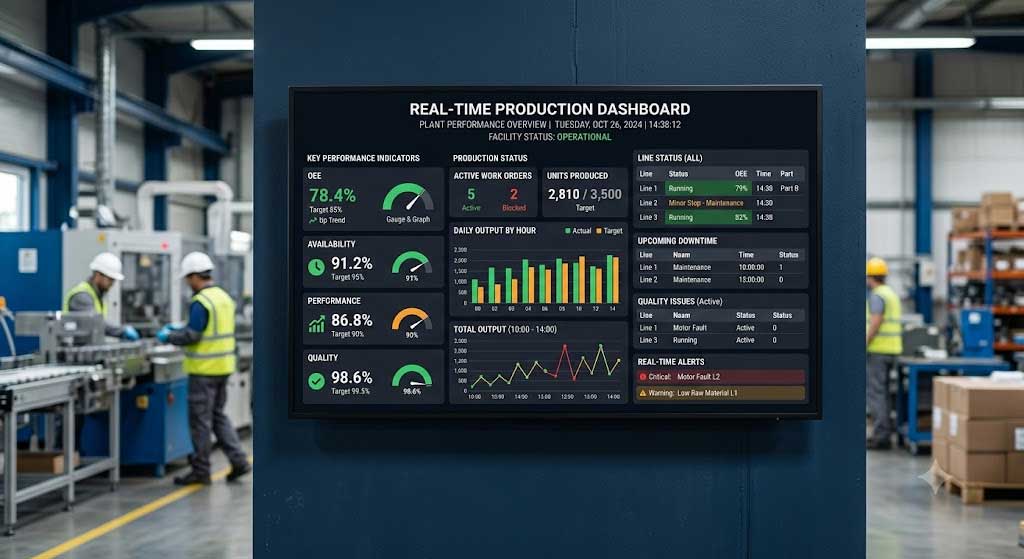
A production dashboard should help managers decide what to do next, not simply display attractive charts. Therefore, its design should reflect the decisions that production teams make throughout a shift. At the plant level, managers need an overview of target versus actual output, delayed work orders, machine status, downtime, quality losses and orders approaching their committed completion dates. At the production-line level, supervisors need operation-wise progress, waiting jobs, material shortages and the reason behind each significant deviation.
Meanwhile, production planners need visibility into schedule adherence, remaining work and resource constraints. Senior management needs to understand how these operational issues affect delivery performance, capacity utilization and production costs. However, every metric needs a reliable definition. For example, a machine marked as running does not necessarily mean it is producing acceptable parts at the expected rate. Similarly, a completed quantity should not automatically be treated as saleable output when quality inspection is pending.
Consequently, dashboards should distinguish completed units, rejected units, approved quantities and work in progress. They should also show when information was last updated so managers can identify stale data before making critical decisions.
How AI Can Make Production Monitoring More Predictive
Traditional monitoring explains what is happening now. With suitable historical data and validated analytical models, AI-assisted monitoring can also help identify patterns associated with future production risks. For example, a predictive model can compare actual cycle times with historical performance for similar products, machines and operating conditions. If cycle times gradually increase, the system may flag a possible performance issue before the production target is missed.
Similarly, historical downtime records can help identify recurring stoppages, while schedule-risk models can estimate whether an open work order is likely to miss its planned completion time. When combined with material availability and operation dependencies, these insights can help planners prioritize interventions.
Nevertheless, AI predictions are only as reliable as the data and assumptions behind them. Missing operator entries, inconsistent downtime codes, inaccurate production standards and changing product mixes can produce misleading results. Therefore, manufacturers should validate model outputs against actual outcomes and retain human oversight for important operational decisions.
For SMEs, the most practical starting point is often not a complex AI project. Instead, it is establishing reliable production data, meaningful exception alerts and consistent workflows. Once these foundations are in place, AI can add value through anomaly detection, recurring bottleneck analysis and risk-based production planning.
How Manufacturing ERP Software Connects Monitoring With Corrective Action
Production monitoring becomes more valuable when identifying a problem leads directly to an accountable action. Otherwise, a dashboard may reveal a delay without helping the team resolve it.
An integrated manufacturing ERP system can connect production orders with bills of materials, inventory, purchasing, quality, maintenance and financial records. Therefore, when an order falls behind schedule, managers can investigate whether the cause is a material shortage, an incomplete preceding operation, a machine issue or a quality hold.
Business process automation can strengthen this connection further. For instance, a configurable workflow can notify the responsible supervisor when output falls below an agreed threshold, escalate an unresolved stoppage and record the action taken. Similarly, a material shortage can trigger a review by stores or procurement according to the company’s approval rules.
For manufacturers evaluating Bluechip Solutions, ProfitPlus ERP and Auvit No-Code ERP with Business Process Automation offer a relevant starting point for discussing connected business processes, operational visibility and workflow automation. The appropriate configuration depends on the factory’s production processes, existing equipment, data availability and integration requirements.
The goal is to create a connected operating process in which production deviations become visible, responsibilities are clear and corrective actions can be tracked.
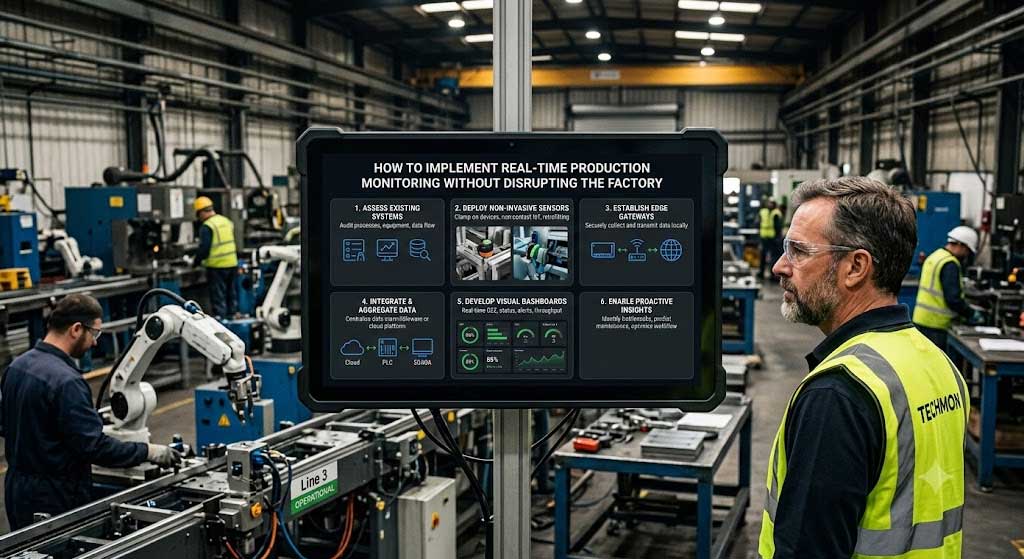
How to Implement Real-Time Production Monitoring Without Disrupting the Factory
A practical implementation should begin with one production line, work centre or product family where delays have a measurable business impact. Before introducing new dashboards, the team should document current production targets, standard cycle times, downtime categories, work-order milestones and reporting gaps.
Next, the factory should identify which information can be captured automatically from machines and which requires operator input or ERP transactions. This distinction matters because not every machine supports direct connectivity, and not every production event can be inferred reliably from a sensor.
Once the data sources are defined, the team can establish baseline performance and configure alerts around meaningful deviations. The initial dashboard should focus on a few actionable measures rather than overwhelming supervisors with dozens of indicators.
After the pilot, managers should compare reporting accuracy, response times, schedule adherence and recurring production losses against the baseline. They should also verify whether alerts lead to completed corrective actions instead of generating notifications that employees eventually ignore.
Finally, the factory can expand monitoring to other lines and integrate additional data sources as operational needs become clearer. This staged approach reduces implementation risk and helps establish measurable business value before wider investment.
Frequently Asked Questions About Real-Time Production Monitoring
What is the main benefit of Real-Time Production Monitoring?
The main benefit is earlier visibility into production deviations. By comparing actual output with planned targets and tracking work-order progress, managers can investigate bottlenecks, downtime and material shortages before they cause larger delivery problems.
Can production monitoring work with existing factory machines?
Yes, depending on the equipment and available interfaces. Some machines support direct data collection through PLCs or other industrial interfaces, while others may require gateways, sensors, operator terminals or manual event recording. Integration feasibility should be assessed before implementation.
How does production monitoring improve on-time delivery?
It helps identify delayed jobs, blocked operations and material constraints earlier. When this information is connected to delivery commitments and escalation workflows, teams can prioritize recovery actions before missed deadlines affect customers.
What is the difference between production monitoring and manufacturing ERP?
Production monitoring focuses on production progress, machine performance and shop-floor events. Manufacturing ERP connects those activities with planning, inventory, procurement, quality, finance and other business processes. When integrated, they provide a more complete view of operational performance.
Can AI predict production delays?
AI models can estimate delay risks using historical cycle times, downtime patterns, work-order progress and other relevant data. However, their usefulness depends on data quality, appropriate model validation and whether the predictions lead to timely human decisions.
Turn Production Visibility Into Better Factory Decisions
When production problems become visible only at the end of a shift, managers have fewer opportunities to recover lost time, protect delivery commitments and control costs. Real-Time Production Monitoring changes that equation by connecting work-order status, actual output, bottlenecks and operational alerts while production is still underway.
For manufacturing businesses, the next step is to identify where delayed information is creating the greatest operational or financial risk. Start with a critical production line, establish measurable baselines and connect monitoring with workflows that assign responsibility for corrective action.
Want to identify where production delays are affecting your factory’s performance?
Connect with Bluechip Solutions to discuss your manufacturing processes, ERP requirements and production visibility goals. Explore how ProfitPlus ERP and Auvit No-Code ERP with Business Process Automation may help connect operational data and business workflows.
Book a Free ERP Consultation: Be the first to get the slot
Get a Factory Production Visibility Audit Checklist to assess work-order tracking, target-versus-actual reporting, bottleneck visibility, downtime recording, material readiness and escalation workflows before selecting a production monitoring solution.