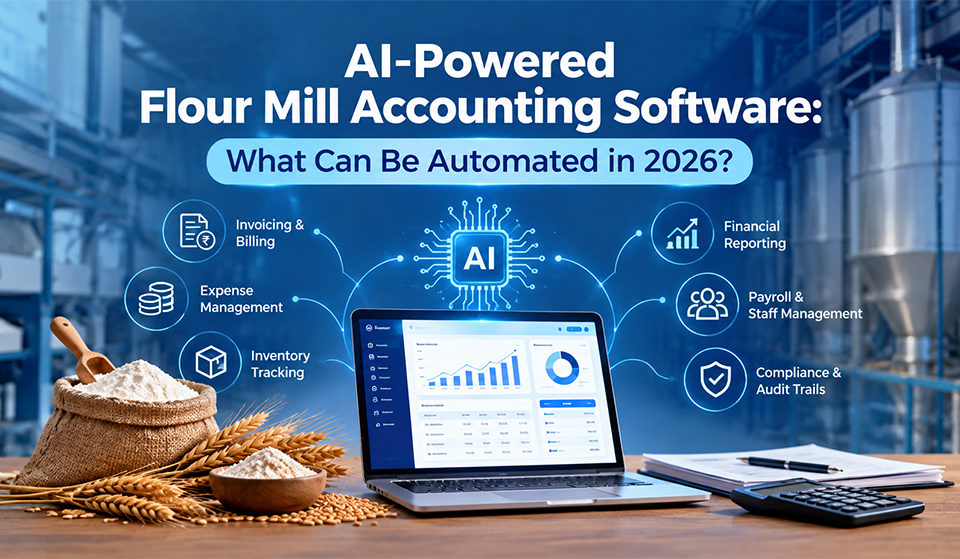
AI-Powered Flour Mill Accounting Software: What Can Be Automated in 2026?

Flour mills rarely struggle because accounting itself is difficult. The bigger problem is that accounting data often arrives late, production records remain disconnected, inventory changes faster than finance teams can update them, and management has to depend on spreadsheets to understand what actually happened.
For a flour mill, a small data gap can quickly become a financial problem. A change in wheat purchase cost affects production costing. A change in extraction percentage affects output margins. Stock differences affect inventory valuation. Delayed purchase entries can distort cash-flow visibility. Meanwhile, manual sales, receivables and payment tracking can leave management without a reliable picture of the business.
That is why AI-powered flour mill accounting software is becoming more relevant in 2026. Modern ERP and accounting platforms can connect finance with procurement, inventory, production, sales and operational workflows. More importantly, AI can help identify patterns, automate repetitive processes and bring exceptions to management attention before they become larger problems.
For flour mill owners, CFOs, finance managers and operations leaders, the real question is therefore not simply whether accounting can be digitized. The more important question is: What can actually be automated across a flour mill’s accounting and financial operations?
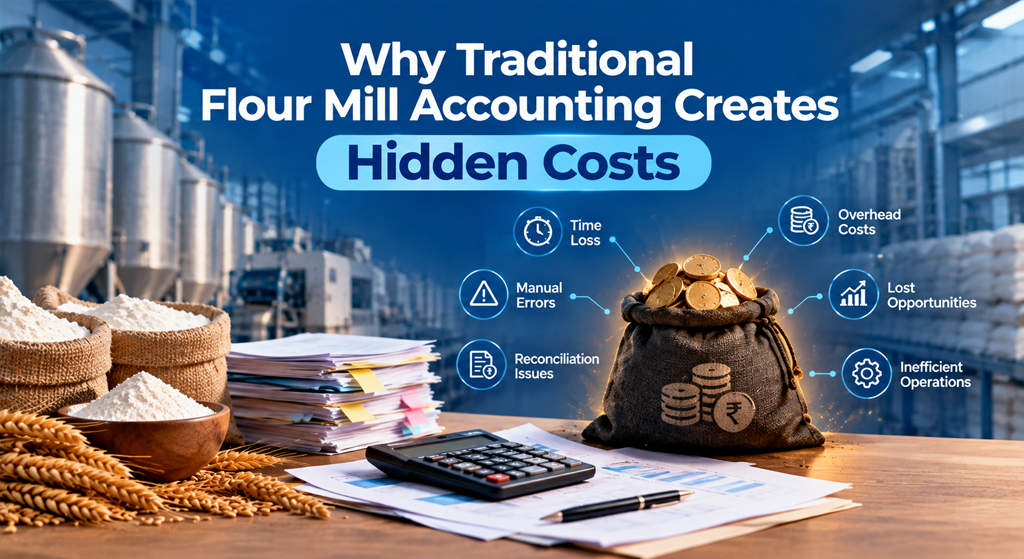
Why Traditional Flour Mill Accounting Creates Hidden Costs
Many flour mills still manage different parts of the business through accounting software, Excel sheets, production registers, WhatsApp messages and manually maintained stock records. At first, this approach can appear manageable. However, as purchase volumes, SKUs, customers and production activity increase, disconnected records create operational friction.
For example, the purchase team may record wheat procurement separately while the production team maintains conversion data elsewhere. The stores team may update physical stock manually, while the finance team waits for documents before posting transactions. Consequently, management may receive financial information that describes what happened several days earlier rather than what is happening now.
The problem becomes even more significant when the business needs to calculate actual production costs. Wheat purchase price is only one component. Freight, loading, unloading, wastage, processing costs, packaging and other expenses can influence the final cost of flour. Therefore, an effective flour mill accounting system should not operate as an isolated accounting application. It should connect financial information with the operational events that generate that information.
What AI-Powered Flour Mill Accounting Software Can Automate in 2026
AI does not replace financial controls or management decisions. Instead, it can reduce repetitive work, identify unusual patterns and help employees act on information faster. The level of automation depends on the ERP architecture, available data, business rules and integrations. However, several areas are particularly suitable for automation in a modern flour mill.
Automated Purchase Accounting and Wheat Procurement
Wheat procurement represents one of the most important financial activities for a flour mill. Yet purchase accounting often involves multiple manual steps. Teams may receive supplier invoices, verify quantities, compare purchase orders, check received quantities and then enter accounting information manually.
An integrated system can connect the purchase order, goods receipt, inventory transaction and supplier invoice. As a result, finance teams can reduce duplicate data entry and improve transaction traceability. AI can additionally help identify unusual purchase prices, repeated invoice patterns or deviations from historical supplier pricing. Instead of asking an accountant to manually compare every transaction, the system can highlight transactions that require attention.
For example, if wheat from a particular supplier suddenly costs significantly more than previous purchases, the system can flag the variance for review. This does not mean the software automatically decides whether the purchase is wrong. Rather, it gives the finance or procurement team an exception to investigate.
Automated Inventory Accounting for Wheat and Finished Products
Inventory is one of the most sensitive areas in flour mill accounting. Raw wheat moves into production, intermediate products may be generated during processing, and finished products such as different flour grades, bran and other outputs eventually move into sales. When these movements are recorded manually, stock reconciliation becomes difficult.
An integrated ERP can automatically update inventory when approved transactions occur. Therefore, purchase receipts can increase raw-material stock, production transactions can consume materials and generate outputs, and sales transactions can reduce finished-goods inventory. AI-based analytics can then identify unusual stock movements, unexpected consumption patterns or inventory variances. For management, this creates an important advantage: instead of discovering a stock problem during month-end reconciliation, the team can investigate unusual movements earlier.
Automated Production Cost Calculation
Production costing is particularly important for flour mills because margins depend on both input costs and output realization. Suppose wheat prices increase while selling prices remain unchanged. The business may continue generating sales revenue while its actual margin gradually declines.
A connected accounting and production system can bring purchase costs, production quantities, wastage, conversion data and associated expenses into the costing process. The system can then provide a more consistent view of production cost. AI can further support variance analysis by comparing actual results against historical or expected patterns.
For instance, if a particular production batch consumes more material than the established operational pattern, the system can highlight the variance. The objective is not to allow AI to blindly change accounting values. Instead, it helps decision-makers understand where financial and operational deviations deserve attention.
Automated Accounts Payable and Supplier Reconciliation
Supplier accounting can consume considerable time when invoices, purchase orders, receipts and payments are maintained separately. Modern ERP workflows can connect these records so that finance teams can verify transactions through a controlled process. Invoice data can be captured, matched against relevant purchasing information and routed for approval according to predefined business rules.
Consequently, accountants spend less time searching for supporting documents and more time reviewing exceptions. Supplier reconciliation can also become more structured because invoices, debit notes, credit notes and payments remain connected to the supplier account. For a growing flour mill, this improves both efficiency and audit readiness.
Automated Accounts Receivable and Customer Payment Tracking
Sales growth does not automatically guarantee healthy cash flow. A flour mill may generate significant revenue while still carrying overdue customer balances. When receivables are tracked manually, finance teams may discover overdue accounts only after payment deadlines have passed.
An ERP-based accounting system can automatically track invoices, due dates, receipts and outstanding balances. AI-driven analytics can identify customers whose payment behaviour is changing. For example, a customer that normally pays within a defined period but repeatedly delays payments may become an exception requiring attention. Management can therefore focus collection efforts where they are most relevant rather than manually reviewing every customer account.
Automated GST and Tax-Related Accounting Workflows
Tax compliance creates another area where automation can reduce repetitive work. An integrated system can maintain structured transaction records across purchases, sales, tax components and financial accounts. This provides finance teams with a more consistent data foundation for compliance activities.
However, automation should not be treated as a substitute for professional tax review. Tax rules and filing requirements can change, and businesses should validate their processes against the applicable regulations. The real benefit comes from reducing manual transaction handling and improving the traceability of the underlying records.
AI-Based Cash Flow and Financial Visibility
Cash flow is often where disconnected accounting becomes most visible to business owners. A traditional accounting report may tell management how much money has been received and paid. However, management also needs to understand upcoming obligations, receivables and procurement requirements.
An integrated system can connect outstanding customer invoices, supplier obligations, planned purchases and historical cash movements. AI-based analysis can then help identify patterns and exceptions within the available financial data. For example, management may see that rising procurement costs combined with slower customer collections could create pressure on working capital.
The system is not making the financial decision for the business. Instead, it gives decision-makers better information before they commit to the next purchase, production cycle or customer credit arrangement.
Automated Financial Reports and Management Dashboards
Finance teams should not have to spend hours preparing the same management reports every month. A modern ERP can generate financial and operational reports from transactional data. Dashboards can bring together revenue, expenses, receivables, payables, inventory and production-related information.
This creates a single operational view rather than forcing managers to compare several spreadsheets. For CEOs and owners, the value is straightforward: they can spend more time interpreting business performance and less time asking employees to compile data.
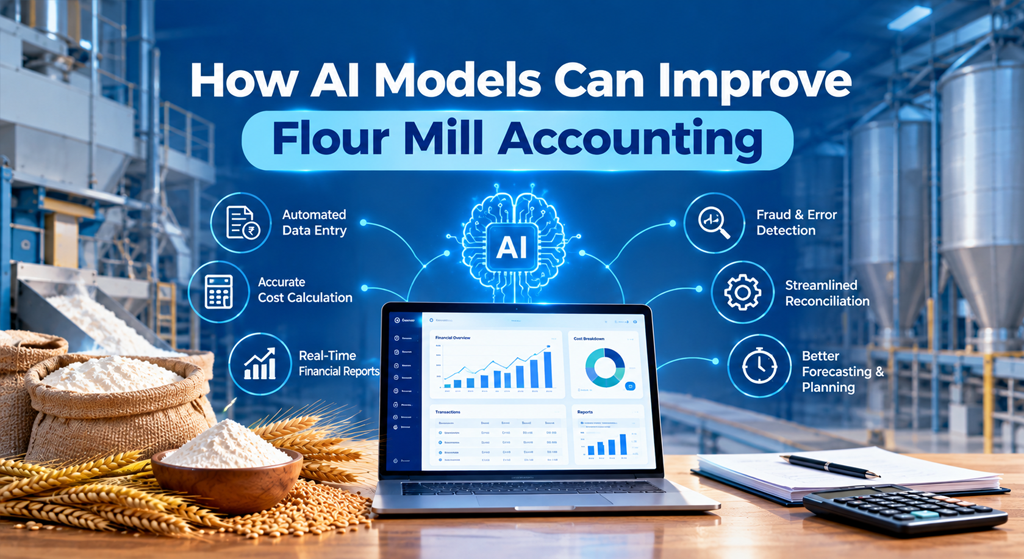
How AI Models Can Improve Flour Mill Accounting
AI becomes useful when it works on reliable business data and clearly defined workflows. A practical AI model for flour mill accounting can analyse historical transactions, supplier prices, customer payment behaviour, inventory movements and production variances.
For example, an anomaly-detection model can identify transactions that differ significantly from established patterns. A forecasting model can analyse historical sales and purchasing behaviour to support planning. A classification model can assist with categorising repetitive transactions when sufficient structured data is available.
However, AI accuracy depends heavily on data quality. If a business enters inconsistent supplier names, incomplete purchase records or incorrect stock quantities, the AI layer cannot magically produce reliable results. Therefore, the foundation should remain clean master data, controlled workflows, approval mechanisms, audit trails and integrated transaction processing.
The Real Pain Point: Connecting Accounting With Operations
The biggest opportunity for flour mills is not simply automating bookkeeping. The larger opportunity is connecting accounting with the activities that create financial transactions. When procurement, inventory, production, sales and finance operate within connected workflows, every department works from a more consistent information base.
Consequently, management can trace a financial result back to the operational activity behind it. That connection becomes especially valuable when margins are under pressure. Instead of asking only why profit declined, management can investigate whether the change came from raw-material prices, production yield, wastage, inventory differences, operating expenses, selling prices or customer payment behaviour.
This is where ERP automation becomes more valuable than standalone accounting software.
Why No-Code ERP Can Matter for Flour Mills
Every flour mill does not operate exactly the same way. One business may need a specific approval workflow for wheat procurement. Another may require customised production records, additional quality controls or specialised reporting. Traditional software customisation can become expensive and time-consuming when every change requires extensive development.
A no-code ERP approach can provide greater flexibility by allowing business workflows, forms, reports and processes to be configured with less dependence on conventional application development. For businesses evaluating an AI-powered flour mill accounting solution, this flexibility matters because automation should adapt to the actual process instead of forcing the business into a rigid workflow.
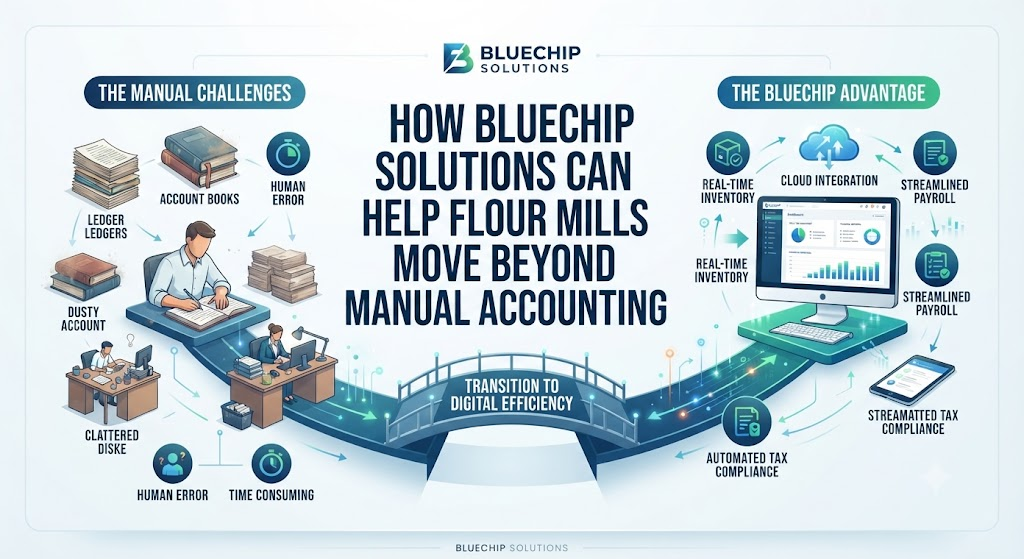
How Bluechip Solutions Can Help Flour Mills Move Beyond Manual Accounting
Bluechip Solutions’ ProfitPlus ERP and Auvit No-Code ERP approach can help businesses connect accounting with broader ERP processes instead of treating finance as an isolated function. For a flour mill, this can provide a foundation for connecting procurement, inventory, production, sales, finance and management reporting through integrated workflows.
The objective is not simply to replace an accounting register with a digital screen. Instead, the goal is to create a connected business process where information moves through the organisation with appropriate controls, approvals and visibility. For management teams, this can reduce repetitive data entry, improve traceability and create faster access to business information.
What Flour Mill Owners Should Check Before Choosing Accounting Software
Before selecting a flour mill accounting solution, decision-makers should look beyond the accounting module itself. The software should be able to connect financial transactions with procurement, inventory, production and sales. It should also provide configurable workflows, user access controls, reporting, auditability and integration capabilities. AI claims should also be evaluated carefully.
Ask what data the AI uses, what decisions it actually supports, how exceptions are presented and whether users can review the underlying transaction before taking action. Most importantly, evaluate whether the software solves the problems your finance and operations teams currently face. If employees still have to maintain separate spreadsheets for stock, production, purchasing and receivables, simply adding an AI label to accounting software will not solve the underlying process problem.
Frequently Asked Questions About AI-Powered Flour Mill Accounting Software
What is flour mill accounting software?
Flour mill accounting software is a business management solution designed to manage financial transactions while supporting the operational requirements of a flour milling business. Modern ERP-based systems can connect accounting with purchasing, inventory, production, sales and reporting.
Can AI automate flour mill accounting?
Yes, AI can support several accounting and financial workflows, including anomaly detection, transaction classification, payment behaviour analysis, financial forecasting and exception identification. However, automation should operate within defined business controls and human review processes.
Can flour mill software calculate production costs?
An integrated ERP can connect raw-material costs, production activity, inventory movements and related expenses to support production costing. The exact costing methodology depends on the business process and accounting requirements.
Can accounting software track wheat inventory?
Yes. When purchasing, inventory, production and sales are integrated, the system can update stock through approved transactions and provide visibility into raw materials and finished goods.
Is AI accounting software suitable for small and medium flour mills?
It can be, provided the solution matches the company’s operational complexity and budget. SMEs should focus on practical automation, scalability, ease of use and integration rather than selecting technology solely because it includes AI.
What is the difference between accounting software and ERP for a flour mill?
Accounting software primarily focuses on financial transactions. ERP connects finance with other business processes such as procurement, inventory, production and sales. For a flour mill, this integration can provide a broader view of operational and financial performance.
From Manual Entries to Connected Flour Mill Operations
The future of flour mill accounting is not simply about entering transactions faster. It is about connecting financial information with procurement, inventory, production and sales so that management can understand what is happening across the business. AI can strengthen that model by identifying unusual transactions, analysing patterns and supporting forecasting. However, the strongest results come when AI operates on structured, connected and trustworthy business data.
For flour mills considering digital transformation in 2026, the practical starting point is therefore clear: identify the repetitive accounting processes, locate the gaps between finance and operations, and determine which workflows can be automated without weakening financial controls.
If your flour mill still depends on Excel, manual reconciliation and disconnected accounting records, it may be time to evaluate a connected ERP approach.
Explore Bluechip Solutions’ ProfitPlus ERP and Auvit No-Code ERP to understand how integrated workflows can support accounting, inventory, procurement, production and business operations.
Get a Flour Mill ERP Assessment
Request a Free ERP Consultation or Demo and discuss your current accounting, inventory and production workflow with the Bluechip Solutions team.