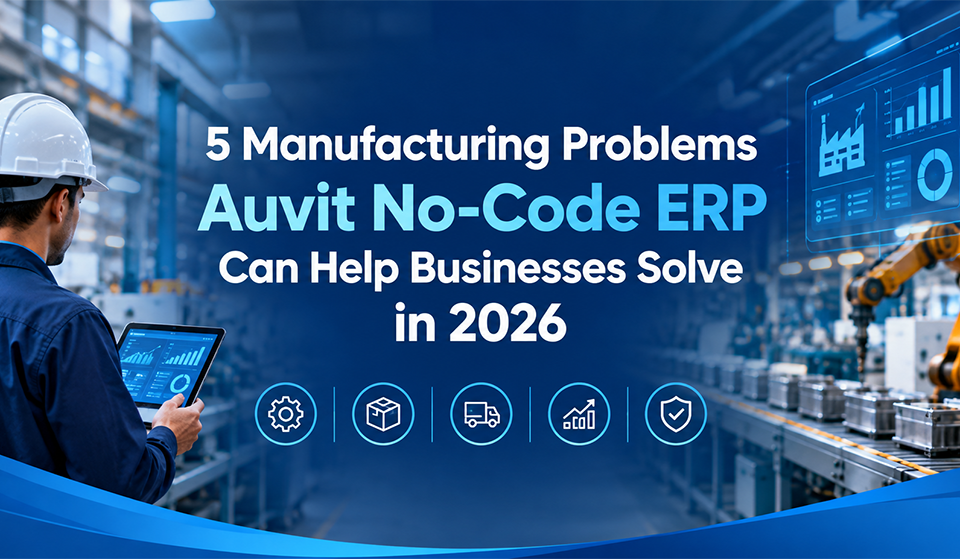

Manufacturing leaders rarely struggle because they lack software. The bigger problem is that critical information, workflows, and decisions often remain disconnected across production, inventory, procurement, quality, finance, and management.
A production manager may know that a work order is delayed, while procurement is still waiting for a material requirement. At the same time, finance may not have a current view of the order’s cost, and senior management may discover the problem only after the promised delivery date is at risk.
That operational disconnect becomes increasingly expensive as manufacturers handle more products, suppliers, locations, production variations, compliance requirements, and customer expectations.
Consequently, manufacturers are placing greater emphasis on connected data, automation, analytics, and artificial intelligence. Deloitte’s 2025 Smart Manufacturing and Operations Survey of 600 manufacturing executives found that respondents reported average improvements of 10%–20% in production output, 7%–20% in employee productivity, and 10%–15% in unlocked capacity from smart manufacturing initiatives. The same research found that manufacturers continue to prioritize data analytics, cloud computing, AI, and IIoT investments.
However, technology alone does not solve manufacturing problems. The system must fit the way the factory actually operates.
This is where a configurable No-Code ERP platform such as Auvit can become relevant. Instead of forcing every business to follow rigid software processes, a No-Code ERP approach allows organizations to configure workflows, forms, approvals, data structures, dashboards, and business rules around their operational requirements.
Why Manufacturing Businesses Are Rethinking Traditional ERP
Traditional ERP systems have helped manufacturers manage accounting, inventory, purchasing, production, and sales for decades. Nevertheless, many organizations still encounter a familiar problem: the software works, but adapting it to changing business requirements becomes expensive and slow.
A new production approval may require customization. A different Bill of Materials structure may require development. A new quality checkpoint may need technical intervention. Even a seemingly simple workflow change can become dependent on developers, consultants, testing cycles, and future upgrade compatibility.
Meanwhile, the factory cannot wait. Manufacturing requirements change because customers change specifications, suppliers change lead times, regulations evolve, product portfolios expand, and companies introduce new production processes. Therefore, an ERP platform needs to provide operational control without making every change a major IT project.
Auvit approaches this challenge through a No-Code Business Process Automation framework, allowing organizations to configure business processes visually rather than relying entirely on conventional programming.
Manufacturing Problem 1: Shop-Floor Data Does Not Reach Decision Makers Fast Enough
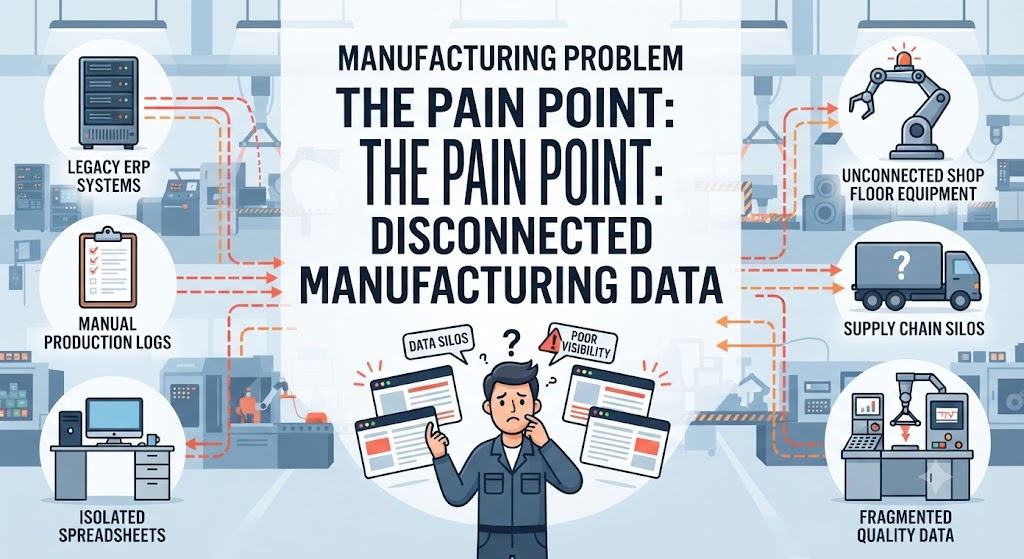
The pain point: disconnected manufacturing data
A production floor can generate thousands of operational events every day. Raw material receipts, machine activity, work orders, production quantities, rejections, quality inspections, downtime, inventory movements, dispatches, and maintenance activities all influence business performance. However, when these records remain distributed across spreadsheets, paper registers, individual applications, and disconnected systems, management receives an incomplete picture.
As a result, a plant manager may react to yesterday’s production problem instead of today’s. A procurement team may discover a material shortage only after production has stopped. Likewise, senior management may see revenue pressure without immediately understanding which operational bottleneck caused it. This is not simply a reporting problem. It is a decision-making problem.
How Auvit No-Code ERP can help
Auvit can connect manufacturing processes across production, inventory, procurement, finance, quality, and management so that operational information becomes available through a common system. For example, when a work order consumes raw material, the resulting inventory movement can become part of the same connected operational record. Consequently, planners can view material availability alongside production requirements instead of waiting for separate reports.
Furthermore, configurable dashboards can give management visibility into production progress, pending orders, inventory positions, and operational KPIs. Mobile and web accessibility can also allow supervisors and authorized employees to capture information closer to the source. Therefore, data does not have to travel through multiple manual reporting layers before reaching decision makers.
This connected approach also creates a stronger foundation for AI because AI models depend on accessible, structured, and reliable operational data. Microsoft similarly highlights the importance of connecting fragmented manufacturing data and creating a digital thread that can support AI-driven decision-making.
Manufacturing Problem 2: Rigid ERP Workflows Cannot Keep Up With Manufacturing Changes
The pain point: every process is slightly different
Manufacturers rarely operate identical processes, even when they produce similar products. One factory may require three approval stages before production begins. Another may require customer-specific inspection procedures. A third may operate with subcontracting, multiple production locations, alternate BOMs, or specialized routing.
Consequently, an ERP workflow designed around a generic process may not match the actual factory. When businesses depend heavily on custom programming, these differences can increase implementation time and maintenance requirements. Moreover, companies can become reluctant to change their processes because they fear the cost of modifying the ERP.
How Auvit No-Code ERP can help
Auvit’s No-Code architecture focuses on configurable business processes. Instead of treating every workflow modification as a conventional software development project, organizations can configure forms, fields, approval flows, business rules, and process stages according to their requirements.
For example, a manufacturer introducing an additional quality approval can configure that checkpoint into the relevant workflow. Similarly, a business changing its purchase approval hierarchy can adjust the process according to its internal authorization structure.
This flexibility becomes particularly valuable when manufacturers expand into new products or markets. Therefore, the ERP becomes a configurable operational platform rather than a rigid application that dictates how the business must work.
Manufacturing Problem 3: Inventory Imbalances Increase Both Costs and Production Risk
The pain point: too much inventory or too little
Inventory management creates a difficult balance. If a manufacturer holds insufficient raw materials, production can stop. Consequently, machines remain idle, employees wait, customer deliveries are delayed, and urgent purchasing becomes necessary.
On the other hand, excessive inventory locks working capital into materials that may move slowly or become obsolete. The problem becomes more complex when purchasing decisions depend on disconnected spreadsheets or outdated consumption information.
How Auvit No-Code ERP can help
Auvit can connect inventory information with purchasing and production requirements, giving planners a more integrated view of material availability and demand. For instance, when active production orders consume materials, the system can provide visibility into current stock positions and upcoming requirements. Therefore, purchasing teams can make replenishment decisions using operational information rather than isolated spreadsheets.
Batch and serial tracking can further strengthen traceability. When a quality issue occurs, manufacturers need to identify which material, batch, supplier, production order, or finished product may be affected. Moreover, AI can extend this capability beyond simple reporting.
A forecasting model can evaluate historical consumption, seasonality, open orders, production schedules, lead times, and other available data to estimate future material requirements. However, such predictions should support human decision-making rather than replace purchasing judgment. This distinction matters because AI output is only as reliable as the data and business context behind it.
Manufacturing Problem 4: ERP Implementation Takes Too Long and Costs More Than Expected
The pain point: the factory needs results before the project becomes a burden
ERP implementation can become difficult when businesses attempt to reproduce every existing process through extensive customization. Requirements expand, integrations multiply, development cycles become longer, and testing becomes more complicated. Consequently, the organization may spend substantial resources before employees experience meaningful operational improvements.
For growing manufacturing businesses, particularly SMEs, this creates another concern: the company needs better systems without creating an IT project that consumes disproportionate time and capital. Deloitte’s 2025 research shows that operational risk remains a significant concern in smart manufacturing transformation, with 65% of respondents ranking operational risk among their first or second priorities for mitigation.
How Auvit No-Code ERP can help
Auvit’s No-Code approach is designed to reduce dependency on traditional application development for process configuration. Because business users can configure elements of the application without writing conventional code for every change, organizations can potentially shorten the distance between requirement identification and implementation.
That can be particularly useful when a manufacturing business needs to modify an approval process, create a new form, introduce a workflow, or adapt an operational dashboard. Additionally, a cloud-based ERP model can reduce the infrastructure burden associated with maintaining traditional on-premise environments, depending on the organization’s deployment and security requirements.
The objective should not simply be to implement ERP faster. Instead, the objective is to reach measurable operational value while keeping the system adaptable as the business grows.
Manufacturing Problem 5: Quality Problems Become Visible After They Become Expensive
The pain point: quality information arrives too late
Quality problems rarely begin with a major failure. Often, small deviations appear first: increasing rejection rates, repeated defects, inconsistent measurements, supplier quality issues, or recurring process variations. When inspection information remains on paper or inside isolated spreadsheets, identifying these patterns becomes difficult.
Consequently, a manufacturer may discover a quality problem only after multiple production batches have already been completed. That creates additional rework, scrap, customer complaints, returns, and compliance pressure.
How Auvit No-Code ERP can help
Auvit can incorporate quality checkpoints directly into manufacturing workflows. For example, inspection requirements can be associated with relevant production stages so that operators and quality teams capture results as part of the operational process. Furthermore, configurable approval rules can help prevent a process from moving forward until the required inspection or authorization has been completed.
The resulting digital trail can also improve traceability because organizations can connect inspection records with relevant production, material, batch, or work-order information. AI can add another layer of analysis by identifying unusual patterns in quality data. For example, an anomaly-detection model could compare current rejection behavior with historical production patterns and flag significant deviations for human investigation.
The AI does not need to make the final quality decision. Instead, it can help quality managers identify where they should investigate first.
How AI Changes the Role of a Manufacturing ERP
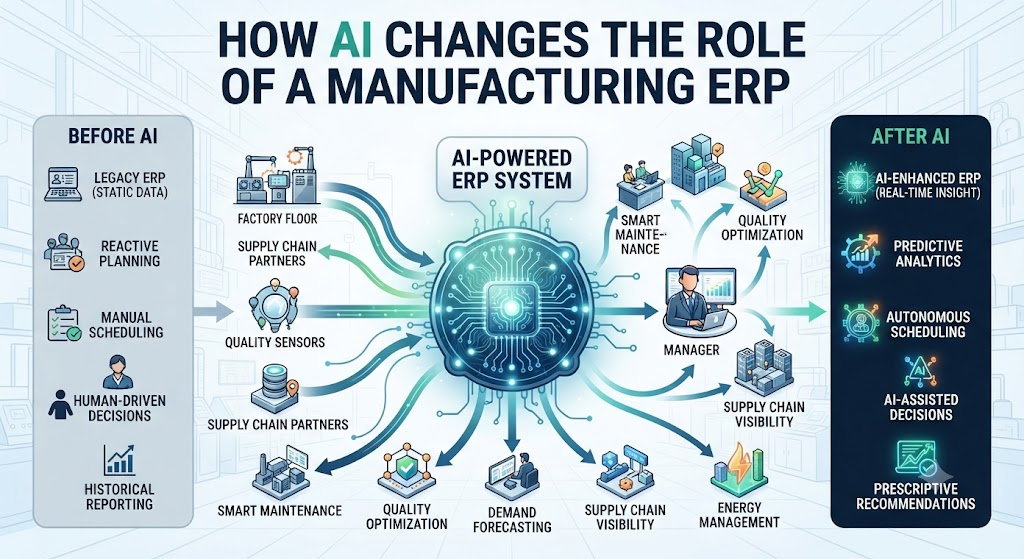
AI should not be treated as a decorative feature added to an ERP dashboard. Its practical value comes from applying models to meaningful business data. For manufacturing, this can include demand forecasting, production planning support, anomaly detection, inventory forecasting, maintenance analysis, quality pattern identification, and natural-language access to operational information.
However, manufacturers first need a reliable data foundation. Deloitte’s 2025 survey found that 29% of respondents were using AI/ML at the facility or network level, while 23% were piloting AI/ML. The survey also showed continued investment in data analytics and cloud technologies, demonstrating that manufacturers are still building the foundations required for broader AI adoption.
Therefore, the sequence matters: connect the data, digitize the process, automate repeatable work, analyze performance, and then expand AI-driven decision support. Auvit’s No-Code architecture can support this progression by bringing configurable business processes and operational data into a connected environment.
Why Auvit No-Code ERP Matters for Manufacturing Decision Makers
For a CEO, the concern is operational visibility and business performance. For a plant manager, the priority may be production continuity, resource utilization, quality, and delivery performance. For a CFO, inventory value, working capital, production cost, and financial control may matter most.
For a CTO or IT manager, meanwhile, scalability, integration, security, maintainability, and the ability to adapt the platform without excessive development effort are critical. A manufacturing ERP therefore needs to connect these perspectives rather than optimize only one department.
Auvit No-Code ERP is positioned around this connected approach, combining ERP capabilities with Business Process Automation so manufacturers can configure processes around their operational requirements.
What Should Manufacturers Evaluate Before Choosing a No-Code ERP?
The right question is not simply, “Does this ERP have manufacturing modules?” Instead, decision makers should ask whether the platform can represent the actual way their factory operates. Can it accommodate their BOM structures? Can production workflows be configured? Can quality checkpoints be integrated into work orders? Can inventory, procurement, production, and finance share operational data? Can authorized users modify workflows without depending on developers for every change? Can the platform provide dashboards for different management levels? Can the data foundation support analytics and AI?
These questions shift the ERP evaluation from a feature checklist toward operational fit. That distinction can significantly influence long-term adoption.
Frequently Asked Questions About No-Code ERP for Manufacturing
What is a No-Code ERP for manufacturing?
A No-Code ERP is an enterprise resource planning platform that allows organizations to configure business processes, forms, workflows, fields, approvals, and other application elements with minimal conventional programming. For manufacturers, this can make ERP processes more adaptable to production-specific requirements.
How can No-Code ERP help manufacturing companies?
No-Code ERP can help manufacturers connect production, inventory, procurement, quality, finance, and other business processes while reducing dependence on traditional custom development for every workflow change.
Can Auvit No-Code ERP support manufacturing workflows?
Auvit is designed as a No-Code Business Process Automation and ERP platform that can be configured around manufacturing workflows, including production processes, inventory management, procurement, approvals, reporting, and operational dashboards.
Can AI be used with manufacturing ERP?
Yes. AI can support manufacturing activities such as demand forecasting, anomaly detection, quality analysis, maintenance insights, production planning, and decision support. However, effective AI requires reliable and connected operational data.
Is No-Code ERP suitable for growing manufacturers?
It can be particularly relevant when a manufacturer expects its processes to change as the business expands. Configurable workflows can help organizations adapt processes without treating every operational change as a large software development project.
Turn Manufacturing Data Into Actionable Operations With Auvit
The biggest manufacturing problem is not always a lack of information. Frequently, the real problem is that the right information does not reach the right person at the right time. Disconnected systems create delays. Rigid workflows slow adaptation. Inventory gaps interrupt production. Quality problems become expensive when detected late. Meanwhile, lengthy ERP customization can make businesses hesitate to improve the system at all.
Auvit No-Code ERP takes a different approach by combining ERP capabilities with configurable Business Process Automation, connected operational data, dashboards, workflow automation, and AI-ready foundations. For manufacturers evaluating their next ERP investment, the starting point should therefore be simple: identify where information gets delayed, where manual work creates risk, and where the current system prevents the business from adapting.
Want to identify the biggest ERP gaps in your manufacturing operation?
Get our Free Guide: Evaluating No-Code Automation for Modern Manufacturing Plants and use it to assess your production workflows, inventory processes, quality controls, reporting gaps, and automation opportunities.
Ready to see how the platform can fit your factory? Request a personalized Auvit No-Code ERP demonstration and discuss your actual manufacturing workflow with the Bluechip Solutions team.
Contact: sales@bluechipsolutions.in