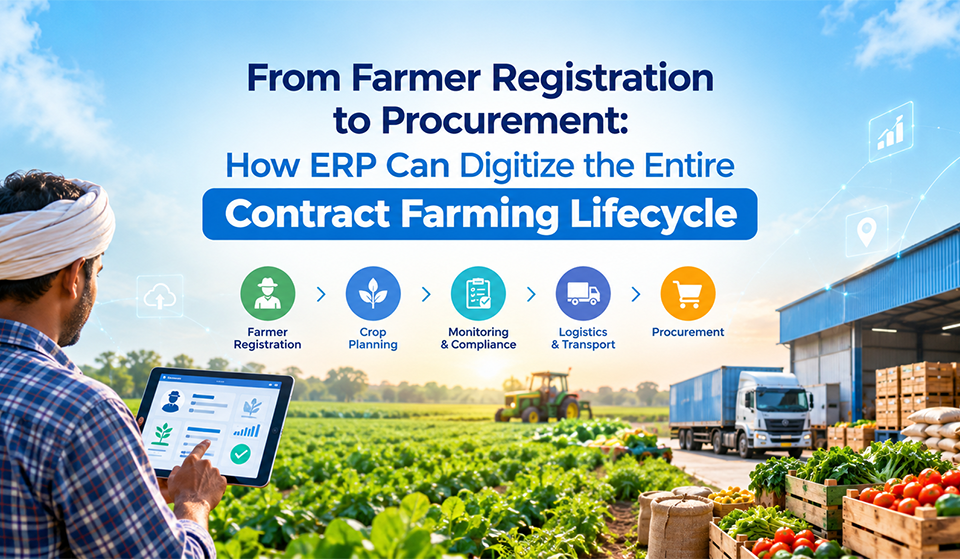
From Farmer Registration to Procurement: How ERP Can Digitize the Entire Contract Farming Lifecycle

Disconnected farmer records, manual field reports, and spreadsheet-based crop planning can delay procurement decisions and increase contract farming costs. For agribusinesses, food processors and agricultural procurement companies, the real challenge is not simply collecting farmer information. The bigger challenge is connecting everything that happens after registration with what the business ultimately needs to procure.
A field executive may register a farmer today. Later, the farmer may receive agricultural inputs, while teams monitor crop progress through phone calls and spreadsheets. Months later, the farmer may deliver the produce to a procurement centre. When teams manage these activities across separate systems, management may struggle to answer basic questions: Which farmers are actively contracted? What crops are they cultivating? What quantity does each farmer expect to produce? Which fields require immediate attention? How much produce should the procurement centre expect? Does the actual procurement match the original contract?
That is where a contract farming ERP can change the operating model.
ERP connects farmer registration, planning, crop monitoring, procurement, inventory, and finance into one digital workflow. Consequently, decision-makers can move from fragmented information to a more continuous view of the entire contract farming lifecycle.
India’s e-NAM ecosystem already demonstrates the direction of agricultural digitisation. Its platform focuses on integrating agricultural markets, improving information availability and supporting real-time information around arrivals, quality and prices. e-NAM increasingly supports digital registration, trade, quality assessment, and transactions for farmers and FPOs.
For contract farming companies, however, the requirement begins much earlier than market trading. It begins with the farmer.
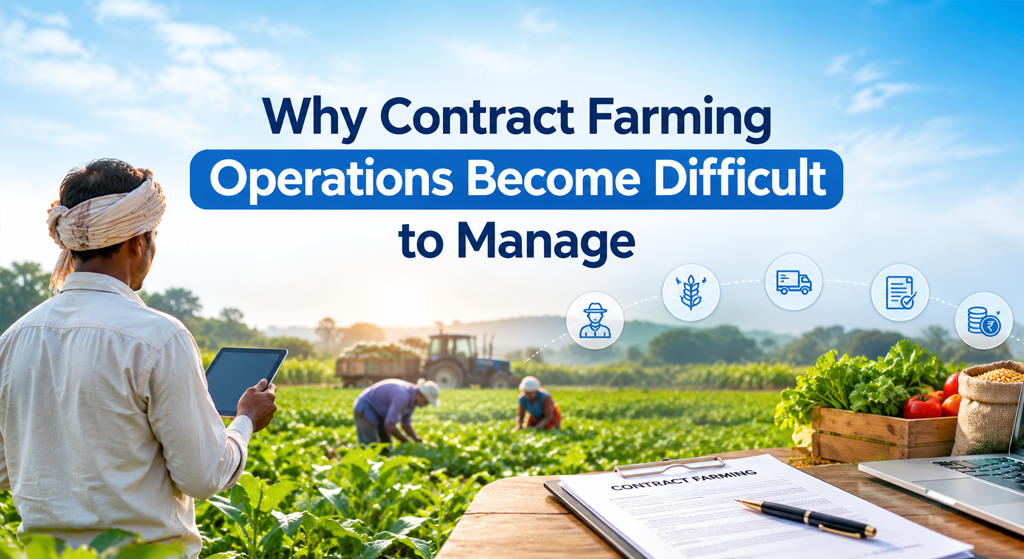
Why Contract Farming Operations Become Difficult to Manage
Contract farming looks straightforward on paper. A company identifies farmers, agrees on crops and quantities, supports cultivation, monitors production and finally procures the harvested produce. In practice, every stage generates operational data.
Farmer identification creates personal and location information. Contract creation adds crop, acreage, expected quantity, price and commercial conditions. Agricultural planning adds seed, input and activity information. Field operations create inspection and crop-status data. Harvesting creates quantity and quality information. Procurement generates weighment, grading, rejection, transport and payment information.
Managing farmer, crop, input, and procurement records across notebooks, Excel, WhatsApp, and disconnected systems limits real-time visibility. Procurement managers may struggle to track commitments, crop progress, expected yields, input distribution, and procurement capacity.
For example, a procurement manager may know that a particular region expects to supply 5,000 tonnes. Without connected data, managers may lack visibility into commitments, crop progress, risks, and procurement volumes.
However, the field team may have more accurate information showing that crop conditions have changed. Delayed field data can lead to inaccurate transport and warehouse planning.
Contracted and procured quantities may differ, while disconnected data can make the cause—crop loss, acreage changes, quality rejection, or incomplete delivery—time-consuming to identify. Therefore, the biggest problem is not the absence of data. It is disconnected data.
Farmer Registration Is the Foundation of Digital Contract Farming
The contract farming lifecycle should begin with a structured digital farmer profile. A contract farming ERP can centralize farmer, location, land, crop, and contract data in one master record. The registration process can also be supported through mobile applications. This is particularly important because field teams are rarely sitting inside corporate offices. They are working across villages, farms and procurement locations.
Bluechip Solutions’ ProfitPlus Contract Farming Management solution documents mobile-based farmer registration and geo-tagging, connecting farmer identification and crop monitoring with real-time data integration.
Field executives can capture and reuse data across the ERP, giving managers real-time visibility into contracts, crops, yields, procurement, and payments while enabling faster risk detection and cost control..
Contract Management Should Connect Farmers With Commercial Commitments
Farmer registration alone does not digitize contract farming. The next challenge is managing the agreement between the company and the farmer. A contract farming ERP can connect a farmer with the crop, acreage, season, expected yield, agreed price or pricing mechanism, delivery expectations and other applicable commercial conditions.
As a result, management can move beyond simply asking, “How many farmers are registered?” and use connected data to take timely operational action. Leaders can identify how many farmers hold active contracts for the current season, measure committed quantities, track contracted crops, verify whether each location has sufficient acreage, and detect where expected quantities are falling behind plan. With this visibility, procurement and field teams can intervene early, adjust sourcing plans, allocate resources, and address supply gaps before they affect procurement targets.
This connection becomes particularly valuable when an organization manages thousands of farmers. Instead of comparing multiple spreadsheets, management can view the contractual position through dashboards and reports generated from the same underlying data.
Connecting Farmer Data Makes Agricultural Planning More Accurate
Once teams record the contracts, they must move to the next operational step: planning. Agricultural planning requires teams to do more than simply decide which crops farmers should cultivate. Companies may need to understand acreage, crop variety, expected yield, cultivation schedules, input requirements, field activities and expected harvest periods.
A disconnected process forces planners to collect information repeatedly. However, an integrated ERP can connect the farmer, field and crop plan. Therefore, when the planned acreage changes, the organization can evaluate its impact on expected production and procurement. This creates an important management advantage: procurement planning can begin before the crop reaches the procurement centre.
For example, if contracted acreage increases in one region, the system can help management understand the potential effect on expected procurement volumes, storage requirements, transport planning and processing capacity. Consequently, agricultural planning becomes a business planning activity rather than merely a field-level exercise.
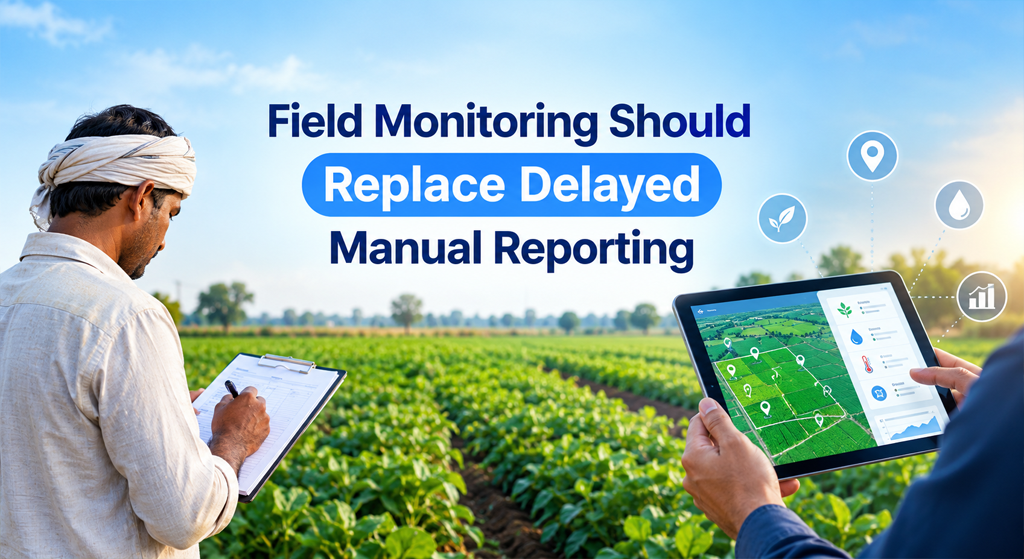
Field Monitoring Should Replace Delayed Manual Reporting
Monitoring is one of the most difficult areas for contract farming businesses. Field executives may visit farms regularly, but their observations can remain trapped in paper forms, spreadsheets, photographs or messaging applications. That creates a delay between what is happening in the field and what management knows.
A mobile-enabled contract farming ERP can bring field information into the central system. Field teams can record visits, crop status, observations, activities and other relevant information while working at the farm. Geo-tagging can further associate farmer and field information with a physical location. This creates a stronger operational record and can help managers identify geographic patterns.
More importantly, teams can connect field monitoring directly to exceptions, accountability, and management action. The crop requires attention, managers can assign a task to the responsible field executive and track its completion. When a field inspection becomes overdue, the system can alert the assigned user. When a planned activity remains incomplete, management can identify the delay and intervene before it affects crop yield or procurement.
This gives decision-makers real-time visibility into field-level risks instead of waiting for periodic reports. Managers can prioritize critical issues, allocate field resources, monitor corrective actions, and protect expected procurement volumes. In this way, an ERP transforms field monitoring from passive record-keeping into a proactive workflow that supports faster and better operational decisions.
AI Can Turn Agricultural Data Into Earlier Decisions
Once farmer, crop, and field data come together in one system, AI and analytics can provide an additional layer of decision support. However, organizations should not treat AI as a magic prediction engine. Its effectiveness depends on the quality, consistency, and history of the underlying data.
For example, historical farmer-level procurement quantities, crop cycles, acreage, location, quality results, and delivery patterns can reveal trends in expected procurement. An appropriate AI model can compare planned quantities with historical performance and current field information to generate an estimated procurement outlook.
Similarly, anomaly detection can identify unusual variations between contracted quantity, expected yield, and actual procurement. Suppose a group of farms has consistently delivered within a predictable range in previous seasons, but current estimates suddenly fall significantly below the contracted quantity. The ERP can flag this variance and direct management toward the affected farms or locations for review.
AI does not replace the agronomist or field manager. Instead, it helps decision-makers identify where to focus attention first. Therefore, organizations should position AI in contract farming ERP as a decision-support capability that helps managers detect risks earlier, prioritize field interventions, improve procurement planning, and make informed decisions while keeping agricultural expertise at the centre of the process.
Procurement Becomes Stronger When the Entire Farm History Is Available
Procurement is where disconnected contract farming processes can create significant financial and operational risk. CEOs and procurement leaders need to track committed produce, identify its source, forecast delivery timelines, and verify whether the expected quality meets business requirements.
An integrated ERP connects procurement directly with farmer contracts, crop plans, field progress, and expected yields. This gives decision-makers a consolidated supply outlook, helping them identify potential shortages early, plan procurement capacity, control logistics and storage costs, and take corrective action before supply gaps affect production or customer commitments.
When produce arrives, the system can record farmer details, quantity, weighment, quality parameters, deductions, accepted quantity and procurement value. Consequently, the company can compare planned procurement with actual procurement without manually consolidating multiple files.
This also creates stronger traceability. A procurement record can remain connected to its farmer, contract, crop and field history. For food processors, that connection can become valuable when management needs to investigate quality variations or understand the origin of specific procurement lots.
e-NAM’s current digital ecosystem similarly highlights the importance of information around arrivals, quality and transactions, demonstrating how agricultural commerce is increasingly moving toward connected digital records.
Connecting Quality Management With Procurement
Quantity alone does not determine procurement value. Quality can influence acceptance, pricing, processing suitability and downstream business performance. Therefore, a contract farming ERP should allow quality information to remain connected to procurement transactions.
Instead of recording quality in a separate register, the organization can associate quality results with the farmer, crop, lot and procurement transaction. Over time, this creates a valuable operational dataset. Management can investigate questions such as whether particular regions consistently produce different quality levels, whether quality varies by crop variety, or whether actual procurement performance differs significantly from the original agricultural plan.
This is where historical ERP data can become more valuable than isolated reports.
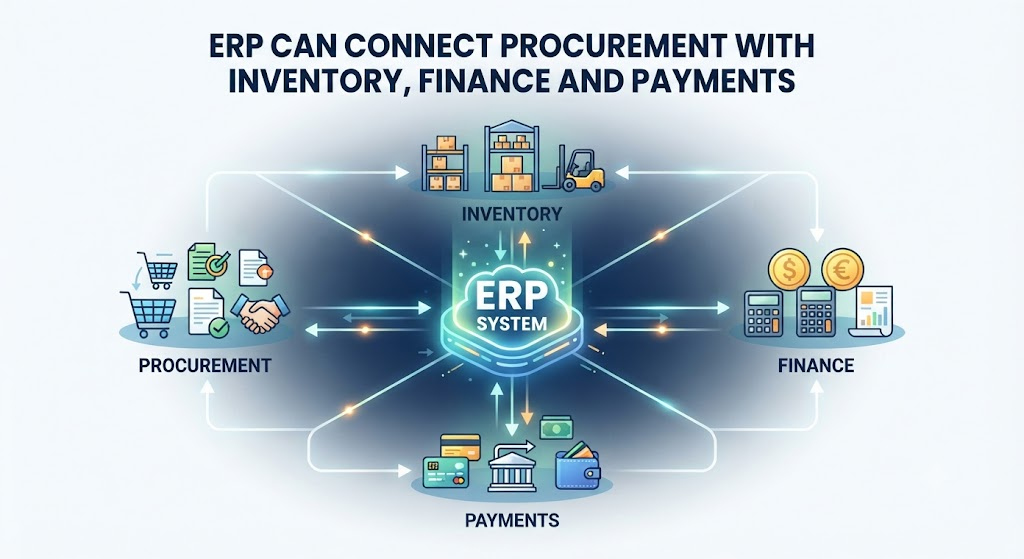
ERP Can Connect Procurement With Inventory, Finance and Payments
The lifecycle does not end when the organization procures the produce. Once procurement is completed, the organization must manage the produce as both an inventory item and a financial transaction. Therefore, procurement should connect directly with inventory, warehouse management, finance, and accounting.
The organization accepts produce, the ERP can update stock records and warehouse balances immediately. When procurement teams record the purchase value, the system can transfer the financial impact to the relevant accounting processes. When payments become due, finance teams can use the same transaction data to verify amounts, track liabilities, and process payments accurately.
This reduces the need for repeated data entry. It also gives senior management a more complete view of the business. Instead of seeing farmer operations, procurement and finance as three separate departments, management can see how agricultural activity ultimately affects inventory and financial performance.
Dashboards Give Decision-Makers One View of Contract Farming
ERP delivers real value when it turns operational data into clear management visibility. A contract farming dashboard can give decision-makers a consolidated view of farmer registrations, active contracts, contracted acreage, expected production, crop progress, procurement quantities, quality results, and payment status.
CEO or business head, this means fewer calls asking different departments for separate reports and an agricultural manager, it means better visibility into field performance. For procurement managers, it means a clearer view of expected arrivals. For finance teams, it means better visibility into procurement liabilities and payments. Most importantly, everyone works from the same operational data.
Why No-Code ERP Matters for Contract Farming
Contract farming businesses rarely operate with exactly the same processes. One organization may work through FPOs. Another may work directly with farmers. Another may have field agents, collection centres and regional procurement teams. Consequently, forcing every company into a rigid workflow can create another form of operational inefficiency.
A no-code or business process automation approach gives organizations greater flexibility because decision-makers can configure workflows, fields, approvals, and business rules around their actual processes. Bluechip Solutions states that its ProfitPlus Contract Farming Management solution runs on the AUVIT BPA platform and supports customization, mobile applications, workflow controls, audit trails, data validation, communication integrations, and modules for farmer management, agricultural planning, agricultural operations, and procurement.
This flexibility helps management adapt processes as business requirements change, improve operational control, reduce dependency on manual coordination, and gain faster visibility into critical contract farming activities. As a result, decision-makers can identify delays, supply risks, approval bottlenecks, and procurement gaps earlier and take corrective action with greater confidence.
That approach is particularly relevant when the organization expects its contract farming model to change as it expands into new crops, regions, farmer groups or procurement structures.
What a Digitized Contract Farming Lifecycle Looks Like
The ideal digital flow is straightforward. A farmer is registered through a structured digital process. The farmer’s location and relevant agricultural information are recorded. The contract is created against the farmer and crop. Agricultural planning establishes expected production. Field teams monitor progress through mobile workflows. Exceptions are identified and assigned for action. Procurement receives an updated view of expected arrivals. Produce is received and quality is recorded. Accepted quantities move into inventory. Procurement values flow into finance. Management dashboards then show the difference between plan, field reality and actual procurement.
Instead of moving information manually from one department to another, the ERP creates a connected operational chain. That is the fundamental shift from manual contract farming management to digital contract farming management.
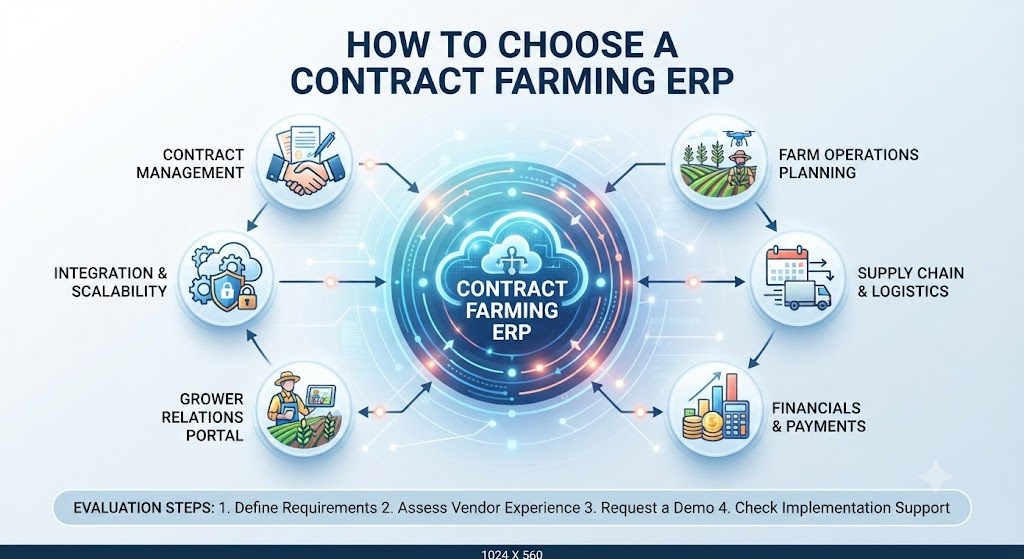
How to Choose a Contract Farming ERP
The right system should not be selected simply because it has a farmer module or an attractive dashboard. Management should first map the complete lifecycle from farmer identification to procurement and ask whether the ERP can connect every stage.
The evaluation should include mobile field operations, farmer and land records, geo-tagging, contract management, crop planning, field monitoring, workflow automation, procurement, quality management, inventory, finance, dashboards, audit trails, security and integration capabilities.
Furthermore, the organization should examine how easily the system can adapt when business requirements change. A contract farming ERP should ultimately fit the company’s operating model rather than force field teams and procurement managers to create workarounds around the software.
The Future of Contract Farming Is Connected, Not Fragmented
The strongest contract farming operation is not necessarily the one with the largest number of spreadsheets or reports. It is the one that can connect field-level activity with management-level decisions. As agricultural businesses continue adopting digital platforms, real-time information, mobile workflows, analytics and AI-assisted decision support will become increasingly important.
However, the foundation remains simple: clean farmer data, connected processes and reliable operational records. For agribusinesses, food processors and procurement-led enterprises, a contract farming ERP can therefore become much more than a farmer database. It can connect registration, contracts, agricultural planning, field monitoring, procurement, quality, inventory and finance into one digital lifecycle.
Bluechip Solutions’ ProfitPlus Contract Farming Management platform is designed around this connected approach, with farmer registration, crop monitoring, mobile field operations and procurement forming part of the broader enterprise workflow.
The practical question for decision-makers is no longer whether individual farming activities can be digitized. The more important question is whether the entire contract farming lifecycle can work from one connected source of operational truth.
Frequently Asked Questions About Contract Farming ERP
What is contract farming ERP?
Contract farming ERP is enterprise software designed to manage and connect the major processes involved in contract farming, including farmer registration, contract management, agricultural planning, field monitoring, procurement, quality, inventory and finance.
How does ERP help with farmer registration?
A contract farming ERP can create centralized digital farmer records and connect registration information with fields, crops, contracts and subsequent procurement activities. Mobile registration can also reduce duplicate manual data entry.
Can ERP track crops and field activities?
Yes. A suitable agricultural ERP can connect farmers and fields with crop plans, field visits, activities, monitoring information, tasks and workflow alerts.
Can contract farming ERP support procurement?
Yes. Procurement can be connected with farmer contracts and expected production, allowing organizations to compare planned quantities with actual received quantities and maintain procurement records.
How can AI be used in contract farming ERP?
AI can potentially analyze historical procurement, crop, acreage, quality and field data to identify patterns, detect unusual variations and support forecasting. However, the usefulness of AI depends on data quality and appropriate model design.
Why is mobile ERP important for contract farming?
Field teams work away from corporate offices. Mobile ERP allows them to capture operational information closer to the source, reducing delays between field activity and management visibility.
Get a Free Contract Farming ERP Consultation
If your contract farming operation still depends on Excel sheets, manual farmer registers, WhatsApp updates, disconnected procurement records or repeated data entry, the first step is to identify where information is being lost between the field and procurement team.
Bluechip Solutions can help businesses evaluate how farmer registration, agricultural planning, crop monitoring, procurement, inventory and finance can be connected through an enterprise ERP approach.
Schedule a Free ERP Consultation and discuss your contract farming workflow with an ERP specialist.
Get the 2026 Contract Farming ERP Evaluation Checklist to assess farmer registration, field monitoring, crop planning, procurement, quality, traceability, AI readiness, integrations, security and management dashboards before selecting an ERP.