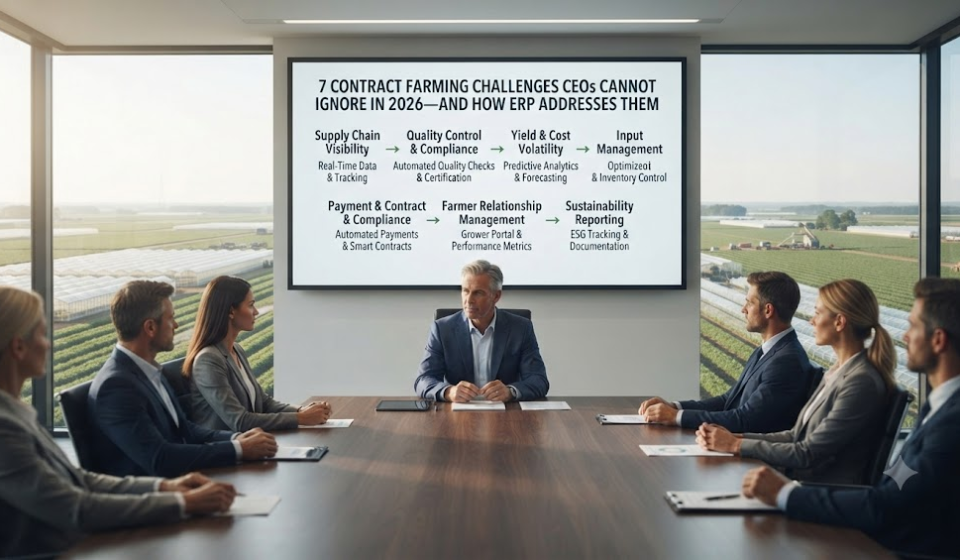
7 Contract Farming Challenges CEOs Cannot Ignore in 2026—and How ERP Addresses Them

Contract farming can create a strong connection between farmers, agribusinesses, processors, exporters, and buyers. However, the business becomes difficult to control when farmer records, crop plans, field activities, procurement, quality checks, inventory, and payments operate through separate spreadsheets, notebooks, messaging apps, and disconnected systems.
For CEOs, the issue goes beyond employees spending too much time entering data. The bigger concern is that leaders make critical decisions without a single, reliable view of contract farming operations.
That risk is becoming more significant as agricultural businesses move toward digital operations. India’s agricultural digital infrastructure is expanding rapidly. As of February 4, 2026, more than 8.48 crore Farmer IDs had been generated under AgriStack, while the Digital Crop Survey in Kharif 2025 covered more than 28.5 crore plots across 604 districts. These developments show how farmer, land, crop, and procurement information is increasingly becoming digital and data-driven.
At the same time, AI-enabled agriculture is moving from experimentation toward practical decision support. ICAR has highlighted AI, machine learning, remote sensing, automation, and data-driven agriculture, while the Government of India launched Bharat-VISTAAR in February 2026 as an AI-powered multilingual agricultural information system.
For contract farming companies, this creates a clear business question: Can your current systems provide management with reliable, timely, and actionable information from farmer registration to final procurement?
If the answer is no, these seven challenges deserve immediate attention.
1. Farmer Data Is Scattered Across Multiple Systems
The first challenge begins before cultivation even starts. Contract farming businesses may work with thousands of farmers across villages, districts, crops, and collection centres. However, farmer information is frequently maintained in Excel files, paper forms, mobile phones, WhatsApp conversations, and separate departmental databases.
Consequently, management may not have a consistent answer to basic questions such as which farmers are active, what crop they have contracted, how much land they cultivate, what quantity is expected, and whether their documentation is complete. This creates duplicate records, outdated information, manual verification, and unnecessary administrative work.
How Contract Farming ERP Solves It
A contract farming ERP creates a centralized farmer master that connects farmer registration with contracts, land details, crop plans, field activities, expected production, procurement, quality, and payments. With mobile-based data capture, field executives can enter information directly from the source. Furthermore, geo-tagging and validation rules can strengthen the reliability of field information.
Instead of asking different departments to reconcile separate spreadsheets, management can access one connected operational record. This is particularly relevant as agricultural systems increasingly depend on digital farmer and crop information. AgriStack itself is designed around Farmer Registry, Geo-Referenced Village Maps, and Crop Sown Registry to establish a more integrated view of farmer, land, and crop information.

2. CEOs Lack Real-Time Visibility Into Field Operations
A contract may look healthy in the ERP or spreadsheet while problems are already developing in the field. Crop progress can change because of weather, pests, disease, water availability, labour shortages, or input-related issues. Unfortunately, when field reporting depends on periodic manual updates, management often receives information after the problem has already affected expected yield. The result is reactive management.
How ERP Improves Field Visibility
A modern agriculture ERP can connect farmer records with crop planning, field visits, activity tracking, inspection records, geo-location, alerts, and workflow approvals. For example, if field executives record crop conditions through a mobile application, the information can immediately become part of the farmer and crop history.
Moreover, workflow rules can identify delayed activities or exceptions and route them to the responsible manager. This does not mean ERP replaces agricultural experts. Instead, it ensures that experts receive better information at the right time. That direction aligns with the broader movement toward digital and data-driven agriculture. ICAR has identified AI, IoT, automation, databases, and decision-support systems as important areas for modern agricultural operations.
3. Expected Procurement and Actual Procurement Do Not Match
Procurement is where weaknesses in contract farming operations become financially visible. A company may plan to procure a specific quantity from contracted farmers. However, actual procurement can differ significantly because of crop failure, lower yield, quality rejection, delayed harvesting, farmer-level deviations, or inaccurate field estimates.
When expected procurement data is maintained separately from field information, procurement teams cannot easily understand why the gap exists.
How Contract Farming Software Connects Planning With Procurement
Contract farming management software can connect expected crop production with actual procurement. For instance, farmer-level crop plans can generate expected quantities. As field teams update crop progress and harvesting information, procurement teams can compare expected quantities with actual arrivals.
Consequently, management can identify emerging supply gaps earlier. The ERP can then connect procurement with weighing, quality assessment, inventory, purchase documentation, and payment processing. This creates continuity from farmer registration to procurement, rather than treating each stage as a separate activity.
Government agricultural initiatives are also placing greater emphasis on digital crop information for procurement planning and logistics. The Digital Crop Survey, for example, is being used to improve crop visibility and support evidence-based procurement planning.
4. Quality and Traceability Break Down Across the Supply Chain
For food processors, exporters, and agricultural businesses, traceability is becoming increasingly important. Yet traceability becomes difficult when a company cannot quickly connect a purchased lot to its farmer, crop, field activity, quality inspection, and procurement transaction. A spreadsheet might tell the procurement department what was purchased. However, it may not provide the complete operational history behind that purchase.
How ERP Creates a Traceable Contract Farming Workflow
An integrated ERP can connect farmer records, contracts, crop activities, procurement batches, quality checks, inventory movements, and payment transactions. Therefore, when a quality issue occurs, management has a clearer route for tracing the relevant procurement information back through the supply chain.
This also supports better accountability because every major transaction can be associated with the appropriate user, date, workflow, and approval. For organizations handling food and agricultural products, that connected history can become an important operational asset rather than simply an audit requirement.
5. Payments Become Delayed When Procurement Data Is Disconnected
Farmer payments are another critical pressure point. Once procurement takes place, payment depends on accurate quantities, quality results, agreed rates, deductions, advances, and contract terms. When these details exist in different systems, finance teams must repeatedly reconcile information. As a result, payment processing can become slower and more error-prone.
How ERP Connects Procurement, Contracts, and Finance
An agricultural ERP can connect farmer contracts with procurement transactions and financial processes. Once approved procurement information reaches the finance workflow, the organization can calculate the relevant payable amount according to configured business rules.
Furthermore, the system can maintain records of advances, deductions, pending amounts, and payment status. This creates a clearer financial trail for both management and operational teams. It also helps CEOs move from asking, “Has this farmer been paid?” to understanding the broader picture: What has been procured, what is payable, what is pending, and where are exceptions occurring?
6. Manual Decision-Making Prevents Early Risk Detection
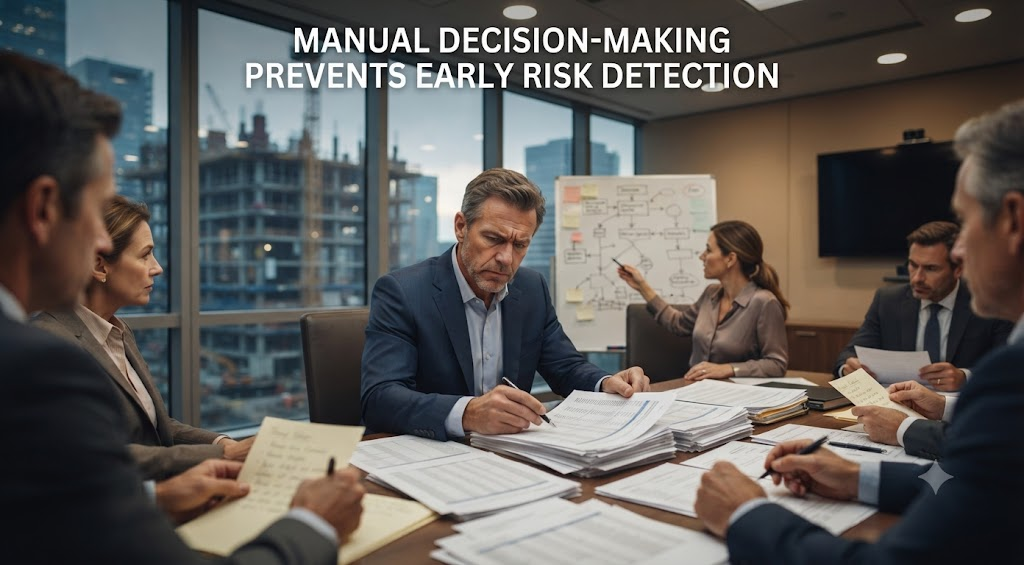
Many contract farming organizations already possess large amounts of data. The problem is that data alone does not create business intelligence. If management must manually compare Excel sheets, field reports, procurement figures, and historical information, valuable patterns can remain hidden. This is where AI and analytics can add another layer of decision support.
How AI Can Strengthen Contract Farming ERP
AI should not be positioned as a replacement for agricultural professionals or business leaders. Instead, it can help identify patterns within existing operational data. A practical AI-enabled contract farming system can use historical procurement, crop performance, field observations, quality results, weather-related information, and farmer-level records to identify potential anomalies or emerging risks.
For example, a model could flag a significant difference between expected and actual crop progress, identify unusual procurement deviations, or highlight farmer groups requiring management attention. The underlying approach can involve anomaly detection, predictive models, trend analysis, classification, and rule-based alerts.
This direction is increasingly relevant. ICAR has been actively exploring AI, deep learning, crop forecasting, disease detection, and agricultural decision-support applications. However, AI recommendations should remain explainable and subject to human validation, particularly where agricultural, financial, or farmer-impacting decisions are involved.
7. Disconnected Departments Prevent CEOs From Seeing the Complete Business
Perhaps the most expensive problem is not an individual process failure. It is the lack of connection between departments. Farmer management may have one set of information. Field operations may maintain another. Procurement may use separate files. Quality teams may operate independently. Inventory and finance may have their own records. Consequently, the CEO receives fragmented information instead of one operational picture.
How an Integrated ERP Creates Management Visibility
A contract farming ERP brings these workflows together. Farmer registration can connect to contracts. Contracts can connect to crop planning. Crop planning can connect to field operations. Field operations can connect to expected procurement. Procurement can connect to quality and inventory. Finally, approved transactions can connect with finance and payments.
That continuity changes the role of ERP from a transaction-recording system into an operational management platform. For a CEO, the value is therefore not simply automation. The real value is having a connected view of the business that supports faster investigation, better planning, stronger controls, and more informed decisions.
India’s broader digital transformation is moving in the same direction. In 2026, the Government of India reported that functional Primary Agricultural Credit Societies are being brought onto ERP-based national software to improve operational efficiency, transparency, and service delivery.
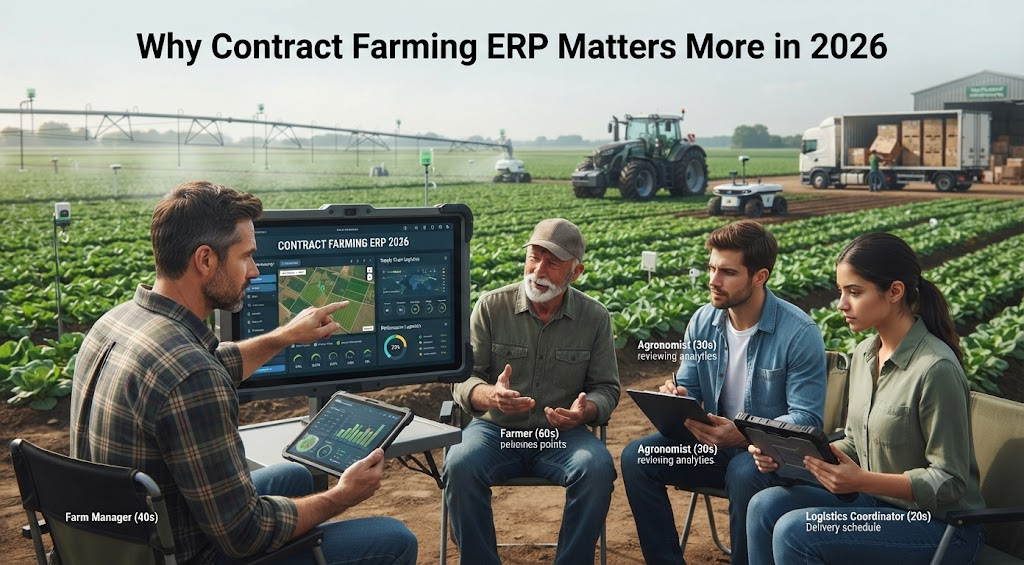
Why Contract Farming ERP Matters More in 2026
Contract farming is becoming increasingly data-intensive. Farmers generate information. Field teams generate information. Crop surveys generate information. Procurement generates information. Quality teams generate information. Finance generates information.
However, disconnected information creates operational friction. An effective ERP therefore needs to do more than digitize paperwork. It needs to connect the entire contract farming lifecycle while giving management the visibility required to act on exceptions.
This is also where no-code and business process automation platforms can become valuable. When workflows change because of a new crop, region, procurement model, approval requirement, or business rule, companies need systems that can adapt without rebuilding the entire application.
For decision-makers, the objective should be straightforward: capture data once, connect it across processes, automate repetitive workflows, and turn operational information into actionable management insight.
How Bluechip Solutions Approaches Contract Farming Digitization
Bluechip Solutions’ ProfitPlus Contract Farming Management is designed around this connected approach through the Auvit BPA platform. The solution can bring together farmer registration, farmer management, agricultural planning, field operations, procurement, workflow controls, mobile data capture, geo-tagging, communication, and business information within an integrated ERP environment.
Instead of forcing field teams to maintain separate records and later transfer information into an office system, mobile-enabled workflows can capture information closer to its source. For management, this creates a stronger foundation for monitoring farmer activities, crop progress, expected procurement, actual procurement, quality, inventory, payments, and operational exceptions.
The broader objective is not simply to replace paper with software. It is to create a connected digital process that helps agricultural businesses respond faster when conditions change.
Frequently Asked Questions About Contract Farming ERP
What is contract farming ERP?
Contract farming ERP is an integrated enterprise resource planning system designed to manage the operational lifecycle between agribusinesses and contracted farmers. It can connect farmer registration, contracts, crop planning, field monitoring, procurement, quality, inventory, finance, and payments.
Why do contract farming companies need ERP software?
Companies need ERP when growing farmer networks and operational complexity make spreadsheets, paper records, and disconnected applications difficult to control. ERP creates centralized data, workflow automation, traceability, and management visibility across connected processes.
Can ERP track farmers and crop activities?
Yes. Depending on the implementation, contract farming software can maintain farmer profiles, land and crop information, field activities, inspections, geo-tagged information, expected production, procurement, and related transactions.
Can AI be used in contract farming?
Yes. AI can support anomaly detection, forecasting, pattern identification, crop-related analytics, risk alerts, and decision support. However, AI outputs should be validated by qualified business and agricultural professionals rather than treated as automatic decisions.
What should CEOs check before selecting contract farming software?
CEOs should examine whether the system connects farmer management, field operations, procurement, quality, inventory, finance, mobile workflows, reporting, security, auditability, integration, and future automation requirements rather than evaluating the software only on individual features.
Turn Contract Farming Data Into Management Visibility
The biggest contract farming challenge is no longer simply collecting information. It is making that information connected, reliable, timely, and useful for decisions. When farmer records remain isolated, managers may miss field problems, disconnect procurement planning from crop progress, and struggle to predict supply gaps. When teams separate quality and procurement records, they lose clear traceability. And when finance operates independently, payment reconciliation takes longer.
An integrated contract farming ERP addresses these gaps by connecting the operational chain from farmer registration to procurement, quality, inventory, finance, and payment. For CEOs and business leaders planning their next phase of agricultural digitization, the right question is therefore not just, “Do we need ERP?”
The more important question is:
Can our current system give us a reliable view of every critical contract farming decision before the problem reaches the bottom line?
If the answer is no, 2026 is an appropriate time to evaluate a connected contract farming management platform.
Explore Bluechip Solutions’ ProfitPlus Contract Farming Management solution: Contractfarming ERP
Get a Contract Farming ERP Readiness Checklist covering farmer management, field monitoring, procurement, traceability, finance, workflow automation, AI readiness, and management dashboards.
Book a Free ERP Consultation to identify where disconnected contract farming processes are creating operational risk and where automation can deliver measurable improvements.