
The Future of Enterprise Operations: How AI-Powered No-Code ERP Is Driving Growth

Enterprise growth is no longer determined only by how much a company sells. Increasingly, growth depends on how quickly the business can understand information, respond to change, automate repetitive work, control costs, and make decisions across departments. That is where AI-powered No-Code ERP is changing enterprise operations.
Traditional ERP systems brought finance, inventory, sales, procurement, production, HR, and other functions into a common system. However, many organizations still struggle when their ERP cannot adapt quickly enough to changing processes. Teams then create spreadsheets, manual approvals, disconnected applications, and workarounds around the ERP.
Consequently, the organization may have an ERP system, yet employees still spend significant time moving information between systems.
AI-powered No-Code ERP takes a different approach. It combines enterprise resource planning, artificial intelligence, workflow automation, analytics, and no-code customization so businesses can continuously improve their processes without depending on lengthy software-development cycles for every operational change.
What Is AI-Powered No-Code ERP?
AI-powered No-Code ERP is an enterprise management platform that combines ERP functionality with artificial intelligence, workflow automation, analytics, and visual application configuration.
Traditional ERP customization often requires developers to modify code, test integrations, prepare deployment packages, and manage technical dependencies. In contrast, a No-Code ERP allows authorized business users and implementation teams to configure workflows, forms, approvals, dashboards, business rules, and processes using visual tools. The AI layer adds another dimension.
Instead of simply storing transactions, an AI-powered ERP can analyze business data, identify patterns, assist employees with decisions, automate repetitive activities, generate insights, and support more intelligent workflows. Therefore, the value does not come from AI alone. It comes from connecting AI + business data + workflows + ERP processes within one operational environment.
Why Traditional Enterprise Operations Are Becoming Difficult to Manage
Many businesses do not have a technology shortage. Instead, they have an integration and process problem. A sales team may maintain customer information in one system. Finance may work in another. Production may depend on spreadsheets. Procurement may use email approvals. Management may receive reports only after employees manually consolidate information.
As a result, leaders often spend more time asking, “Which number is correct?” than asking, “What should we do next?” This problem becomes even more serious as the organization grows.
A process that works for 20 employees may become inefficient for 200 employees. A spreadsheet that works for one location may become difficult to control across multiple branches. A manual approval that takes ten minutes can become a significant bottleneck when hundreds of transactions pass through the same process.
Therefore, enterprise growth requires more than adding software. It requires an operational architecture that can grow with the business.
The AI Adoption Gap: Why Companies Need More Than AI Tools
AI adoption is accelerating, but enterprise-scale value remains difficult to achieve. McKinsey’s 2026 State of AI research reports that nearly nine in ten respondents use AI in at least one business function, while 44% report that AI is scaling across their enterprise. However, the same research shows that organizations are still working to convert experimentation and adoption into measurable enterprise value.
This creates an important distinction. Using an AI assistant to write an email is useful. However, connecting AI to purchasing, inventory, finance, production, sales, customer service, and management workflows can have a much broader operational impact. The challenge is therefore not simply “How can we use AI?” The better question is:
“Where can AI become part of the business process itself?” AI-powered No-Code ERP addresses this question by placing intelligence directly alongside operational data and workflows.
How AI-Powered No-Code ERP Solves the Enterprise Data Problem
One of the biggest operational problems companies face is fragmented data. When information is distributed across spreadsheets, legacy applications, emails, and departmental databases, AI cannot easily provide reliable enterprise-level intelligence.
For example, imagine a manufacturing company experiencing rising production costs. The reason may involve raw-material prices, supplier performance, production wastage, machine downtime, inventory levels, delayed orders, or changes in product mix. If these datasets remain disconnected, management may only see individual symptoms.
An integrated ERP can bring the information together. AI can then analyze relationships between operational events and highlight patterns that deserve attention. Consequently, management can move from retrospective reporting toward more proactive decision-making.
How No-Code ERP Helps Businesses Adapt Faster
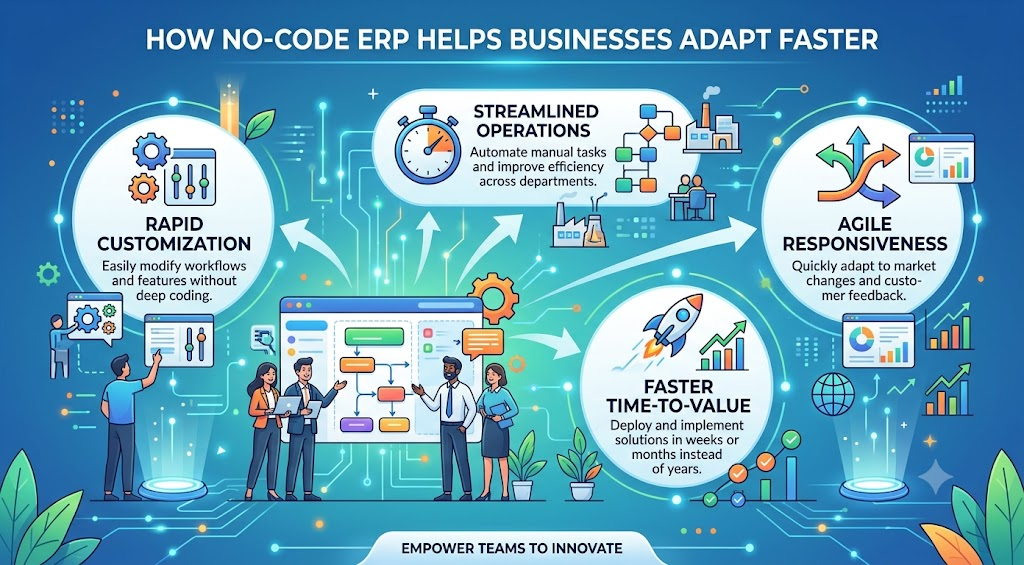
Business processes rarely remain unchanged. A company may introduce a new approval hierarchy, open a new branch, add a product category, change its procurement policy, introduce a new compliance requirement, or modify its customer onboarding process. With traditional ERP customization, even relatively simple changes can become dependent on development resources.
This creates a common operational pain point: the business knows what needs to change, but the software cannot change quickly enough. No-Code ERP reduces this dependency by allowing business processes to be configured visually. For example, an organization could create a purchase approval workflow based on transaction value. A low-value purchase could follow a simple approval path, while a high-value purchase could automatically involve department heads and finance.
The business can therefore change the process without rebuilding the entire ERP application.
AI + No-Code: Why the Combination Matters
AI and No-Code solve different problems, but their combination creates a stronger enterprise technology model. AI provides intelligence. No-Code provides adaptability. ERP provides operational structure. Workflow automation provides execution. Analytics provides visibility.
Together, these capabilities create an environment where the ERP does more than record business transactions. It can help the organization understand, automate, adapt, and improve its operations. For example, an AI-enabled procurement workflow could analyze historical purchasing patterns, identify unusual requirements, flag potentially delayed supplier deliveries, and route transactions through the appropriate approval process.
Meanwhile, the No-Code layer allows the organization to modify that workflow when procurement policies change. This combination becomes particularly valuable for growing businesses because operational requirements can change faster than traditional software development cycles.
How AI-Powered No-Code ERP Drives Business Growth
Growth creates complexity. More customers create more transactions. More products create more inventory movements. More employees create more approvals. More locations create more coordination requirements. Without process automation, this complexity can increase administrative costs.
AI-powered No-Code ERP addresses this problem by automating repetitive processes and providing centralized operational visibility. For finance teams, automation can reduce manual data entry, improve reconciliation workflows, and provide faster financial reporting.
For sales teams, integrated customer and order information can provide better visibility into sales pipelines, quotations, orders, receivables, and customer activity. For manufacturing companies, ERP data can connect materials, production planning, inventory, quality, wastage, and finished goods.
For management, dashboards can bring together operational and financial information so leaders can identify problems earlier. Therefore, ERP-driven growth is not simply about doing more work with software. It is about creating the capacity to grow without increasing operational complexity at the same rate.
Real-Time Business Visibility Becomes a Competitive Requirement
Delayed information can lead to delayed decisions. Consider a company whose management receives a monthly inventory report. By the time excess inventory becomes visible, capital may already be tied up. Similarly, if management discovers a production delay only after the scheduled delivery date, the opportunity to correct the problem has already become smaller.
A modern ERP can provide real-time or near-real-time visibility into operational transactions. AI can build on that information by identifying patterns, exceptions, anomalies, and areas requiring attention. Consequently, management can spend less time collecting information and more time acting on it.
AI-Powered ERP Can Turn Business Data Into Action
Data becomes valuable when it supports action. Suppose an ERP identifies that a particular product is repeatedly experiencing stock shortages. A traditional report may simply show the shortage. An intelligent system can go further by connecting inventory movement with sales demand, procurement lead times, supplier performance, and historical consumption.
The resulting insight can help management investigate the underlying cause. Similarly, an ERP could flag unusual expense activity, delayed receivables, abnormal production wastage, or unexpected changes in order patterns.
However, organizations should not treat AI recommendations as unquestionable decisions. Human review, appropriate controls, data quality, and governance remain essential, particularly for financial, compliance, and high-impact operational decisions.
Why Enterprise Leaders Are Moving Toward Composable and No-Code Architecture
Legacy ERP environments can become difficult to modify because business processes are deeply connected to custom code and older integrations. That creates technology debt. As organizations adopt new digital tools, they often add another application instead of changing the existing process. Over time, this creates an increasingly complicated technology landscape.
No-Code and composable approaches aim to reduce that rigidity. Instead of rebuilding large applications for every requirement, organizations can configure and extend processes around changing business needs. This approach also aligns with the broader movement toward AI-assisted enterprise application development. Gartner’s recent research on enterprise low-code platforms highlights AI-assisted tooling, composable architectures, governance, and faster application delivery as important characteristics of modern enterprise application platforms.
The objective is not to eliminate professional developers. Rather, it is to allow technical teams to focus on complex architecture and integrations while business teams gain greater control over everyday process configuration.
What Businesses Should Look for in an AI-Powered No-Code ERP
Choosing an AI-powered ERP should not begin with the question, “How many AI features does the product have?” Instead, decision-makers should examine whether the platform can solve actual operational problems. The ERP should connect core business functions rather than creating another data silo.
It should provide meaningful workflow automation instead of simply adding dashboards. It should support no-code or low-code configuration without sacrificing governance and security. It should provide integration capabilities so existing applications and data sources can participate in the wider architecture.
It should also provide clear audit trails, access controls, reporting, and data governance. Most importantly, the AI capabilities should connect to real business processes. An impressive chatbot that cannot access relevant business information may have limited operational value. Conversely, an AI capability embedded into purchasing, finance, inventory, production, customer service, or management workflows can become considerably more useful.
How Companies Can Prepare for AI-Powered ERP Adoption
Successful adoption starts with business processes, not technology. First, organizations should identify repetitive tasks, approval bottlenecks, reporting delays, data inconsistencies, and manual processes that create measurable operational costs.
Next, leadership should determine which processes require automation and which require decision support. After that, the organization can prioritize ERP workflows based on business value. For example, automating a high-volume approval process may produce faster benefits than immediately attempting a complex AI forecasting project.
Data quality should also receive attention. AI cannot consistently produce reliable insights from inaccurate, duplicated, incomplete, or poorly governed data. Therefore, ERP modernization and AI adoption should progress together with data governance.
The Future of Enterprise Operations Is Intelligent and Adaptable
The next generation of ERP will not simply be a digital replacement for paper-based processes. Instead, ERP platforms are increasingly becoming intelligent operating environments. They will connect business data, automate workflows, support employees, surface exceptions, provide predictive insights, and adapt to changing processes.
At the same time, No-Code technology will help organizations respond faster when their business models change. That combination matters because enterprise growth creates constant operational change. A company cannot expect its processes to remain identical for the next five or ten years. Markets change, customers change, regulations change, supply chains change, and internal structures change.
Therefore, the ERP itself must become more adaptable.
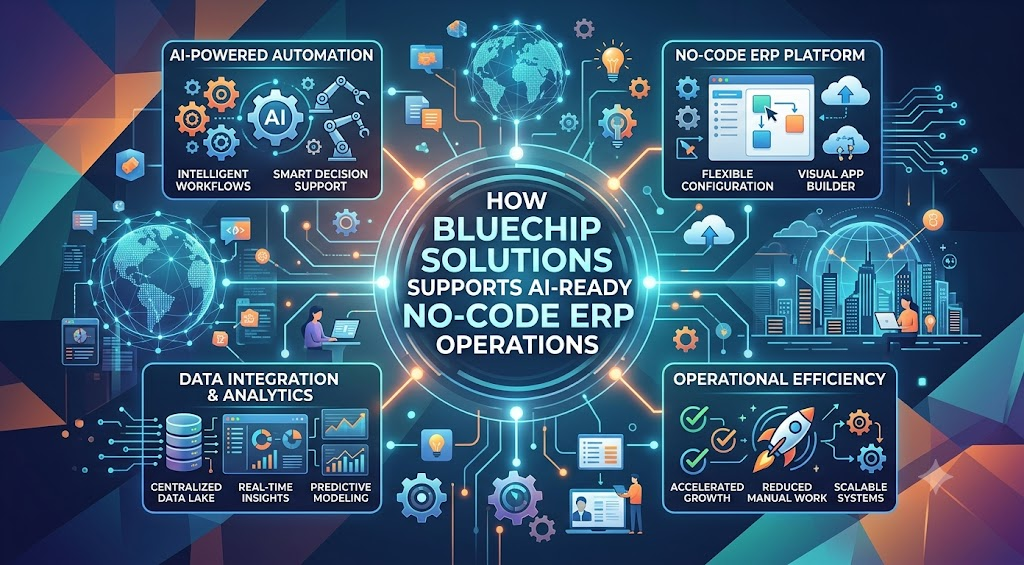
How Bluechip Solutions Supports AI-Ready No-Code ERP Operations
For organizations looking to modernize enterprise operations, Bluechip Solutions’ Auvit No-Code ProfitPlus ERP brings ERP, business process automation, workflow management, reporting, dashboards, and configurable business processes into an integrated environment.
The platform is designed around the principle that businesses should not have to rebuild their technology every time an operational requirement changes. With configurable workflows and business process automation, organizations can adapt processes while maintaining centralized control over enterprise information.
For growing organizations, this approach can help connect departments, reduce disconnected manual processes, improve visibility, and create a stronger foundation for AI-driven operations. The goal is not simply to add AI to an ERP. The goal is to create an AI-ready enterprise operating environment where data, processes, people, automation, and decision-making work together.
Frequently Asked Questions About AI-Powered No-Code ERP
What is an AI-powered No-Code ERP?
An AI-powered No-Code ERP combines enterprise resource planning with artificial intelligence, workflow automation, analytics, and visual process configuration. It allows organizations to manage core business operations while adapting workflows without extensive traditional coding.
How does No-Code ERP help business growth?
No-Code ERP can help businesses adapt processes faster, automate repetitive activities, reduce dependency on custom development for routine changes, and improve visibility across departments.
Is AI-powered ERP suitable for small and medium-sized businesses?
Yes. SMEs can use AI-powered ERP to centralize operations, automate repetitive processes, improve financial and operational visibility, and build scalable processes without immediately creating large technology teams.
Can AI-powered ERP replace employees?
ERP automation is primarily designed to automate repetitive activities and support employees. Human oversight remains important for decisions involving business judgment, financial controls, compliance, and strategic management.
What is the difference between AI ERP and traditional ERP?
Traditional ERP primarily focuses on recording, managing, and reporting business transactions. AI-powered ERP adds capabilities such as intelligent analysis, automation, anomaly detection, recommendations, and AI-assisted decision support.
Why is No-Code important for ERP?
No-Code allows organizations to configure and modify business processes more quickly without requiring traditional software development for every operational change. This can make the ERP more adaptable as the organization grows.
Conclusion: From ERP Software to an Intelligent Business Operating System
The future of enterprise operations will not be defined by ERP software alone. Instead, businesses will increasingly look for platforms that combine ERP, AI, automation, real-time data, analytics, and No-Code adaptability.
The companies that benefit from this shift will not necessarily be those that simply purchase the most advanced AI technology. They will be the organizations that connect AI to meaningful business processes and measure whether those processes actually improve operational outcomes.
For CEOs, CIOs, CFOs, and business leaders, the important question is therefore no longer whether ERP should become smarter. The more practical question is:
Can your ERP adapt as quickly as your business changes?
If the answer is no, moving toward an AI-powered No-Code ERP architecture can provide a path toward more connected, adaptable, and intelligent enterprise operations.
Ready to Build a More Intelligent Enterprise?
Discover how an AI-ready No-Code ERP can connect your business processes, automate repetitive work, and give leadership greater operational visibility.
Book a Free ERP Consultation with Bluechip Solutions and identify which business processes can be automated, connected, and made more intelligent.
You can also request an AI-Ready ERP Assessment to evaluate your current systems, manual workflows, data silos, reporting gaps, and automation opportunities before investing in a new ERP platform.