
ERP 2030 will look very different from the ERP systems many companies use today. Instead of simply recording transactions, future ERP software will increasingly help businesses understand what is happening, predict what could happen next, recommend the right action and, in controlled situations, execute that action automatically. This shift is already underway. Gartner’s 2026 ERP research describes the movement from traditional ERP toward enterprise resource execution, where connected data, AI, composable architecture and autonomous capabilities work together.
For business leaders, however, the important question is not whether ERP will become more intelligent. It is how quickly their existing ERP environment can evolve without creating unnecessary cost, disruption or security risk. Therefore, understanding the technology roadmap for ERP 2030 can help organizations make better investment decisions today rather than replacing systems reactively tomorrow.
Why ERP Is Changing Faster Than Before
Traditional ERP was designed primarily around transactions, workflows and centralized business records. Consequently, employees often had to search for information, interpret reports manually and then decide what action to take.
That model becomes increasingly difficult when businesses operate across multiple locations, suppliers, currencies, sales channels and increasingly complex customer expectations. Moreover, managers cannot afford to wait until the end of the month to discover that inventory is excessive, production is falling behind or cash flow is under pressure.
AI is therefore changing the role of ERP. McKinsey reports that generative AI and agentic systems are moving beyond individual task automation toward the restructuring and orchestration of enterprise operations. As a result, the future ERP system will increasingly move from being a system of record to becoming a system of intelligence and execution.
ERP 2030 Will Be AI-Native, Not Just AI-Enabled
One of the biggest changes will be the way artificial intelligence is built into ERP. Many current ERP systems add AI features around existing applications. However, ERP 2030 is more likely to embed intelligence directly into finance, procurement, manufacturing, inventory, sales, HR and supply-chain workflows.
For example, instead of asking a finance employee to investigate overdue invoices manually, an AI-enabled ERP could identify unusual payment behaviour, assess customer history, recommend a collection action and prepare the communication for approval. Similarly, a manufacturing ERP could detect that production is likely to miss its schedule because of material availability, evaluate alternative production sequences and recommend a revised plan before the delay affects the customer.
Therefore, AI-powered ERP will not simply answer questions. It will increasingly understand business context and support decisions. Gartner’s 2026 research highlights AI-driven autonomous ERP as one of the major directions shaping enterprise applications, alongside connected data and advanced analytics.
AI Agents Will Become Digital Workers Inside ERP
Perhaps the most significant development on the ERP 2030 roadmap will be the rise of AI agents. Unlike conventional automation, which generally follows predefined rules, agentic AI can interpret goals, evaluate information and coordinate multiple actions. Consequently, an ERP agent could potentially handle an entire business process rather than one isolated task.
Consider procurement. Today, a purchasing team may review inventory, identify shortages, check approved suppliers, request quotations, compare prices and create purchase orders. By 2030, much of this workflow could be orchestrated by AI, while people retain approval authority for high-value or high-risk decisions.
The same model could apply to accounts receivable, demand planning, employee onboarding, expense management and supply-chain monitoring. Gartner estimates that more than $40 billion of software revenue will be exposed to agentic arbitrage between 2026 and 2030, demonstrating how significant the shift toward agent-based enterprise software could become.
However, businesses should not interpret this as “remove humans from ERP.” Instead, the more practical model is AI execution with human supervision.
Real-Time ERP Will Replace Delayed Decision-Making
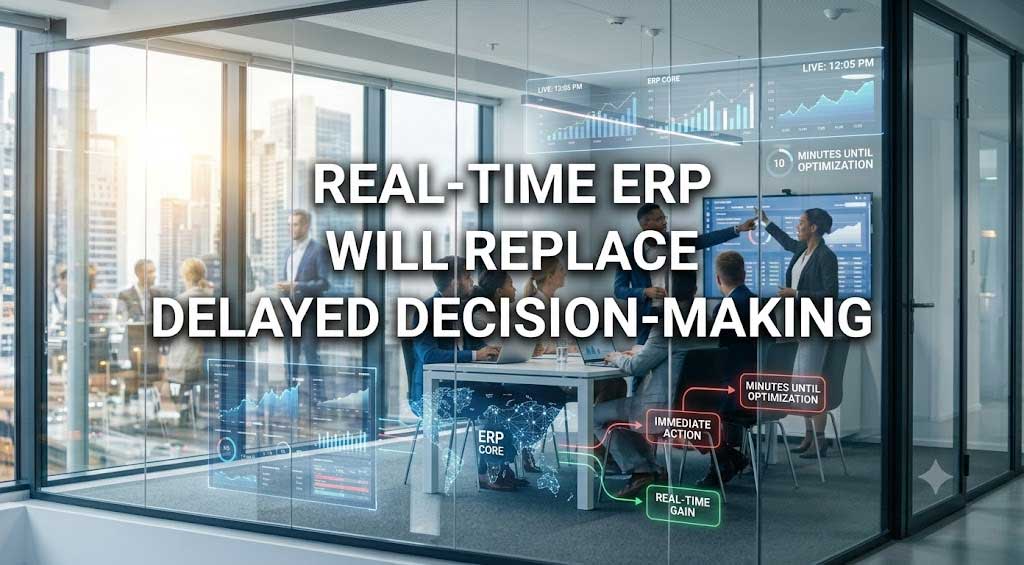
Another major change will be the movement from historical reporting toward real-time decision intelligence. Traditional reports tell managers what happened. Consequently, a business may discover a problem only after the opportunity to correct it has passed.
ERP 2030 will increasingly combine transactional data, operational events, external information and predictive models to identify emerging issues. For instance, if customer demand suddenly increases, an intelligent ERP could connect sales orders with inventory, production capacity, supplier lead times and cash-flow requirements. Instead of giving management five separate reports, the system could provide one connected view of the situation and recommend the most practical response.
This is especially important for manufacturers, distributors and growing enterprises where a small change in demand can quickly affect procurement, production and delivery.
Predictive ERP Will Help Businesses Act Before Problems Occur
Predictive analytics will also become a core ERP capability. Rather than simply showing current inventory levels, ERP software will increasingly forecast future requirements. Similarly, instead of reporting equipment downtime after it occurs, manufacturing ERP systems can use operational data to identify patterns associated with potential failures.
The same principle applies to finance. Gartner forecasts that embedded AI in cloud ERP finance applications could contribute to a 30% faster financial close by 2028. Its research also identifies AI-driven planning and forecasting, adaptive analytics, intelligent process automation and AI trust and security as important developments in cloud ERP finance.
Therefore, companies evaluating ERP should increasingly ask whether the system can help them predict and prevent problems, rather than simply document them.
ERP Interfaces Will Become More Conversational
ERP software has traditionally required employees to understand menus, screens, reports and transaction codes. However, ERP 2030 will make business systems considerably easier to interact with. Instead of navigating through multiple screens, a manager could ask:
“What caused this month’s production delay?” The ERP could then analyse relevant production, inventory, procurement and order data and provide an explanation. Likewise, a CFO could ask:
“Which customers are creating the highest working-capital risk?” The system could analyse payment behaviour, outstanding invoices and sales information and return a contextual answer. This shift matters because ERP intelligence becomes more valuable when more employees can access it without needing advanced technical knowledge.
Gartner predicts that 80% of enterprise software and applications will be multimodal by 2030, compared with less than 10% in 2024. Consequently, future ERP interfaces may increasingly support text, voice, images and other forms of interaction.
Cloud ERP Will Become the Foundation for Continuous Innovation
Cloud ERP will remain an important part of the ERP 2030 roadmap because organizations need systems that can evolve continuously. However, moving to the cloud alone will not solve every ERP problem. Businesses still need clean data, strong integrations, reliable security, scalable architecture and well-defined processes.
IDC-backed research published through SAP in 2026 reports that 69% of organizations are modernizing ERP and 70% are investing in intelligent systems. Therefore, organizations should evaluate cloud ERP based on its ability to support continuous innovation rather than simply asking whether the software is hosted in the cloud.
Composable ERP Will Make Business Systems More Flexible
ERP systems have historically been criticized for being difficult and expensive to customize. That problem will become increasingly important as businesses need to adapt faster. Composable ERP addresses this challenge by allowing organizations to combine modular capabilities, integrations and applications instead of depending entirely on one rigid system.
As a result, businesses can introduce new capabilities without rebuilding the entire ERP environment. This approach is particularly valuable for growing companies because business processes change as the company expands. A flexible ERP platform can therefore reduce the need for expensive redevelopment every time a new requirement emerges.
Gartner’s current ERP research identifies modular, flexible, cloud-based architectures and connected data as important foundations for autonomous and intelligent ERP.
ERP 2030 Will Put Data Quality at the Centre of AI
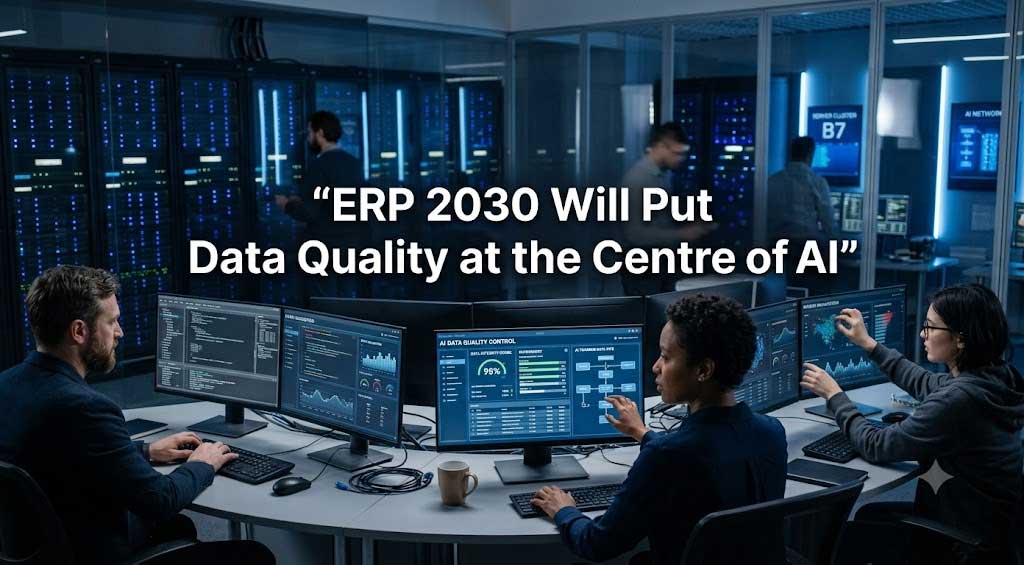
There is, however, an important reality that businesses should not overlook: AI cannot compensate for poor ERP data. If customer records are duplicated, inventory data is inaccurate, product masters are inconsistent or financial information is incomplete, an AI system can produce unreliable recommendations.
Therefore, ERP modernization should begin with data governance. Businesses need consistent master data, clear ownership, controlled access, auditability and reliable integrations. Furthermore, AI-generated decisions should be traceable so that employees understand why a recommendation was made.
This is especially important as organizations move toward autonomous processes. The greater the authority given to AI, the stronger the requirements for governance, security and human oversight become.
Cybersecurity and AI Governance Will Become ERP Priorities
As ERP becomes more autonomous, security will become more than a technical requirement. An AI agent capable of creating purchase orders, approving transactions or modifying business workflows represents a different risk profile from a traditional reporting system.
Consequently, ERP 2030 will require stronger identity management, permissions, audit trails, anomaly detection and AI governance. Gartner specifically identifies AI trust, risk and security management as an emerging theme in cloud ERP finance. Therefore, business leaders should evaluate not only what AI can automate, but also what controls exist around those automated actions.
What Business Leaders Should Do Before 2030
The biggest mistake would be waiting until 2030 to prepare for ERP 2030. Instead, organizations should begin by identifying processes where ERP creates friction today. If employees spend excessive time entering duplicate information, preparing reports, reconciling transactions, tracking inventory or manually coordinating approvals, those processes are strong candidates for modernization.
Next, businesses should evaluate whether their current ERP has the architecture needed for AI, automation, integrations and real-time analytics. The objective should not be to purchase the most technologically advanced ERP available. Rather, it should be to create an ERP environment that can evolve as business requirements change.
McKinsey similarly warns that organizations can create a “great divide” by investing heavily in AI while neglecting the ERP capabilities and data foundations required for AI to work effectively. Therefore, ERP modernization and AI strategy should be planned together.
The ERP 2030 Roadmap Starts With Business Problems
ERP 2030 will not be defined by one technology. Instead, it will emerge from the convergence of AI agents, connected data, cloud infrastructure, predictive analytics, automation, conversational interfaces and flexible architectures. For business leaders, the practical opportunity is clear. Companies that modernize their ERP foundation now can progressively introduce intelligent automation instead of attempting a disruptive transformation later.
The winning ERP strategy will therefore be less about owning more software and more about creating a business platform that can sense, analyse, decide and execute faster while keeping people in control.
At BlueChip Solutions, businesses can explore ERP modernization around real operational requirements rather than forcing processes into a rigid software model. If your organization is struggling with disconnected data, manual processes, limited visibility or slow decision-making, now is the right time to assess whether your ERP is ready for the next stage of enterprise technology.
Ready to understand where your ERP stands on the road to 2030? Book a free ERP consultation with BlueChip Solutions and identify the automation, AI and modernization opportunities that can create measurable business value.
Frequently Asked Questions About ERP 2030
What will ERP look like in 2030?
ERP in 2030 is expected to become more intelligent, automated, connected and conversational. Instead of primarily recording transactions, future ERP platforms will increasingly use AI, predictive analytics and AI agents to support decisions and execute business processes under appropriate human supervision.
Will AI replace ERP systems by 2030?
AI is more likely to transform ERP than completely replace it. Current research suggests that AI agents will increasingly operate alongside and on top of enterprise applications, while ERP continues to provide important transactional data, controls and business context.
What is AI-powered ERP?
AI-powered ERP is an enterprise resource planning system that embeds artificial intelligence into business processes such as finance, procurement, inventory, manufacturing, sales and planning. It can use AI for prediction, recommendations, natural-language interaction, anomaly detection and workflow automation.
Why is cloud ERP important for the future?
Cloud ERP provides a foundation for continuous updates, scalability, integrations and new intelligent capabilities. However, cloud deployment alone is not enough. Businesses also need clean data, flexible architecture, security and strong governance to gain long-term value.
Should businesses replace their ERP before 2030?
Not necessarily. The right decision depends on the ERP’s architecture, scalability, data quality, integration capabilities and ability to support automation and AI. In many cases, progressive modernization can be more practical than an immediate full replacement.
What is the biggest ERP challenge businesses will face by 2030?
One of the biggest challenges will be balancing automation with control. As ERP systems become more autonomous, organizations will need reliable data, cybersecurity, governance, human oversight and clear accountability for AI-assisted decisions.