
Running a business becomes expensive when information is scattered across departments, employees spend hours on repetitive tasks, inventory is poorly managed, and management lacks real-time visibility. Many organizations assume increasing revenue is the only way to improve profitability. However, reducing operational waste often delivers faster and more sustainable results.
Enterprise Resource Planning (ERP) software helps businesses eliminate unnecessary costs by integrating finance, sales, inventory, procurement, manufacturing, HR, customer service, and reporting into one intelligent platform. Modern AI-powered ERP systems go even further by providing predictive insights, automated workflows, and data-driven recommendations that reduce both direct and hidden business expenses.
Whether you operate a manufacturing company, distribution business, construction firm, retail enterprise, or service organization, ERP can significantly improve efficiency while lowering operational costs.
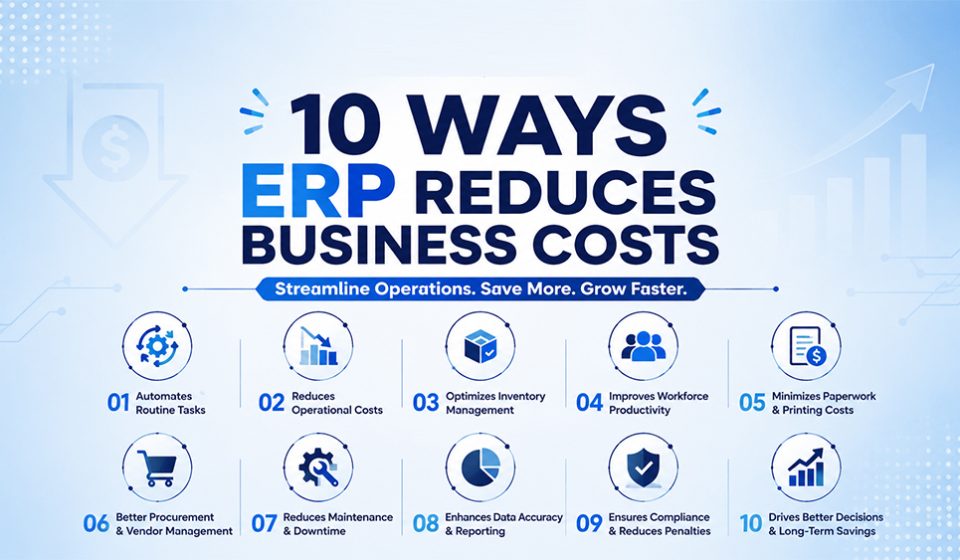
This comprehensive guide explains 10 practical ways ERP reduces business costs, the challenges businesses commonly face, and how AI-powered ERP solutions help solve them.
Why Reducing Business Costs Requires More Than Cutting Expenses
Many organizations attempt to reduce costs by limiting hiring, cutting marketing budgets, or delaying investments. While these actions may reduce spending temporarily, they rarely solve the root causes of operational inefficiencies.
The real challenge lies in hidden costs that accumulate every day, including:
- Duplicate data entry
- Inventory carrying costs
- Production delays
- Manual approval processes
- Human errors
- Poor forecasting
- Delayed customer service
- Unplanned equipment downtime
- Lack of business visibility
An ERP system addresses these issues by connecting every department into one centralized platform where information flows automatically and decisions are based on real-time data rather than assumptions.
How AI-Powered ERP Helps Businesses Save More Than Traditional ERP
Traditional ERP systems mainly record transactions. Modern AI-powered ERP solutions analyze business data continuously to recommend smarter actions.
Artificial Intelligence can help organizations:
- Predict inventory shortages before they happen
- Forecast customer demand more accurately
- Detect unusual spending patterns
- Identify delayed payments
- Recommend optimized production schedules
- Reduce procurement costs
- Improve workforce planning
- Minimize operational risks
Instead of reacting to problems, businesses can prevent them before they become expensive.
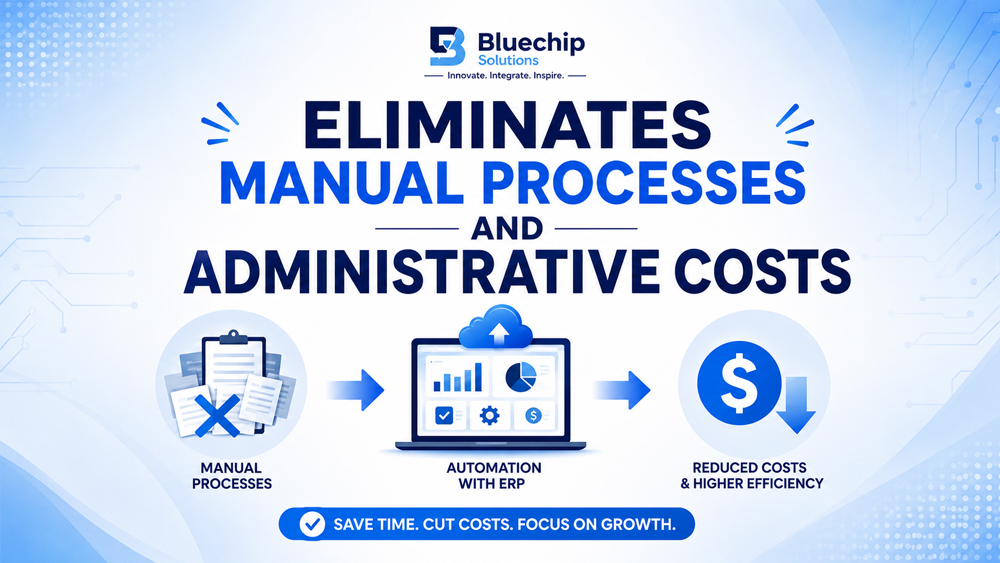
1. Eliminates Manual Processes and Administrative Costs
One of the biggest hidden expenses in any organization is manual work. Many businesses still rely on spreadsheets, emails, paperwork, and repeated data entry across multiple departments. Employees spend valuable time performing tasks that software can complete within seconds. For example, when a sales order is created manually, accounting may need to enter the same information again. Inventory teams update stock separately, while management waits for reports generated manually.
This duplication increases labor costs and creates opportunities for mistakes. An ERP system automates these workflows by connecting departments through a single database. Once information is entered, every authorized department accesses the same data instantly. AI-driven workflow automation further reduces administrative effort by automatically routing approvals, sending reminders, generating invoices, and updating records without human intervention. The result is lower administrative costs, improved productivity, and more time for employees to focus on strategic work.
2. Reduces Inventory Holding Costs
Inventory is one of the largest investments for manufacturing and distribution companies. Holding too much inventory increases storage costs, insurance expenses, warehouse requirements, and the risk of obsolete stock. On the other hand, insufficient inventory causes production delays and missed sales opportunities. ERP software continuously tracks inventory movement across warehouses in real time.
Using AI-based demand forecasting, businesses can predict future demand by analyzing historical sales, seasonal trends, purchasing behavior, and market patterns. This helps companies purchase only what they actually need. Consequently, businesses reduce excess inventory, avoid stockouts, improve warehouse utilization, and free up working capital.
3. Improves Production Efficiency and Lowers Manufacturing Costs
Manufacturers often lose money due to machine downtime, production bottlenecks, inefficient scheduling, and material wastage. Without integrated planning, production managers struggle to coordinate raw materials, labor availability, machine capacity, and customer delivery schedules. ERP software provides complete visibility into the production lifecycle.
AI-powered scheduling algorithms optimize production sequences based on demand, machine availability, and workforce capacity. Manufacturers can identify delays before they affect delivery commitments, reducing overtime costs and improving production efficiency.
Improved planning also minimizes scrap, rework, and unnecessary production expenses.
4. Optimizes Procurement and Supplier Management
Purchasing decisions significantly influence operational costs. Many companies continue buying from the same vendors without comparing pricing, supplier performance, or delivery reliability. ERP software centralizes procurement activities, enabling businesses to evaluate suppliers based on pricing history, delivery timelines, product quality, and purchasing trends.
Artificial Intelligence analyzes purchasing patterns to recommend better sourcing strategies and identifies opportunities for bulk purchasing discounts. Organizations gain stronger control over procurement while reducing material costs and supplier-related risks.
5. Reduces Financial Errors and Compliance Costs
Accounting mistakes can become expensive. Incorrect invoices, duplicate payments, tax calculation errors, and delayed financial reporting increase compliance risks while consuming valuable employee time. ERP software integrates accounting, purchasing, sales, payroll, and inventory into one financial ecosystem.
Every transaction updates financial records automatically. AI continuously monitors financial data for unusual activities, duplicate transactions, and spending anomalies. Businesses gain accurate financial reporting, faster audits, simplified GST compliance, improved cash flow management, and lower accounting costs.
6. Minimizes Employee Productivity Loss
Employees become less productive when they spend time searching for information across multiple software applications. Sales teams wait for inventory updates. Finance requests purchase information. Managers ask for reports. Operations teams manually verify stock levels. These delays reduce overall business efficiency. ERP software provides a centralized information system where employees access real-time business data instantly.
AI-powered dashboards personalize insights based on employee roles, helping staff make faster decisions without searching through multiple reports. Higher productivity translates directly into lower operational costs.
7. Improves Customer Service While Reducing Support Costs
Customer dissatisfaction often results from delayed responses, incorrect order information, and poor communication between departments. When customer service representatives lack visibility into inventory, production status, invoices, or delivery schedules, resolving customer issues becomes slow and expensive.
ERP integrates customer data, sales, inventory, logistics, and finance into a unified platform. Support teams immediately view complete customer history and provide faster resolutions. AI-powered customer insights also help identify customers at risk of leaving, allowing businesses to take proactive measures that improve retention while reducing acquisition costs.
8. Enables Better Business Decisions Through Real-Time Analytics
Poor decisions frequently arise because managers rely on outdated reports. By the time monthly reports become available, business conditions may have already changed. Modern ERP systems deliver real-time dashboards covering sales, procurement, production, finance, inventory, and customer performance.
AI analyzes this data continuously and highlights unusual trends before they impact profitability. Instead of relying on assumptions, executives make informed decisions supported by accurate business intelligence. This significantly reduces costly strategic mistakes.
9. Reduces Equipment Downtime and Maintenance Costs
Unexpected equipment failures create expensive production interruptions. Emergency repairs cost significantly more than planned maintenance. ERP integrates maintenance schedules with production planning and asset management. AI-powered predictive maintenance analyzes equipment usage, maintenance history, and operational patterns to estimate when machines may require servicing.
Businesses can schedule maintenance proactively, reducing downtime, extending equipment lifespan, and lowering repair expenses. This approach improves production reliability while protecting capital investments.
10. Scales Business Operations Without Increasing Overhead
Growth often creates operational complexity. New branches, warehouses, customers, products, and employees require additional coordination. Without ERP, businesses typically hire more staff simply to manage increasing workloads. ERP enables organizations to scale efficiently because standardized workflows, automation, and centralized data reduce dependency on manual processes.
AI continuously optimizes workflows as business volume grows, ensuring operations remain efficient without proportionally increasing administrative expenses. This allows organizations to expand while maintaining healthy profit margins.
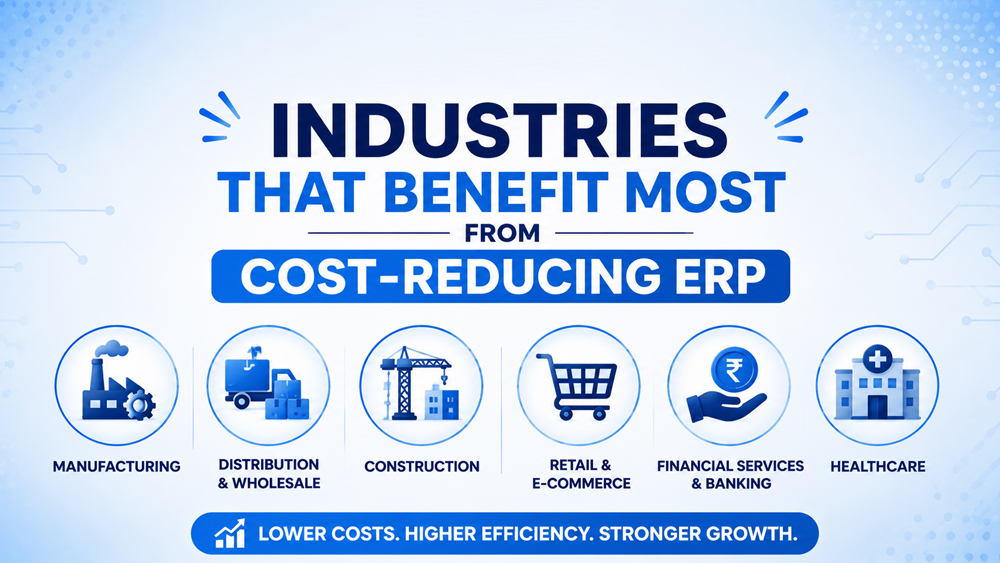
Industries That Benefit Most from Cost-Reducing ERP
Organizations across multiple industries experience measurable cost savings through ERP implementation. Manufacturing companies reduce production costs through better planning and inventory optimization. Distribution businesses improve warehouse efficiency and procurement management. Construction firms gain tighter project cost control and resource utilization.
Retail organizations optimize inventory while improving customer experience. Financial service providers automate compliance and reporting. Healthcare institutions streamline operations while maintaining regulatory compliance. Service organizations improve project management, billing accuracy, and resource allocation.
What to Look for in a Cost-Effective ERP Solution
Choosing ERP software based solely on price often becomes more expensive in the long run. Businesses should evaluate whether the ERP platform offers AI-powered automation, real-time reporting, cloud accessibility, workflow customization, mobile access, strong security, integration capabilities, scalability, and industry-specific functionality. A modern no-code ERP platform also enables faster customization without expensive software development, reducing implementation costs while adapting quickly to changing business requirements.
Why AI-Powered No-Code ERP Delivers Faster ROI
Many organizations delay ERP adoption because they worry about implementation costs and lengthy deployment timelines. Modern no-code AI-powered ERP platforms significantly reduce these concerns. nstead of months of development, businesses can configure workflows, automate approvals, customize reports, and modify business processes with minimal coding effort. This accelerates implementation, reduces consulting costs, simplifies future upgrades, and improves return on investment. Organizations gain flexibility without sacrificing performance.
Frequently Asked Questions
How much can ERP reduce business costs?
The exact savings depend on the industry, company size, and existing operational inefficiencies. Businesses commonly achieve cost reductions through improved inventory management, workflow automation, reduced manual errors, and optimized resource utilization.
Is ERP suitable for small and medium businesses?
Yes. Cloud-based ERP solutions have made enterprise technology accessible to SMEs by reducing infrastructure costs while offering scalable features that grow with the business.
Does AI make ERP more effective?
Yes. AI enhances ERP by providing predictive analytics, intelligent automation, demand forecasting, anomaly detection, and data-driven recommendations that improve operational efficiency and reduce costs.
Start Reducing Business Costs with AI-Powered ERP
Reducing business costs is no longer about cutting budgets—it is about eliminating inefficiencies. An AI-powered ERP system helps organizations automate operations, improve decision-making, optimize inventory, strengthen financial control, and increase productivity across every department.
Businesses that invest in intelligent ERP today position themselves for sustainable growth, improved profitability, and greater operational resilience.
Ready to reduce operational costs and improve business efficiency?
Book a FREE AI-Powered ERP Consultation with Bluechip Solutions and discover how a modern, no-code ERP platform can help your organization automate processes, reduce expenses, and scale confidently.
👉 https://bluechipsolutions.in/
Request a personalized ERP demo and see how AI-driven automation can transform your business operations while delivering measurable ROI.