

From Month-End Chaos to Continuous Close: Can AI ERP Help Finance Teams Close Books Faster?

A finance team can record thousands of transactions correctly throughout the month and still struggle to close its books on time. The problem often begins when accounting teams must bring together bank statements, purchase invoices, sales records, payroll entries, expense claims, inventory valuations and outstanding approvals from different departments. Although the information already exists, it is scattered across systems, spreadsheets, emails and individual work queues.
Consequently, the final days of the month become a race against deadlines. Accountants chase missing documents, investigate reconciliation differences, correct journal entries and wait for department heads to approve transactions. Meanwhile, CFOs wait for reliable financial statements before evaluating profitability, cash flow and business performance.
This raises an important question: What if financial closing did not begin at the end of the month?
With AI ERP for finance, businesses can move towards continuous accounting, where transactions are validated, reconciliations are performed, exceptions are identified and approvals are processed throughout the accounting period. Rather than concentrating every financial activity into a few stressful days, finance teams can maintain cleaner, more accurate records continuously.
Why Traditional Month-End Financial Closing Is Becoming a Business Bottleneck
Month-end closing is not just an accounting exercise. It determines when management receives reliable information about revenue, expenses, liabilities, profitability and cash positions. However, the traditional closing process creates several operational dependencies. For example, an accounts payable executive may record an invoice, but the corresponding purchase receipt might not yet be updated in the inventory system. Similarly, a bank transaction may appear in the statement without a matching entry in the accounting ledger.
Although these differences may look small individually, they accumulate across hundreds or thousands of transactions. Research published by Ledge in its 2025 Month-End Close Benchmarks found that 50% of surveyed finance teams take six or more business days to close their books. Furthermore, 94% still use Excel somewhere in their closing process, while half identify spreadsheets as a major reason for delays.
The underlying problem is therefore not necessarily a lack of accounting knowledge or employee productivity. It is the dependency on disconnected financial information and manual verification. For growing companies, the situation becomes more complicated when multiple branches, warehouses, legal entities and business units contribute financial data. Without standardized workflows, finance teams repeatedly collect, validate and consolidate information before they can even begin their final review.
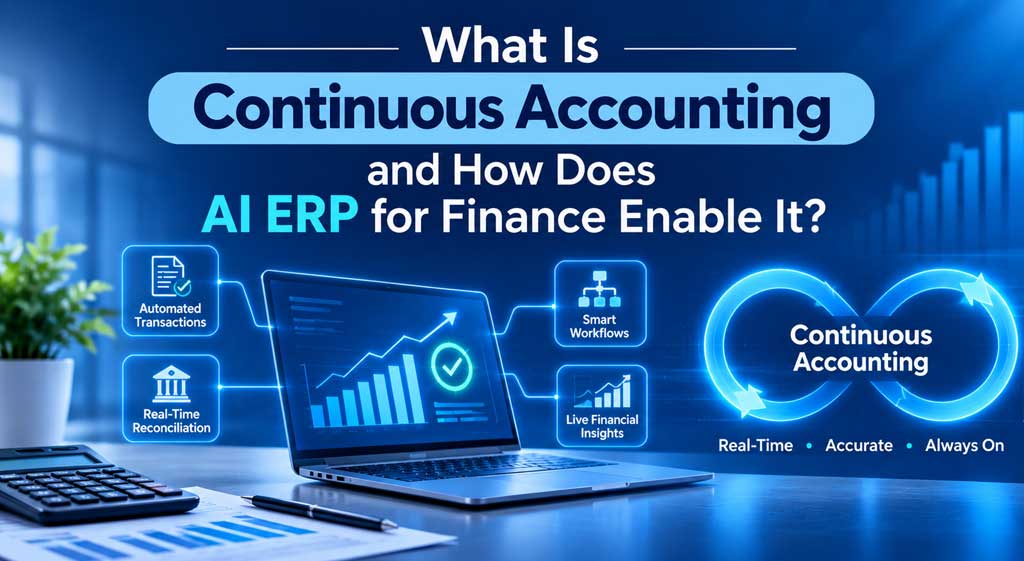
What Is Continuous Accounting and How Does AI ERP for Finance Enable It?
Continuous accounting replaces the traditional end-of-month concentration of accounting activities with ongoing transaction processing, reconciliation, validation and monitoring. Instead of waiting until the accounting period ends, businesses maintain financial records throughout the month. Whenever a transaction is recorded, the associated information can be checked against relevant records and business rules.
For instance, when a supplier invoice enters the system, the ERP can check its purchase order, goods receipt, supplier details and approval status. If all required information matches, the invoice can move through the configured approval process. If a discrepancy exists, it can be flagged for investigation.
AI can further enhance this process through pattern recognition, anomaly detection, intelligent classification and transaction-matching recommendations, depending on the capabilities and integrations implemented. The important difference is that finance teams no longer discover every problem during the closing period. Instead, they can identify and resolve exceptions while there is still time to correct them.
How AI-Based Financial Close Automation Works
AI financial close automation can combine transaction data, historical accounting patterns, predefined business rules and workflow information to identify activities that require attention. For example, a machine-learning model can evaluate historical payment descriptions, transaction amounts, supplier identifiers and posting patterns to recommend potential bank transaction matches. However, the model should also consider confidence levels and retain human review for ambiguous or material transactions.
Similarly, anomaly-detection models can identify unusual expense amounts, duplicate invoice patterns, unexpected account movements or deviations from historical trends. These capabilities should support accounting judgement rather than replace it. Financial controls, authorization limits, audit trails and human approval remain essential.
Automated Financial Reconciliation: Identify Differences Before They Delay Closing
Reconciliation is one of the most time-consuming stages of month-end closing because the same financial activity may appear differently across multiple records. Consider a manufacturing company that receives payments from several customers. Its bank statement records the incoming amounts, the accounts receivable ledger records customer payments, and the sales system contains invoice references. If payment descriptions are incomplete or multiple invoices are settled together, accountants may need to investigate each difference manually.
An AI-enabled ERP reconciliation workflow can compare transaction amounts, dates, references, account details and historical matching patterns to suggest corresponding entries. Once a high-confidence match is established under the configured controls, the system can automate the permitted reconciliation step. Transactions with missing references, partial payments, bank charges or amount differences can instead enter an exception queue.
How Intelligent Matching Reduces Reconciliation Work
Traditional matching often depends on exact values or manually maintained spreadsheet formulas. However, real business transactions are not always recorded in identical formats. An intelligent matching approach can consider multiple attributes together. For example, it may identify a customer payment that combines three invoices, even when the bank narration contains only a shortened customer reference.
Furthermore, historical matching patterns can help the system recommend likely relationships between transactions. For finance managers, this creates a more useful reconciliation process: routine matches require less manual intervention, while unusual transactions receive focused attention. Nevertheless, every automated match should remain traceable to its source records, matching criteria and approval history. This is particularly important for audit readiness.
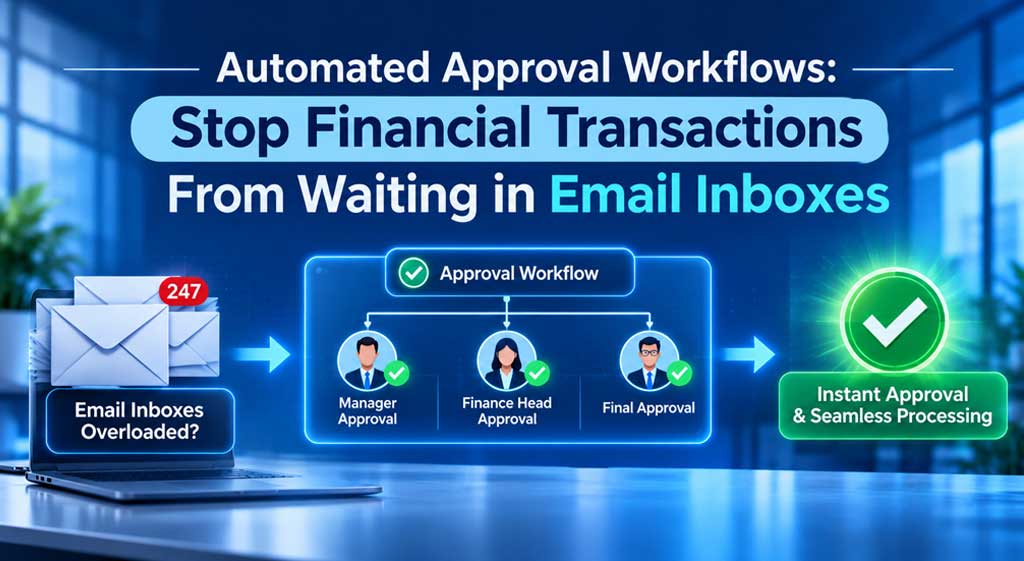
Automated Approval Workflows: Stop Financial Transactions From Waiting in Email Inboxes
A financial transaction can be completely accurate and still remain unprocessed because it is waiting for approval. This frequently happens with supplier invoices, employee reimbursements, purchase expenses, journal entries and payment requests. An invoice may reach the finance department on time, but if the responsible budget owner is unavailable, the transaction remains pending.
Consequently, the finance team cannot complete its review or finalize the relevant accounts. An integrated ERP workflow can address this problem by assigning approval responsibilities according to transaction type, department, amount, cost centre and authorization hierarchy.
For example, an invoice below a configured approval threshold may follow a shorter approval route, while a high-value purchase may require additional authorization from a department head and finance controller. Moreover, automated reminders, escalation rules and approval status tracking can highlight transactions that remain pending beyond their expected completion time.
Why Approval Visibility Matters During Month-End Closing
The real advantage is not simply sending approval notifications faster. It is giving finance managers visibility into the entire approval chain. They can identify which transactions are pending, who is responsible, how long they have been waiting and whether the delay affects financial reporting.
With this information, companies can address approval bottlenecks before the closing deadline rather than chasing individual employees during the final days.
AI-Powered Exception Tracking: Find Financial Anomalies Before They Become Reporting Errors
One of the biggest weaknesses in traditional month-end closing is that accounting teams often discover problems only when balances fail to match. For example, an unexpected increase in operating expenses may result from a duplicate invoice, an incorrect ledger allocation, an unrecorded credit note or a transaction posted to the wrong cost centre.
Without centralized exception tracking, accountants may spend hours searching through spreadsheets, emails and individual transaction histories. An AI-enabled financial monitoring approach can compare current transactions against historical patterns, predefined thresholds and accounting rules to identify unusual activity.
For instance, a system could flag a supplier invoice that closely resembles an invoice already recorded, even when its reference number differs slightly. Similarly, an unusual expense recorded against a particular department could be highlighted for verification.
Moving From Reactive Error Correction to Predictive Financial Monitoring
A more advanced approach involves evaluating transaction patterns before the accounting period closes. Machine-learning models can identify recurring anomalies, unusual posting frequencies and deviations from expected account behaviour. In addition, rule-based controls can detect missing approvals, incomplete documentation, unusual account combinations and transactions exceeding configured limits.
However, an anomaly does not automatically mean fraud or an accounting error. It is an indication that the transaction requires investigation. This distinction is important because finance teams need explainable alerts, supporting evidence and documented resolution rather than unexplained AI-generated warnings.
When exceptions are assigned to responsible employees and tracked until resolution, businesses can reduce repeated investigations and prevent unresolved issues from accumulating at month-end.
Integrated ERP Records: Eliminate the Data Gaps Between Finance and Operations
Automation becomes less effective when financial information is distributed across disconnected applications. Consider a manufacturing business operating separate systems for purchasing, inventory, production, sales, payroll and accounting. A purchase may be recorded in procurement, received in the warehouse, consumed in production and eventually reflected in the cost of finished goods.
If these records are not connected, the finance department must collect and reconcile information from multiple sources before determining the actual financial position. An integrated ERP platform connects these business activities through shared records and controlled transaction flows.
When an approved purchase receipt is recorded, relevant inventory information can become available to the accounting process according to the company’s configured accounting policies. Likewise, sales invoices, customer receipts, supplier liabilities, production costs and payroll transactions can feed the appropriate financial records.
This reduces duplicate data entry, improves transaction traceability and makes it easier to investigate differences between operational and financial records. For businesses with multiple departments or locations, centralized access also helps finance managers monitor transaction status without repeatedly requesting separate reports.
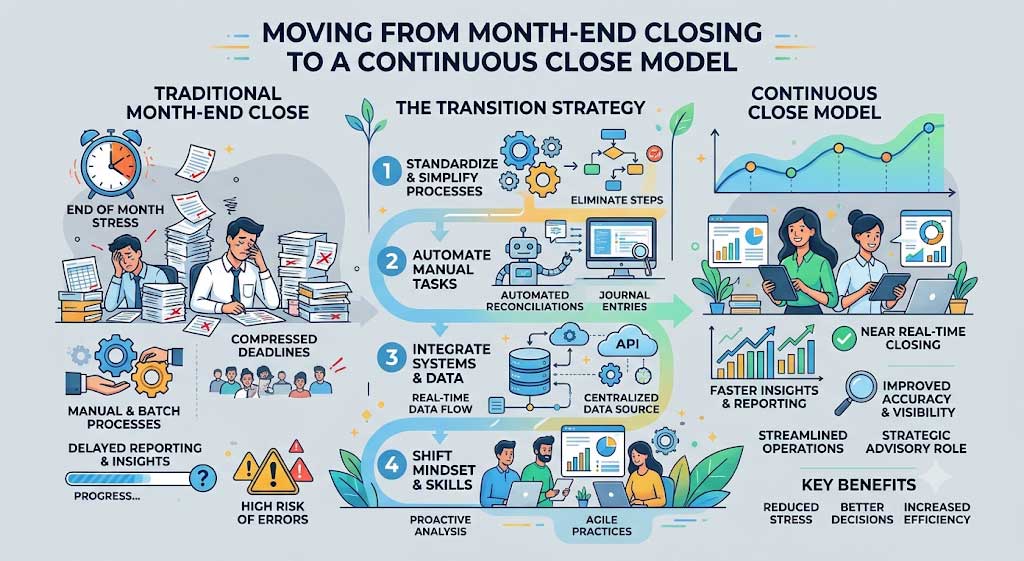
How to Move From Month-End Closing to a Continuous Close Model
Implementing AI financial close automation requires more than purchasing software and enabling automated reports. Businesses must first understand which activities create the greatest delays. The most effective starting point is to examine the previous three to six closing cycles. Identify which reconciliations repeatedly remain incomplete, which approvals are delayed, which accounts require frequent adjustments and which departments submit information late.
Next, standardize the accounting processes and establish clear ownership for each activity. Without consistent transaction definitions and approval responsibilities, automation may simply reproduce existing inefficiencies at a faster rate. Once the underlying processes are established, businesses can prioritize automated reconciliation, integrated transaction records, approval workflows and centralized exception management.
Finally, introduce AI-assisted matching and anomaly detection where reliable historical data and appropriate controls are available. Finance leaders should measure the results through close-cycle duration, reconciliation completion rates, unresolved exceptions, approval turnaround time, post-close adjustments and the percentage of transactions processed without manual intervention.
The objective is not to achieve an arbitrary three-day close. It is to produce accurate financial information sooner without weakening internal controls.
How Auvit No-Code ERP Can Support More Connected Financial Operations
For businesses looking to reduce financial process fragmentation, an integrated ERP platform provides the foundation for connecting accounting with purchasing, sales, inventory and other operational activities.
Bluechip Solutions’ Auvit No-Code ProfitPlus ERP provides a configurable business application environment that brings multiple enterprise processes together. Its no-code business process automation approach supports configurable workflows, document management, scheduling, reminders, escalations and dashboards.
This can help organizations structure financial approval processes, connect operational information with accounting activities and improve visibility into pending transactions. Moreover, its configurable architecture allows businesses to adapt workflows as approval hierarchies, reporting requirements and operational processes evolve.
It is important to distinguish workflow automation and integrated ERP capabilities from advanced AI functions. AI-based reconciliation recommendations, predictive exception detection and intelligent financial forecasting require appropriate model capabilities, integrations, data quality and implementation. These should be evaluated against the organization’s actual requirements rather than assumed to be available as standard features.
For CFOs and finance managers, the practical objective is to establish a connected financial environment where fewer transactions depend on manual follow-ups and more financial information is available for timely review.
Frequently Asked Questions About AI Financial Close Automation
Can AI ERP reduce month-end closing time?
Yes. AI ERP can help reduce month-end closing time by automating routine reconciliation, connecting financial records, tracking exceptions and streamlining approval workflows. Actual improvements depend on transaction volumes, integration quality, process standardization and internal controls.
What is AI financial close automation?
AI financial close automation uses ERP integrations, workflow automation, machine learning and intelligent transaction analysis to streamline accounting activities. It can assist with transaction matching, anomaly detection, reconciliation recommendations and identifying incomplete closing activities.
What is the difference between traditional month-end closing and continuous accounting?
Traditional month-end closing concentrates reconciliation, validation and reporting activities towards the end of an accounting period. Continuous accounting distributes these activities throughout the month, helping finance teams identify discrepancies and resolve pending transactions earlier.
Can AI automatically reconcile bank statements?
AI-assisted reconciliation can compare bank transactions against ledger entries using amounts, dates, references and historical patterns. High-confidence matches may be processed under configured controls, while ambiguous or unusual transactions should be reviewed by authorized finance personnel.
Is AI financial close automation suitable for manufacturing companies?
Yes. Manufacturing businesses can benefit from connecting purchasing, supplier invoices, inventory movements, production costs, sales transactions and accounting records. This improves the availability of financial information required for cost analysis, reconciliation and period-end reporting.
Stop Preparing for Month-End. Start Managing Your Finances Continuously.
Your finance team should spend less time collecting information and correcting preventable discrepancies and more time understanding profitability, controlling expenditure and supporting business decisions. A faster financial close begins well before the last working day of the month. It requires connected records, standardized workflows, timely approvals, automated reconciliations and a structured approach to resolving exceptions.
With the right ERP foundation and carefully implemented AI capabilities, businesses can move towards continuous accounting without compromising financial accuracy or accountability.
Ready to improve financial visibility and streamline your accounting workflows?
Explore how Auvit No-Code ProfitPlus ERP by Bluechip Solutions can help connect business processes, automate workflows and strengthen financial operations.
Schedule a Free ERP Demo: https://bluechipsolutions.in/schedule-call-widget.php
Email: sales@bluechipsolutions.in
Website: https://bluechipsolutions.in/